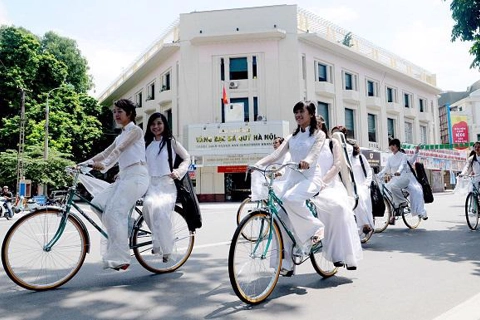
Should Hanoi pilot bicycle-only lanes?
Hanoi should collect opinions from the public, experts and relevant units for the plan of piloting bicycle-only lanes to ensure consensus.
The Hanoi People’s Committee has recently announced a pilot plan to build lanes exclusively for bicycles in a bid to reduce congestion in the coming time.
The move has prompted a question that experts are pondering: “Should Hanoi pilot bicycle-only lanes?”
Vu Hoang Chung, a traffic expert, said it is a very positive idea in terms of three main goals. “The first is to encourage people to use eco-friendly vehicles and protect the environment. The second is to reduce the number of motorized means of transport, contributing to ensuring order and traffic safety. And the third one is to protect disadvantaged people who use non-motorized vehicles”
He added that designating an exclusive space for bicyclists is now a trend in urban transport development, as bikes are environmentally friendly and suitable for urban commuting.
“However, prioritizing bicycles needs to be carefully considered,” Chung stressed, pointing out the challenges in implementation.
Currently, there are many types of vehicles in Hanoi that need to be prioritized, such as buses, ambulances, among others. The deployment of bicycle-only lanes would hinder normal traffic, even cause disruption.
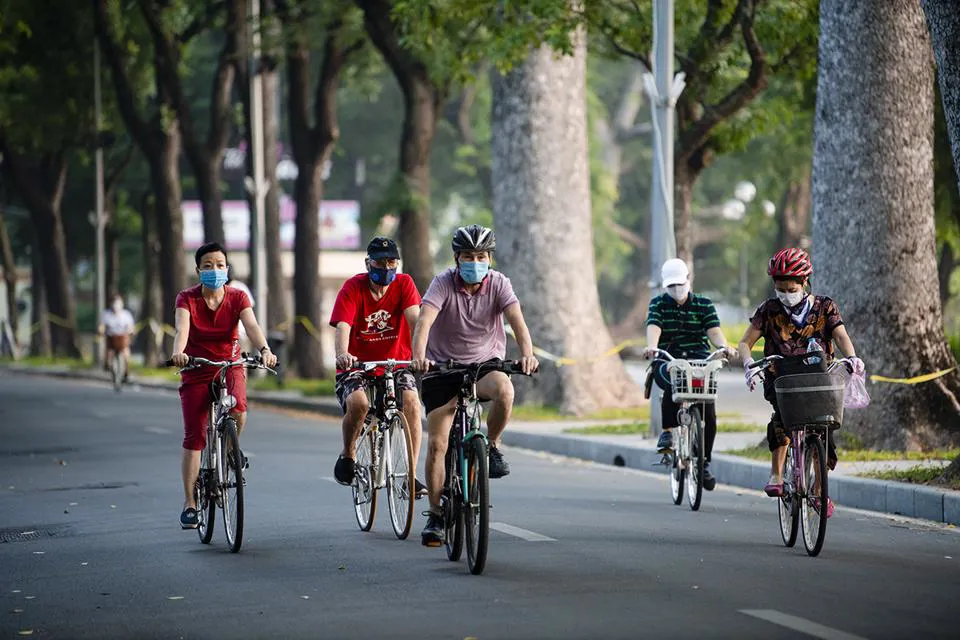
People cycle near Hoan Kiem Lake, Hanoi. Photo: Nhu Hoan/ The Hanoi Times |
“Bike-only lanes may affect the circulation of other types of vehicle. What is more important for cyclists is not an exclusive lane but a place to park bikes, especially, for people who commute by buses or metro line and live over 500 meters from the station,” Chung said.
“Therefore, it is necessary to re-plan parking spots and parking lots, especially for bicycles, take into account the option of facilitating cyclists' access to public transport and most importantly, ensure the safety of cyclists,” he stressed.
In fact, many countries, including China and the Netherlands have banned cars and motorbikes in some parts of their countries. Bicycles have become the primary, preferred, and popular means of transport in these countries. Nevertheless, it is also important to consider the conditions for bicycles to become prevalent means of transport in those cities.
In the Netherlands, there are about 35,000 kilometers of bike-only lanes, but every two people have three bicycles on average. The country has spent more than 40 years cultivating the habit of using bicycles among local residents. And a crucial factor is that the highest average temperature in the Netherlands is only about 25°C.
“The conditions in Hanoi hugely differ. The local residents’ main means of transport are motorbikes, accounting for about 85% of private vehicles. Whereas, bicycles account for less than 2% and public transport only meets about 12-15% of people’s travel demand,” Chung said.
“Moreover, summer in Hanoi with months of scorching sunshine and heavy rain, both unfavorable for bicycling. The highest temperature in the summer can reach 40°C,” he added.
“Hanoi is short of practical and suitable conditions to prioritize bicycles in a popular way. Most people find it inconvenient and difficult to go to work, to school, and shopping every day by bike,” Chung noted.
Many other experts believe that the optimal model for Hanoi's traffic is developing public transport with the greatest priority for urban railways. In the next decades, when the metro lines and bus networks are expanded, it is possible to consider increasing connectivity from residential areas to the public transport hubs by bicycle.
“Even if priority is given to bicycles for traveling from home to public transport hubs, what should be done is establishing a bicycle parking area for people around the station, not an exclusive lane,” Chung stressed, adding that the city should collect opinions from the public, experts and relevant units to ensure consensus on the plan.
In early 2022, the Ministry of Construction collaborated with the German Agency for International Cooperation (GIZ) to study infrastructure for bicycles in urban areas. The study showed that bicycles in Vietnam currently account for less than 3% of the total number of vehicles on road.
The ministry said it would take time for Vietnamese to switch to bicycles due to potential traffic hazards posed by other motorized vehicles.