Technological advancement must be guided by ethics and responsibility: Vietnam President
The Hanoi Convention conveys a message that reflects Vietnam’s consistent approach to global integration, founded on law, driven by cooperation and centered on people.
THE HANOI TIMES — Vietnamese President Luong Cuong affirmed the importance of shared commitment in building a safe cyberspace when he addressed the signing ceremony of the UN Convention against Cybercrime ( the Hanoi Convention ) opened in Vietnam’s capital city today [October 25].
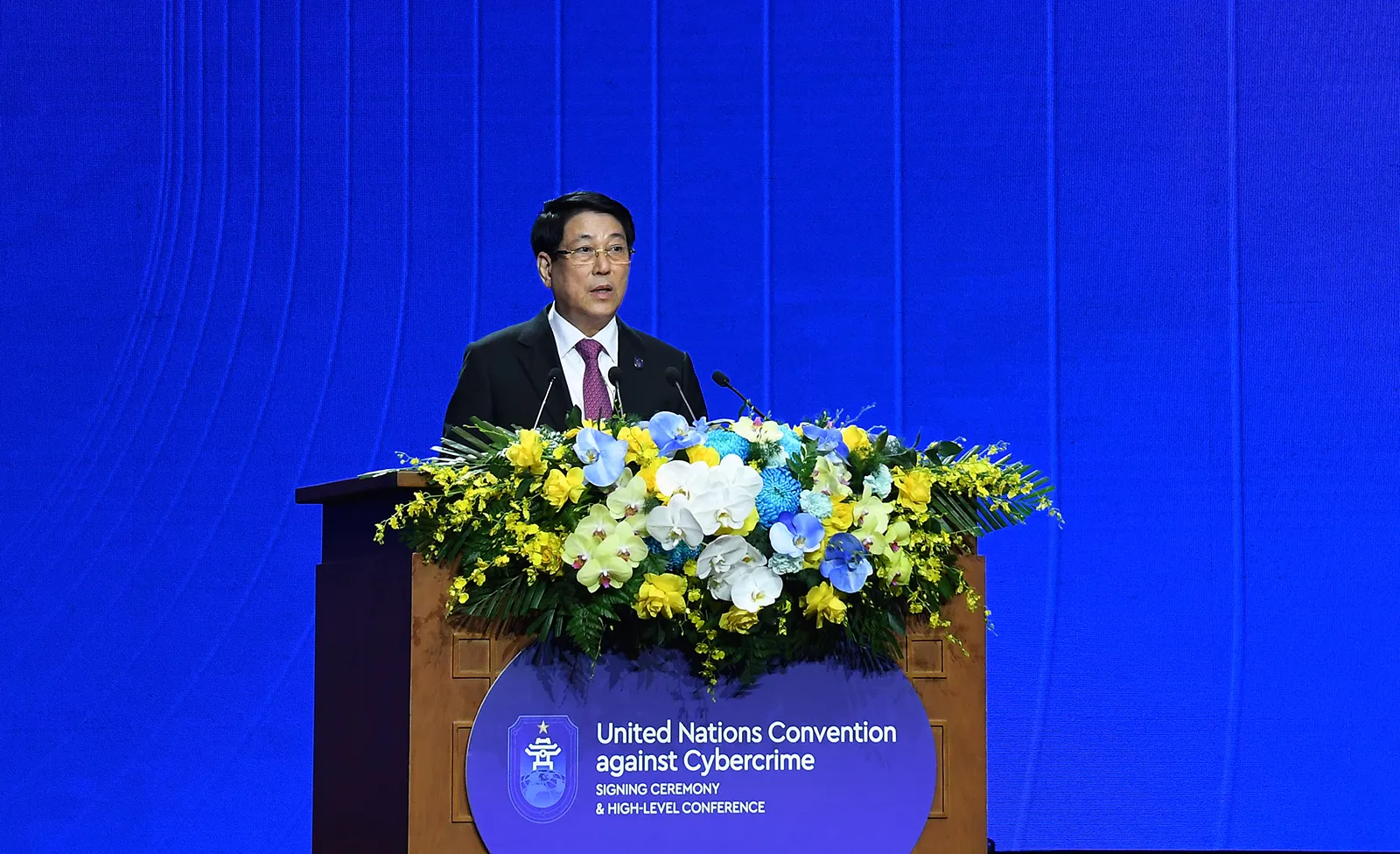
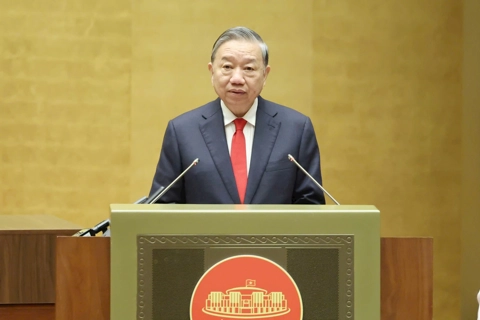
Vietnam's President Luong Cuong speaks at the signing ceremony of the UN Convention against Cybercrime held in Hanoi on October 25. Photo: Hai Minh/VGP
Cyberspace is emerging as a new domain for development and also a new frontier of global security where opportunities and challenges intertwine. In this context, technological progress must go hand in hand with ethics and responsibility to ensure sustainable and safe development for humanity.
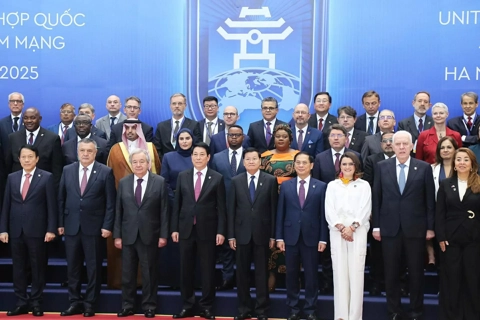
Speaking at the ceremony, which was attended by representatives of more than 100 UN member states and organizations, President Luong Cuong stressed that the theme “Combating cybercrime, sharing responsibility, towards the future” reflects the spirit of international solidarity and the shared commitment to building a safe, healthy, and sustainable cyberspace.
The event marks the establishment of a global legal instrument and reaffirms the vitality of multilateralism where nations rise above differences to shoulder responsibilities for peace, security and common development.

The two-day event gathers representatives of more than 100 UN member states and many international organizations. Photo: Baoquocte
According to him, the Hanoi Convention conveys three clear and far-reaching messages to the world amid increasingly complex cybercrime challenges.
First, it reaffirms the commitment to shaping order and ensuring safety and security in cyberspace based on international law, providing the foundation for technology to advance within a transparent and responsible framework.
Second, it highlights the spirit of sharing, partnership and mutual support, as only through cooperation and capacity building can countries safeguard a stable and sustainable cyberspace.
Finally, it underlines that the ultimate goal of all efforts is the people, ensuring technology serves life, creates equal opportunities for all and leaves no one behind in the global digital transformation.
These three principles embody the core spirit of the Hanoi Convention – respect for the rule of law, cooperation and people-centered development. They also reflect Vietnam's consistent principle in global integration: law as the foundation, cooperation as the driving force and people as the goal of progress.
He called on countries to ratify the Convention soon to establish a fair, inclusive and rules-based digital order where technological progress truly aligns with ethics and responsibility.
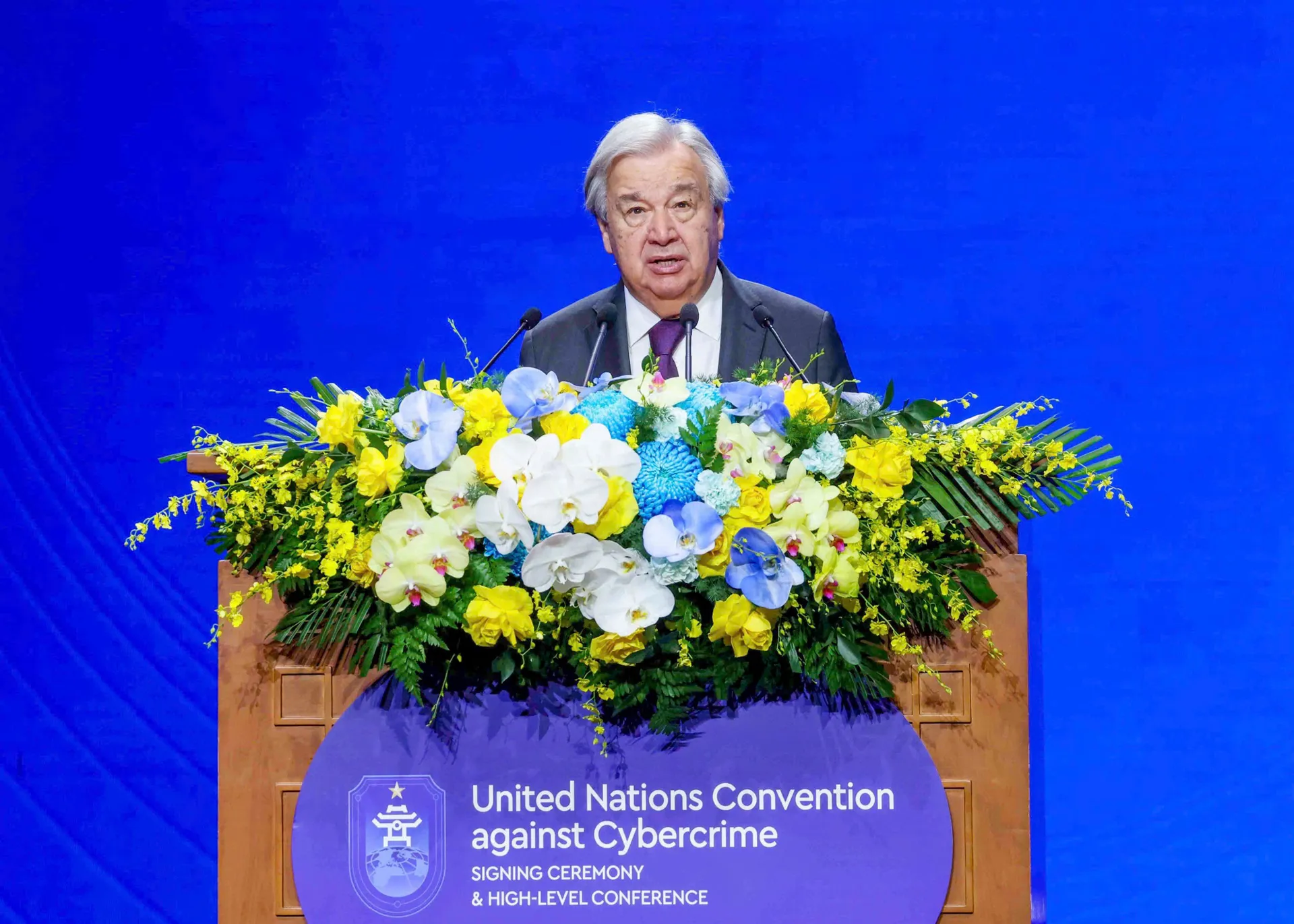
United Nations Secretary-General António Guterres speaks at the event. Photo: Nhat Bac/VGP
Speaking at the opening ceremony, United Nations Secretary-General António Guterres emphasized that the UN Convention against Cybercrime is a landmark document marking the first international effort in more than two decades to establish a collective defense mechanism against cybercrime.
He affirmed that the Convention represents a commitment to protecting fundamental human rights, including privacy, dignity and safety, both in the physical world and in cyberspace and stands as a testament to the power of multilateralism.
According to the Secretary-General, one of the Convention’s key breakthroughs is the creation of a legal framework for cross-border sharing of electronic evidence, enabling more effective coordination among investigative and judicial authorities.
The document also, for the first time, recognizes online abuse such as the dissemination of child sexual exploitation materials as serious criminal offenses, setting binding obligations for victim protection and content removal.
He noted that the Convention will complement the upcoming Global Digital Compact, contributing to closing the digital divide and advancing international cooperation in digital transformation.
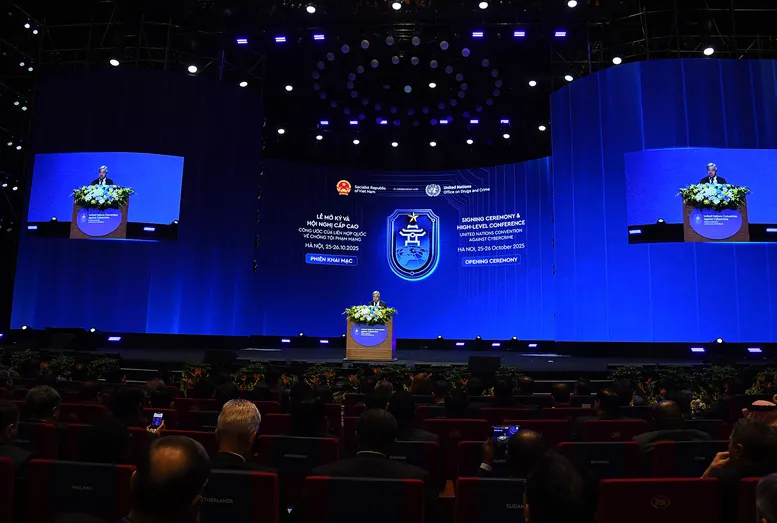
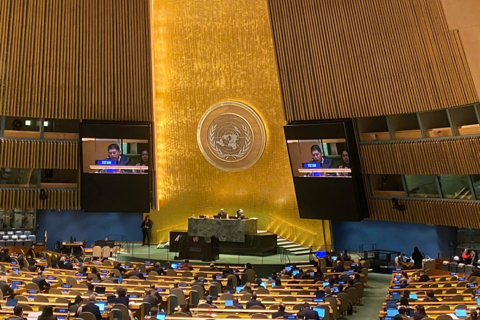
Overview of the signing ceremony. Photo: Nhat Bac/VGP