Treasures of Thang Long Citadel: A cultural journey at Hanoi Museum
The Hanoi Museum stands as a proud guardian of Vietnam’s enduring cultural legacy and narrates Thang Long-Hanoi’s thousand-year history and evolution through the display of more than 70,000 artifacts and documents spanning various eras.
THE HANOI TIMES — Visitors to the Hanoi Museum can explore carefully curated exhibitions featuring objects of immense historical and cultural value preserved over generations.
The relics, which range from everyday items to rare national treasures, paint a picture of a city that has long been at the heart of Vietnamese civilization.
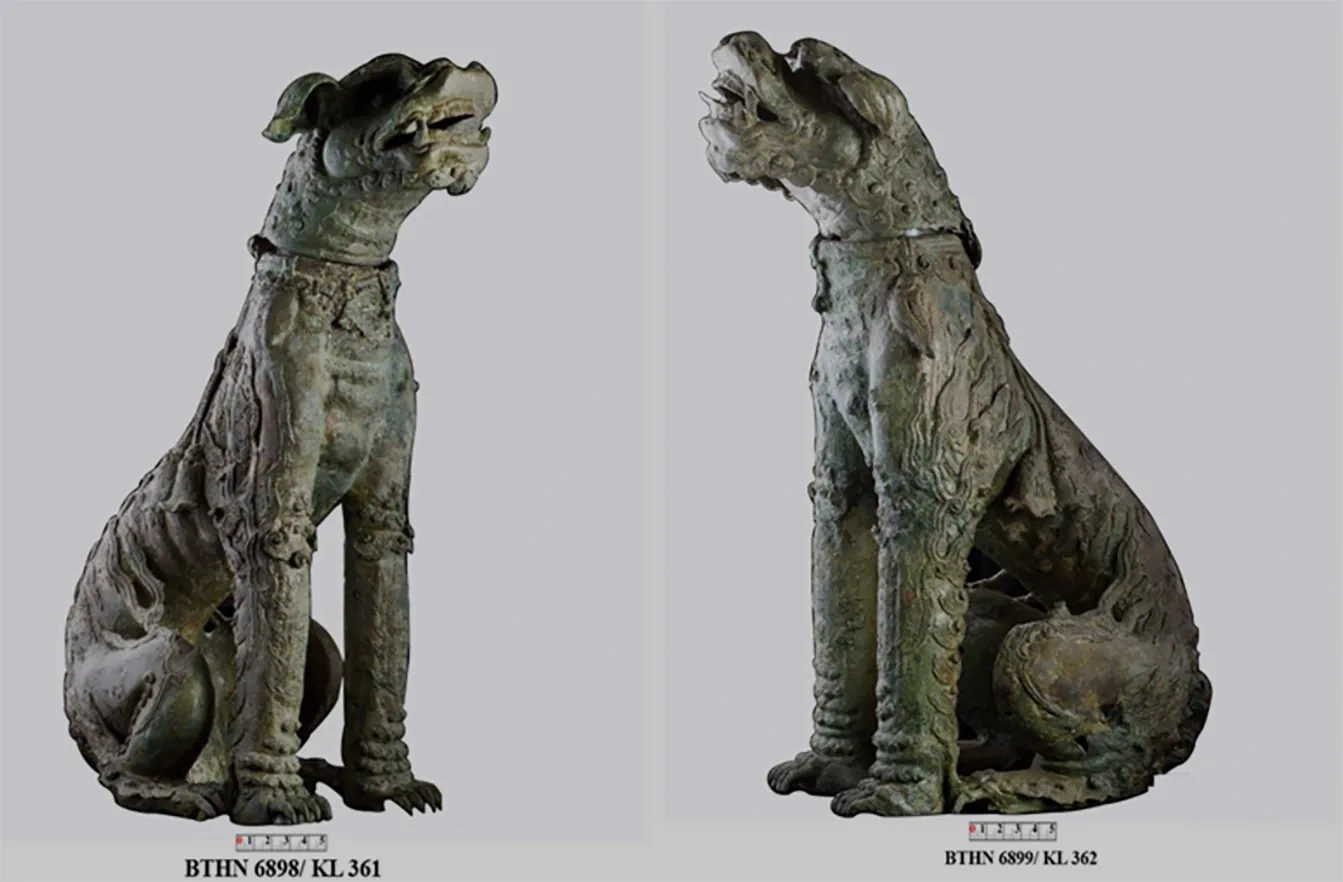
A rare pair of bronze lion statues from the Revival Le Dynasty (1533–1789). Photo: Department of Cultural Heritage.
Among the most remarkable highlights is the Thanh Mai Bell, cast in 798. Found in the Bai Rong area of the former Thanh Oai District in Hanoi, the bell was declared one of the ten most significant artifacts of Vietnamese Buddhist culture. Equally captivating is the ceramic dragon altar from Bat Trang, a distinctive 17th-century piece from the renowned ceramic village that reflects the sophistication of Vietnamese spiritual craftsmanship.
According to Nguyen Tien Da, Director of the Hanoi Museum, two bronze lion statues are among the most prominent national treasures on display. They were masterfully crafted during the Le Trung Hung (Revival Le Dynasty) period (1533–1789). These sculptures exemplify the artistic excellence and spiritual depth of Vietnamese artisans.
Through these priceless pieces, the Hanoi Museum preserves the memory of a storied past and invites visitors to connect with the enduring soul of Thang Long - Hanoi.
Largely intact artifacts
According to its national treasure record, the pair of bronze lion cubs was collected by the Hanoi Museum in 1992. They originally arrived still covered in soil, with several small areas on their bodies and legs chipped.

Young visitors explore Vietnam’s cultural heritage at the Hanoi Museum. Photo courtesy of Hanoi Museum
"This indicates that the artifacts were likely discovered by locals. Currently, the bronze lion cub statues are well preserved, with an even layer of greenish-gray patina covering them. This is the result of the museum's preservation process and efforts to promote their value," said Da.
The bronze lion cub statues remain largely intact and are carefully preserved by the Hanoi Museum.
Each seated lion, made of three seamlessly joined parts, features a majestic posture with raised heads and straight front legs. Their vividly detailed faces, with expressive eyes, curved tongues, and prominent fangs, appear almost to be smiling. Meanwhile, the bodies, with sunken bellies, broad chests, and bell collars, display visible tendons that reflect both their sacred strength and delicate craftsmanship.

The bronze lion statues of the Revival Le Dynasty are on display at the Hanoi Museum. Photo: Hanoi Museum
Their entire bodies are covered in thick fur, curling around their heads, but their ribs are exposed, implying an ascetic life dedicated to religious practice.
The national treasure record describes it as "...a legendary creature that still has the real features of an animal very close to human life. It is a loyal friend and servant to humans in daily life."
The return of the Dong Son tradition
What is highly commended in the pair of lion cubs are the dense yet discernible decorative patterns. Their beards, fur, tendons, bells, and other details are crafted with fine lines, reflecting the talent of the creators.
More importantly, this style attests to the return of a tradition from over 1,000 years ago, during the golden age of the Dong Son culture, when bronze drums were adorned with dense patterns. The superb techniques of Dong Son bronze casting also seem to have been revived under the Revival Le Dynasty, as evidenced by the ultra-thin castings and virtually no technical flaws.
The bronze lion statues at the Hanoi Museum are among the rare religious bronze artifacts found in Vietnam. While similar statues exist in museums in Hanoi, Haiphong, and Ninh Binh, they are either damaged, incomplete, or only single lions from original pairs.

The pair of stone dragons at the Thang Long Imperial Citadel's Kinh Thien Palace is also a representative treasure of the Revival Le Dynasty (1533–1789). Photo: Institute of Imperial Citadel Studies
The An Bien Collection holds the most intact similar pair, but those lion cubs are part of an incense burner and differ from the Hanoi Museum’s larger guardian statues (59 cm tall, 12 kg vs. 45 cm, 3 kg).
The Hanoi pair was designated a national treasure for exemplifying the distinctive artistic style of the Revival Le Dynasty (17th–18th centuries), when lion cub imagery flourished in Vietnamese religious art.
In fact, lion cubs became a defining symbol of Revival Le Dynasty aesthetics. The pair at the Hanoi Museum is true proof of this, drawing inspiration from the decorative motifs found on Dong Son bronze drums and jars. Their form and style closely resemble ceramics from the Ly (1009–1225) and Tran (1225–1400) dynasties, as well as Tran dynasty bronze pots and Mac dynasty (1527–1677) incense burners.
The bronze lion statues at the Hanoi Museum are exceptional examples of Vietnam's rich artistic and spiritual heritage. They are not only rare, well-preserved relics, but also embody the cultural and aesthetic values of their time.
Their designation as national treasures highlights their enduring significance in Vietnamese art history and their vital role in preserving the nation’s cultural identity.