Unknown story of a house in French-designed Old Quarter
The old house retains some distinctive architectural features over the course of time, making it a priceless piece of Hanoi’s heritage.
The French-style house at 44 Hang Be Street in Hang Bac Ward, Hoan Kiem District, located in Hanoi's Old Quarter, used to be a tenement and a primary school in the past.
| The old French-style mansion of 44 Hang Be Street. Photo: Lai Tan/The Hanoi Times |
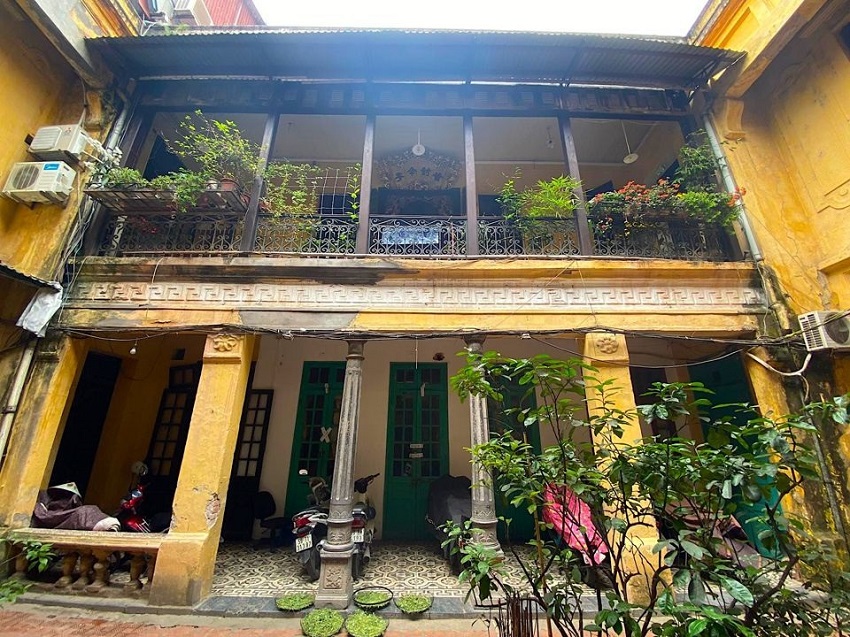
The house has aged over time, with a rather small entrance and a gate reinforced with an iron frame. Still, there are remnants of a golden era in the daily activities here.
Both home and school
After hearing about the mansion’s owner - one of the richest people in Hanoi at the time - and the daughter’s wedding in the largest house on Hang Be Street in the 1930s, visitors may find it strange that it was both a school and the young lady’s home.
Above the entrance gate, which resembles a village gate in the middle of the busy street, was a sign that read: ‘Bac Son Primary School’.
Today, few people know about the school, as its former students had lived for nearly half a century before the name was changed.
Chu Bich Ngoc, currently a cultural officer in Vinh Hung Ward, Hoang Mai District, said
“The ones born in the 1970s like me started school at 44 Hang Be Street. At that time, the classes were held on the first floor, on the left side, as one looked in from the outside.
Every day, the children chanted new words in the quiet room with only the chirping of birds, while the owners still lived on the second floor. Later, after the school merged into Trung Vuong - Nguyen Du Primary School, the old generation - then grandpas and grannies - still remember the name ‘Bac Son’ full of memories.”
The current owner of the house, Le Thi Thuy (born in 1955), vividly recalled this period. According to Thuy, the mansion was built in 1926, and the initial owners were Truong Trong Vong and Nguyen Thi Suu, famously wealthy merchants in Hanoi’s Old Quarter in the early 20th century and also Thuy’s maternal grandparents.
| The mansion used to be a renowned primary in Hanoi. Photo: Real Times |
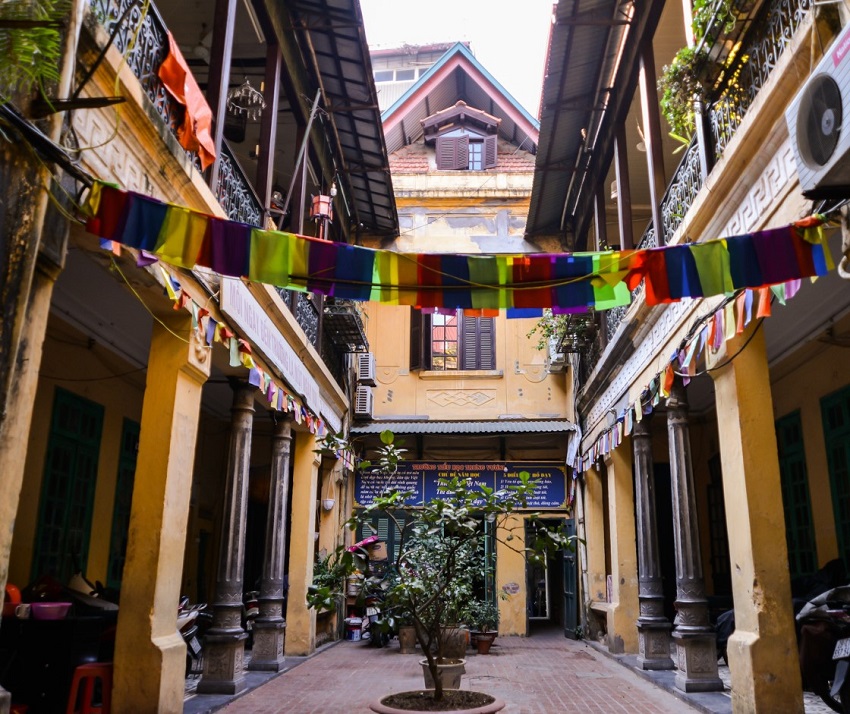
In the 1960s, Thuy’s mother, Truong Thi Mo (1924-2020), donated part of the mansion to the State for use as a classroom. Until the 2000s, the classroom in the 800-square-meter mansion was still in use, where many generations of students had memorable school life.
Although her family’s social status was not the same as before, Thuy was still seen as a ‘princess’ in the eyes of her peers since she lived in a large mansion with a maid who took care of everything.
Even more special is that her son, born in 1991, also studied at the school within their home. The school also witnessed the love story of a young couple from the 90s, who were in the same class, fell in love with each other and became husband and wife.
“My son’s wedding photos were also taken at my house and right at the school of memories. During our pre-wedding visit to the bride’s family, her parents decided to take a unique set of wedding photos right at the typical Hanoi house,” Thuy excitedly boasted about the highlight of her story.
Preserving golden memories
| The mansion's owner Truong Thi Mo and her husband. Photo: Dan Viet |
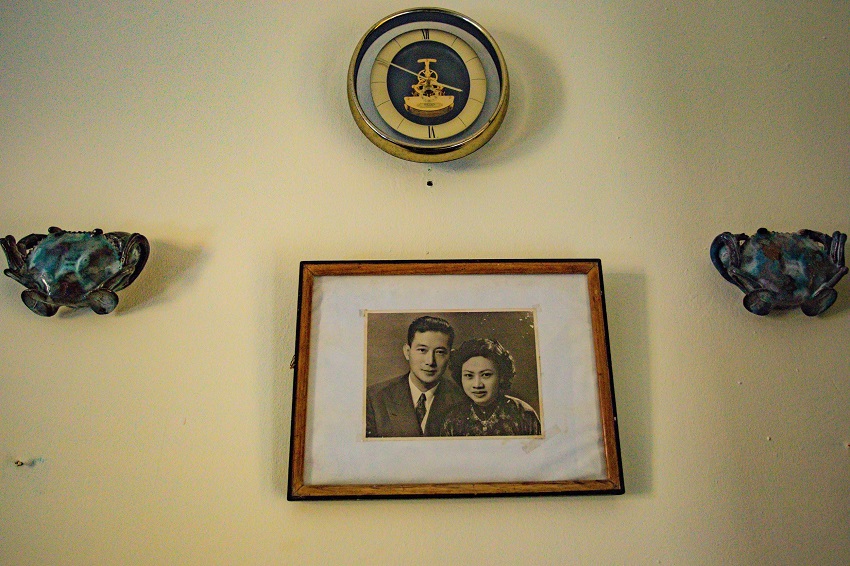
Merchant Truong Trong Vong hired a French architect to design and supervise the construction of the house at 44 Hang Be Street, which featured a courtyard surrounded on all four sides by living rooms and bedrooms for the entire clan, with four intricately carved stone pillars.
The story of how the house came to be was told in detail by the neighbors today - Hung, who runs a drink stall, and Lan, who sells rice vermicelli at the entrance.
Truong Thi Mo passed away in 2020, but she is still remembered for her kind heart: a wealthy woman but still eager to do social work in the community as long as she could.
Local authorities always come to the house to visit the family on special occasions, while tourists are welcomed here every day to learn about an old Hanoi …
Going back to the not-so-distant past, Thuy continued: “When she was still alive, my mother often talked about the mansion her father, Truong Trong Vong, built. Hailing from Van Dien Town, Thanh Tri District, he was among the biggest contractor in Hanoi in the 1920s”.
After a period of successful business, he bought land on Hang Be Street and moved his extended family from his hometown to the city. This was convenient both for their business and for his children and grandchildren to study at better schools.”
“The house was designed by a famous French architect and built in almost a year by up to 100 construction workers from the provinces near Hanoi. Its highlight is four stone block pillars, exquisitely carved with peach, bamboo, chrysanthemum and apricot tree patterns, to bring good luck, wealth and prosperity to its owners. That's what can be seen from the outside.
But what people may not know is that the interior was ahead of its time. The wardrobes, tables, shelves and decorative ceramic tiles are the same age as the house, surprising many with their modern and comfortable design,” Thuy said.
| The interior decoration of the mansion 44 Hang Ba Street in Hoan Kiem District, Hanoi. Photo: Real Times |
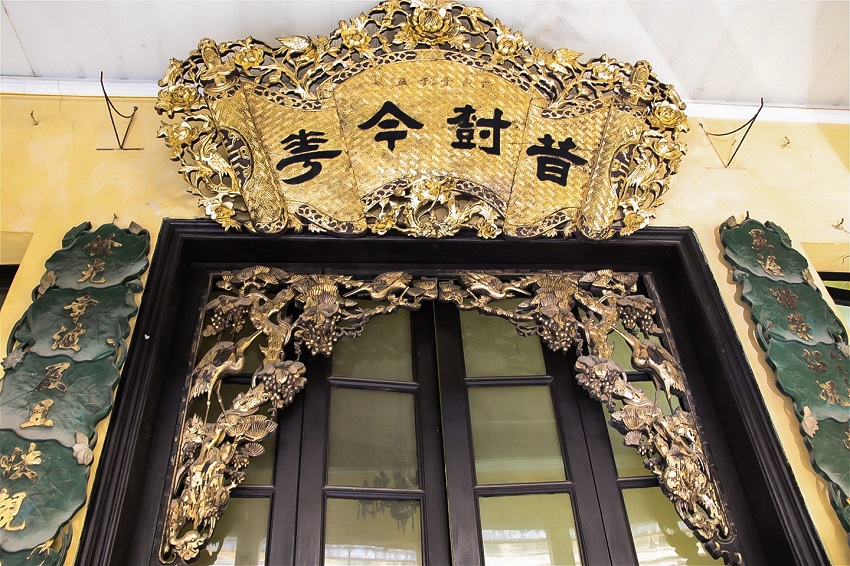
The house’s golden age and architecture are so well known that main scenes of many Vietnamese films such as Ha Noi Mua Dong Nam 46 (Hanoi in winter 1946), Tuoi Thanh Xuan (The Youth), Mua La Rung Trong Vuon (The Leaf Fall Season) or Huong Ngoc Lan (The Scent of the Ylang) were shot at the house at 44 Hang Be Street.
Many artists and singers also choose the mansion as a location to film music videos. Tourists from sunny Southern Vietnam or Western countries visiting Hanoi often visit the house, where everything, like a glazed tile or patterned window bars, whispers old stories.
Thuy can’t help but become a tour guide in her home and school, which makes her look much younger than her age. She often cheerfully makes a pot of jasmine tea to greet Spanish or French groups of visitors.
When a Vietnamese film crew wished to repaint the rooms to suit the plot, she agreed that the original arrangements in each room be preserved to reflect the spirit of her grandparents.
Through the ups and downs of history, Thuy’s family now only lives in an area of more than 200m2, which is still maintained in its original state. Around the house are still the slogan ‘Ren Duc Luyen Tai’ (Cultivate Virtue, Cultivating Talent) - the trademark of Bac Son Primary School - reminiscent of the owners who lived amicably, always willing to contribute to the community.