Untold story of an ancient village in the heart of Hanoi
Located in the west of the capital, Trich Sai Village has always been famous for being an ancient village with a deep-rooted culture.
Trich Sai Ancient Village in Tay Ho District, Hanoi is one of six ancient villages in the ancient Ke Buoi region, bearing precious memories of Thang Long Citadel’s glory days.
The village not only stands out for the craftsmanship of Linh cloth - a type of silk favored by kings, but also for numerous relics of historical values.
Centuries-old village
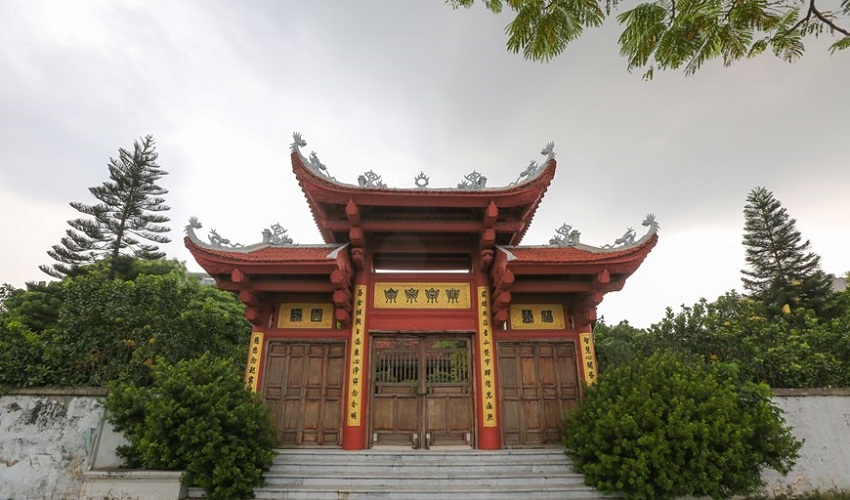
| The hundred-year-old Thien Nien Pagoda in Trich Sai Village. Photo: VNA |
Like many villages in the Ke Buoi region, Trich Sai lies on the alluvial plain along Thien Phu and To Lich rivers. Thanks to fertile deposits, the village’s history and culture have been built up over centuries and incredibly enriched.
It is not clear when the village of Trich Sai appeared, but many documents show that this place has existed since the Later Le Dynasty (1428-1527). Therefore, it is now nearly 600 hundred years old.
Trich Sai Village is located in a privileged location, next to the romantic West Lake. The people of Trich Sai always proudly cherish their history and traditions.
Nguyen Thi Tao, a 90-year-old villager, explained: “The village’s name is derived from the ancient villagers’ work. ‘Trich Sai’ means ‘chopping firewood’.
A part of the West Lake in the sunset viewed from Trich Sai Street. Photo: Quan tra Thanh thoi |
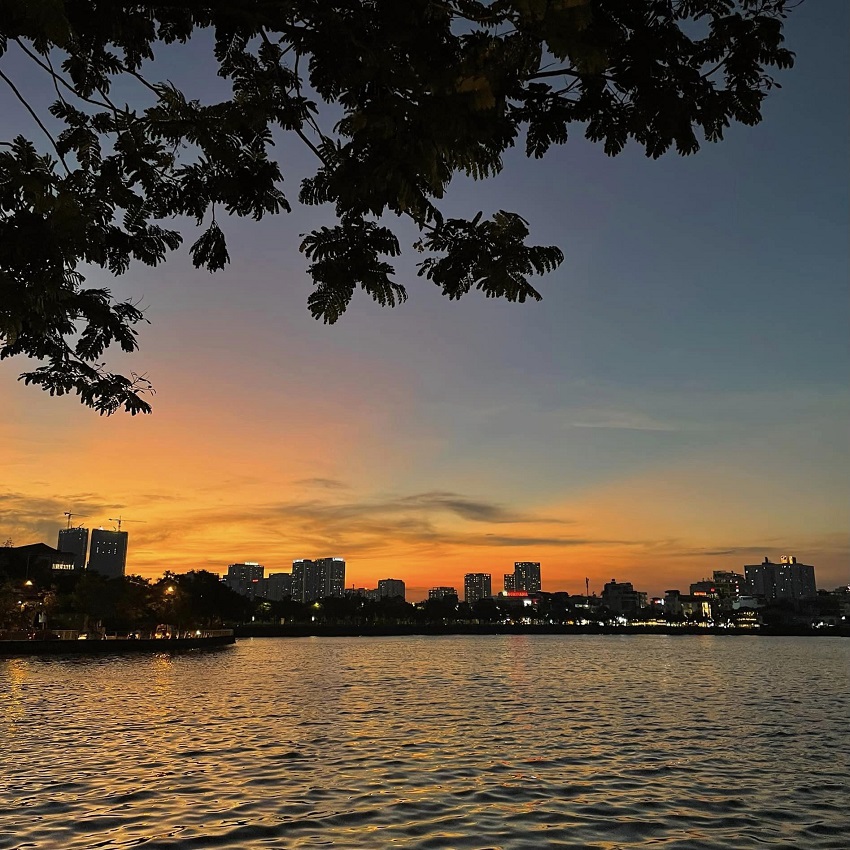
"In the past, the area around West Lake was mostly an ironwood forest, and our ancestors were all lumberjacks who also hunted for food. That’s why over time, they gave the village that name,” she noted.
Trich Sai never comes to mind without its Linh cloth, which has been renowned throughout the country as ‘Buoi’s Linh’ (a kind of silk woven in Ke Buoi or the area around today’s Trich Sai Street) and praised for generations, along with other silk fabrics like La Khe’s The (in Ha Dong District), Phung’s Soi (in Dan Phuong District), Van Phuc’s Van (Van Phuc Silk Village in Ha Dong District), and Mo’s Nhieu (in Tay Mo and Dai Mo wards, Nam Tu Liem District).
The godmother of the craft is Lady Pham Thi Ngoc Do, a beautiful Champa woman with a talent for weaving. During the Late Le Dynasty, King Le Thanh Tong built a palace for the favorite royal concubine in Trich Sai Village. Together with her maidservants, she taught the people how to weave Linh cloth.
Unfortunately, during the famine in 1945, silk cloth wasn’t as valuable as rice, so Trich Sai villagers had to change their jobs and the craft also gradually disappeared.
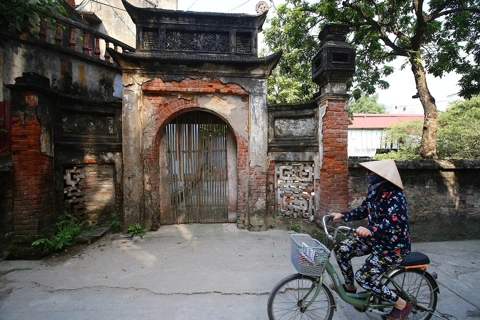
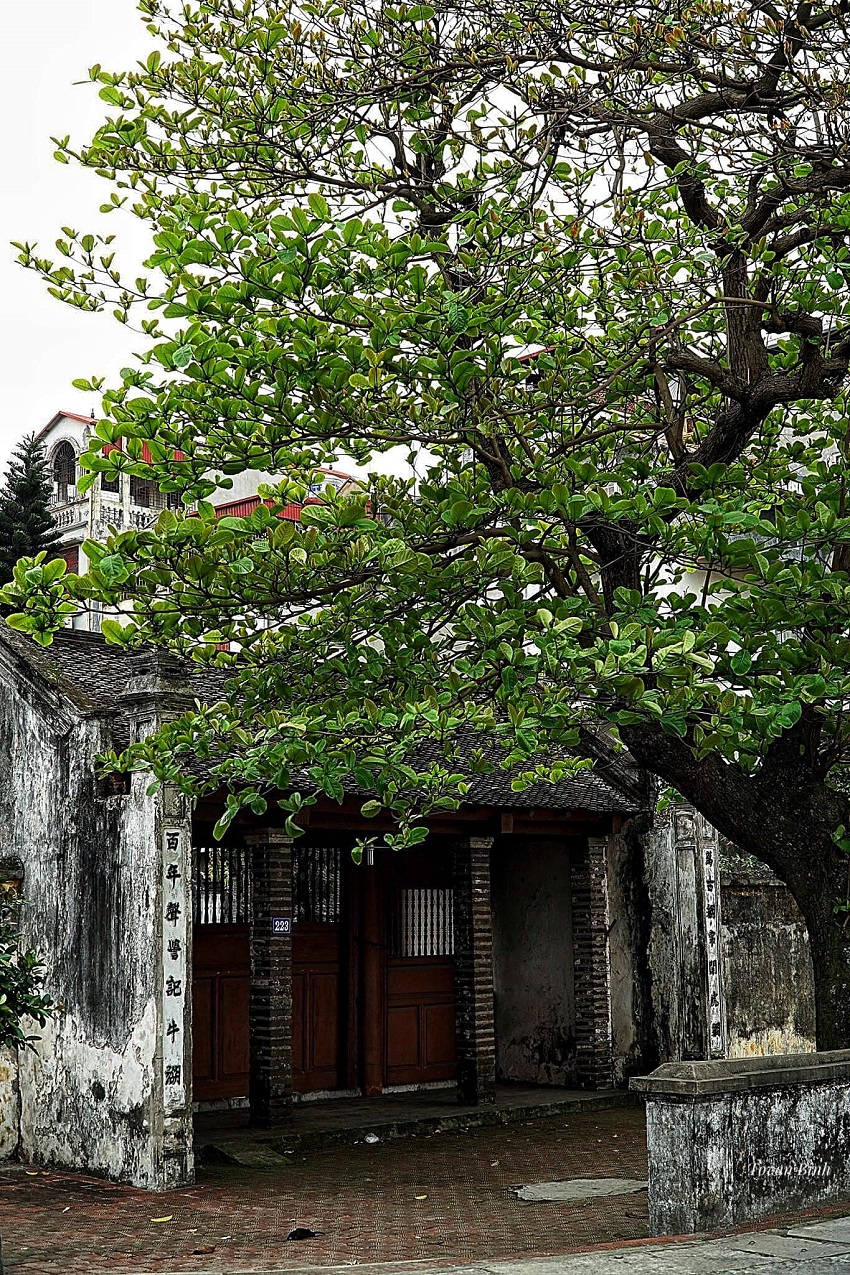
| The timeless beauty of ancient architecture in Trich Sai Village or the area around today's Trich Sai Street. Photo: To Van Binh |
Land of marvelous historical sites
Stopping at the ancient village in the middle of crowded Hanoi, in the hearts of visitors, everyone feels an extraordinary sense of peace.
It seems that, under the modern paint, there is still somewhere the rustic breath of a hundred years old places hidden under the shadow of old trees, mossy houses and ancient communal houses.
Few people know that Trich Sai Village is home to all kinds of historical relics from communal houses, pagodas, temples, shrines, and temples of literature. These are typical of land located in the heart of the prosperous ancient Thang Long Citadel.
The most notable site is the Communal House of Trich Sai Village, built in the year 1612 under the reign of King Le Kinh Tong. This place is dedicated to general Muc Than, who saved King Ly Nhan Tong (1066 - 1128) from the conspiracy of grand chancellor Le Van Thinh when the king toured the West Lake.
| The stone objects inside Trich Sai Communal House. Photo: Vietlandmarks |
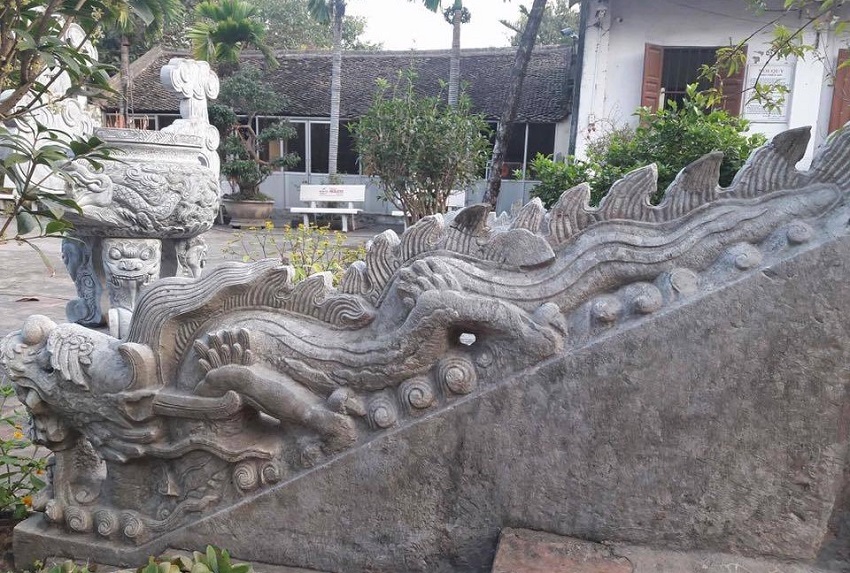
The communal house is a fine example of the Nguyen Dynasty’s architecture, including closed gables, a three-door archway, left-hand and right-hand chambers, a front hall, a sanctuary, and two corridors.
For the villagers, the communal house not only has artistic and architectural values, but it is also the place for their cultural and spiritual activities, expressing gratitude to the general who saved his king and served his country.
Trich Sai communal house has just been renovated but still retains the old Thang Long’s cultural identity.
Through historical ups and downs over more than four centuries, were it not for the local conservation efforts, Trich Sai Communal House would not be in as good shape as it is today.
Tran Duy Cuong, an 83-year-old former head of Trich Sai Village’s relic management board, recounted: “Around 1951, the French colonialists burned down the communal house for fear that this would be a hideout for resistance leaders. In 1994, the villagers helped rebuild the structure and renovate the western sanctuary.
Trich Sai Communal House was built in 1612 to worship Muc Than - a talented general during the reign of King Ly Nhan Tong (1066 - 1128). Photo: tayho.gov.vn |
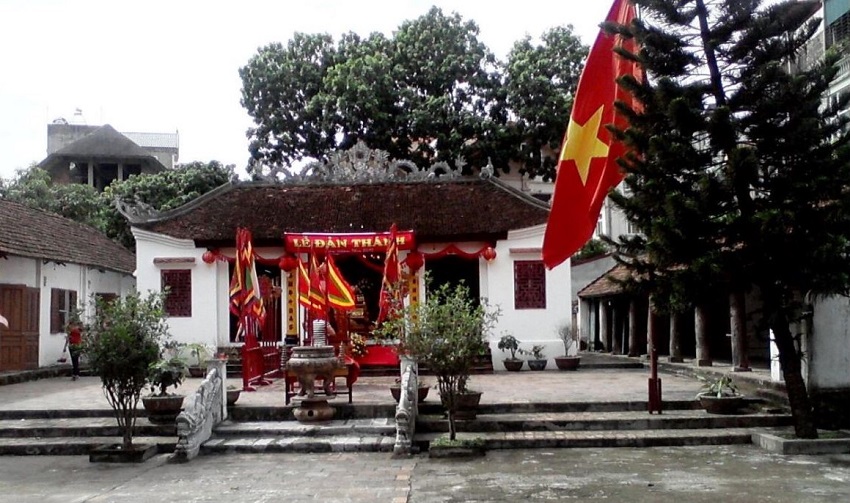
In 2002, the five-compartment front hall was restored, and the last renovation was in 2006 when two chambers on the left-hand side were rebuilt.”
About ten meters to the left of the communal house is the relic of Gia Hoi Temple, devoted to the three princesses of King Ly Nam De, namely Van Phuc (Great Fortune) Lady, Van Loc (Great Prosperity) Lady, and Van Tho (Great Longevity) Lady.
According to the villagers, the ladies offered great help to the local people in many aspects of life. In addition, there is also a shrine to Trich Sai’s weaving godmother Pham Thi Ngoc Do, a temple to three Chinese saints, as well as the ancient and august Thien Nien or A Thousand Years Pagoda.
“Currently, relics in the village include the temple, communal house, and temple of literature, all recognized as a city-level relic cluster. Particularly, Thien Nien Pagoda was recognized as a national-level cultural relic in 1992.