Vietnam eyes top 3 in investment environment in ASEAN next 2 years: Party Chief
A key objective is to trim off at least 30% of administrative procedures and cut both business costs and unofficial fees.
Party General Secretary To Lam has set a goal for Vietnam to become one of the top three investment destinations in ASEAN within the next two to three years.
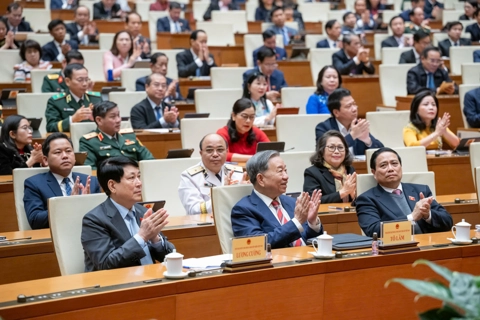
| Party Chief To Lam at the meeting. Photos: Thong Nhat/VNA |
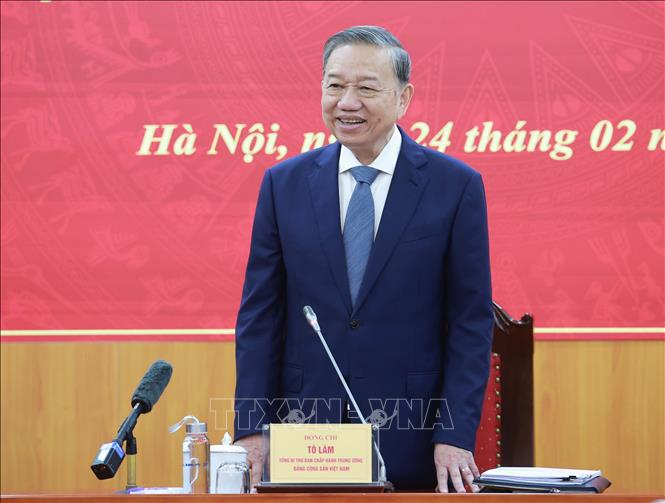
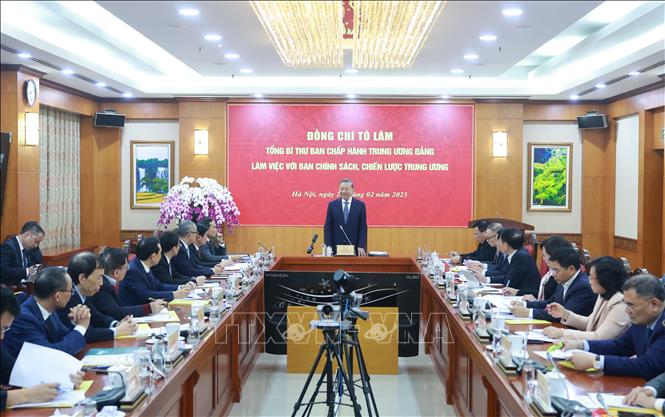
This objective was announced during the Party Chief’s meeting with the Central Policy and Strategy Committee along with various ministries, sectors, and economic experts on February 24.
For 2025, Vietnam has set an ambitious target of achieving economic growth of at least 8%, laying the groundwork for double-digit growth in subsequent years.
To spur economic development, To Lam emphasized the need for continued institutional reforms and improvements in the business environment.
A key objective is to reduce administrative procedures by at least 30% and cut both business costs and unofficial fees. At least 30% of unnecessary business conditions will also be eliminated, said To Lam.
The Party Chief emphasized that achieving this goal would position Vietnam among ASEAN’s top three investment environments within the next two to three years.
Vietnam’s legal framework currently struggles to keep pace with the rapid development of the digital economy, technological innovation, and international integration, especially in areas such as financial technology (fintech), artificial intelligence (AI), platform economies, e-commerce, and special economic zones.
To address this gap, he suggested that Vietnam should boldly adopt specialized legal frameworks, including controlled experimentation with regulations for new technologies, special tax incentives for economic and technological zones, and specific mechanisms for resolving trade disputes in these special zones.
For sustainable economic and social development, he stressed the importance of engaging the entire population in productive labor. “If everyone works diligently and all economic sectors actively participate in economic and social development, economic growth will inevitably accelerate,” he stated. Policies and mechanisms, he added, should encourage the participation of all sectors of the economy.
To attract global investment, Vietnam also plans to introduce open financial policies for international financial hubs and develop duty-free port models to become a major logistics center. Other initiatives include establishing a "National Investment One-Stop Portal" and implementing policies to attract skilled workers and reward public officials for outstanding performance.
Recent reforms have minimized unclear or unnecessary business requirements. However, the Ministry of Planning and Investment notes that government oversight of enterprises remains burdensome. Although administrative procedures have been simplified, businesses still have to interact with multiple agencies, which results in high compliance costs.
| Overview of the meeting. |
To unlock growth potential, the government’s Resolution 02/2025 outlines five key reform areas: addressing legal and enforcement issues in project implementation, enhancing the quality of the list of conditional business sectors, reforming sector-specific management and inspections, increasing the use of information technology for inter-agency data sharing, and improving business development services.
On the demand side, the Party Chief urged the government to boost investment in national infrastructure and encourage private sector involvement by creating a transparent and accessible investment environment with low costs and easy access to credit. Domestic consumption should also be strengthened to sustain GDP growth, alongside increasing exports of processed agricultural, forestry, and fishery products rather than relying solely on raw production.
On the supply side, land and real estate policies should facilitate market transactions, attract investment, and promote urban areas as growth drivers. To Lam also proposed establishing a "National Housing Fund" to develop affordable housing in major cities. Supporting policies would include completing high-quality urban infrastructure and developing a national digital map for planning and land valuation.
Vietnam aims to build one million social housing units by 2030. Between 2021 and 2024, 644 social housing projects with a total of 580,109 units were launched, according to the Ministry of Construction. Of these, 96 projects have been completed, delivering 57,620 units, while 133 projects are under construction with 110,200 units. The remaining 415 projects, once fully implemented, could provide an additional 412,200 units.
In 2023, the Party Secretariat's Directive 34 emphasized the need for a long-term and sustainable social housing development fund. The government previously tasked several ministries with studying the feasibility of such a fund, including allowing businesses to use land assets as collateral for credit loans.
On digital currency management, the Party Chief also stressed the need for policies that ensure Vietnam remains competitive in adopting new financial technologies and modern transaction methods, avoiding delays that could widen the country’s economic gap with other global economies.