Vietnam’s FDI disbursement hits five-year high as manufacturing remains dominant
Strong manufacturing inflows and rising capital absorption pushed Vietnam’s foreign investment performance to a new peak in 2025, reinforcing the country’s standing as a resilient destination for global investors.
THE HANOI TIMES — Vietnam’s disbursed foreign direct investment (FDI) in 2025 rose an estimated 9% year-on-year to a five-year high of US$27.6 billion, according to the General Statistics Office under the Ministry of Finance.
The office said the result is a bright spot in Vietnam’s FDI landscape during a year of global economic uncertainty.
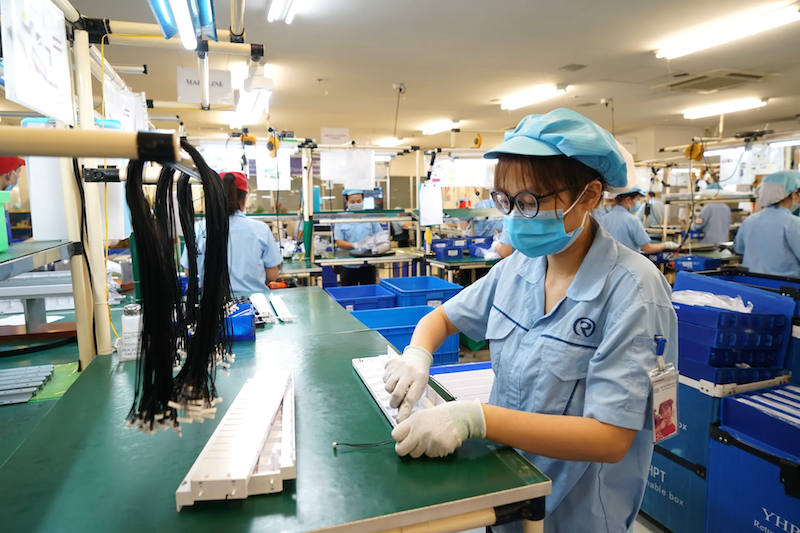
Electronics production at Rhythm Precision Vietnam at Hanoi's Noi Bai Industrial Park. Photo: Pham Hung/The Hanoi Times
Manufacturing and processing remained the backbone of FDI disbursement, attracting $22.9 billion, or nearly 83% of total implemented capital.
Real estate activities contributed $1.9 billion, accounting for 7%, while electricity and gas production and distribution added nearly $915 million, or 3.3%.
These figures demonstrate strong foreign investor confidence in Vietnam’s investment climate and the economy’s capacity to absorb capital, the agency said.
Total registered foreign investment into Vietnam edged up 0.5% from a year earlier to reach $38.4 billion in 2025.
Authorities licensed more than 4,000 new projects nationwide with registered capital of $17.3 billion. While the number of new projects increased 20%, their total registered capital declined 12%.
Among newly registered projects, manufacturing and processing continued to lead, drawing $9.8 billion and accounting for 56.5% of the total. Real estate ranked second with $3.7 billion, or 21%, while other sectors together attracted $3.8 billion.
In terms of investment partners, among 90 countries and territories with newly licensed projects in Vietnam, Singapore led with registered capital of $4.8 billion, representing 28% of the total.
It was followed by China with $3.6 billion (21%), Hong Kong with $1.7 billion (10%), Japan with $1.6 billion (9.4%) and Sweden with $1 billion (5.8%).
Alongside new registrations, capital adjustments and share purchase activity remained robust. Adjusted capital from 1,400 existing projects reached $14.1 billion, up 0.8% from 2024.
Combined, newly registered and adjusted capital showed manufacturing and processing attracting $18.6 billion, or 59% of the total, while real estate drew $6.3 billion, accounting for 20%.
Investment through capital contributions and share purchases surged 55% year on year to $7 billion across nearly 3,600 transactions, highlighting growing foreign interest in mergers, acquisitions and strategic partnerships in Vietnam.