Vietnam targets record $74 billion agriculture exports in 2026
Vietnam’s agriculture, forestry, and fisheries exports are expected to set a new record in 2026, as the sector accelerates market opening, deep processing and value-chain integration to strengthen competitiveness amid rising global uncertainty.
THE HANOI TIMES — Vietnam’s agriculture, forestry and fisheries exports are forecast to climb 5.7% year on year to a record US$74 billion in 2026, Deputy Minister of Agriculture and Environment Phung Duc Tien said on January 6.
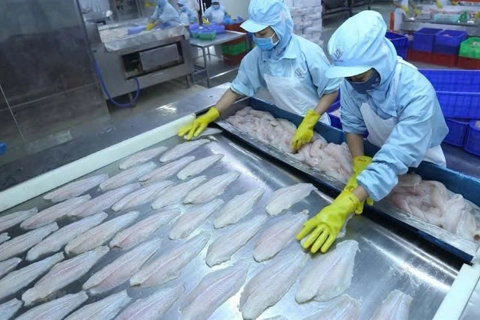
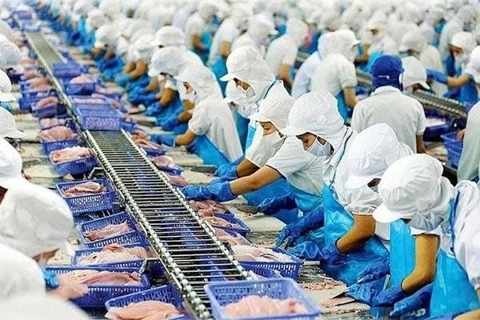
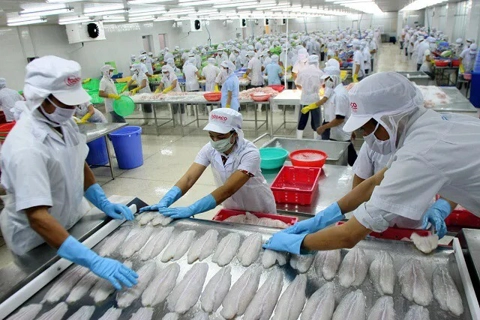
Agricultural exports are projected to advance 7.2% to around $40 billion while seafood international sales and forestry and wood-based shipments are expected to expand by 7.6% and 3.6%, reaching $12 billion and $18.8 billion, respectively, Tien told the ministry’s monthly press briefing.

A wood processing workshop in Hanoi's Ung Thien Commune. Photo: Pham Hung/The Hanoi Times
The deputy minister said this year will be crucial for rolling out development goals for the 2026-2030 period.
Against this backdrop, the agriculture and environment sector will maintain an open-market orientation while pushing exports in a more efficient and sustainable direction.
To deliver on the 2026 target, the ministry will pursue a holistic value-chain approach that connects raw material zones with standards, processing, logistics and end markets.
Standardizing production areas in line with concrete market demand will stand out as a top priority.
Planned measures include widening the use of planting-area and aquaculture codes, tightening oversight of input quality and food safety and reinforcing traceability systems.
Production will increasingly align with recognized benchmarks such as GAP, organic and sustainability certifications, helping limit export alerts and reduce rejected consignments.
The ministry will also fast-track deep processing and product diversification by channeling investment into modern processing, preservation and packaging technologies.
Ministerial bodies and local authorities will steer producers toward refined, convenient and ready-to-eat goods, while agricultural by-products will be leveraged to build new value chains in animal feed, bio-based materials and extracts.
Lowering logistics costs remains central to boosting export competitiveness.
Efforts will focus on expanding cold storage capacity, strengthening cold-chain networks and developing regional logistics hubs, alongside streamlining transport routes and raising efficiency at ports and border gates.
Authorities will intensify digitalization of procedures to speed up customs clearance and ease compliance burdens for exporters.
The ministry will continue talks on market access and work to resolve technical barriers to trade as well as sanitary and phytosanitary requirements.
Brand building, geographical indications and market-specific marketing strategies will gain momentum to sharpen the global profile of Vietnamese agricultural products.
The sector will also scale up circular economy practices and low-emission production, which Tien described as a “passport” to premium markets and high-end retail channels.
Providing context for the outlook, Tran Gia Long, Deputy Director of the ministry’s Department of Planning and Finance, said combined exports of agriculture, forestry and fisheries reached $70 billion in 2025, marking a 12% rise from the previous year.
Agricultural products generated $37.3 billion, up 13.7%, while livestock exports climbed 17.4% to $627.8 million. Seafood earnings increased 12.7% to $11.3 billion and forestry products added $18.5 billion, reflecting growth of 6.6%.
Vietnam recorded 10 export categories valued at more than $1 billion, including three that surpassed the $8 billion mark. Wood and wood products topped the list with $17.3 billion, followed by fruits and vegetables at $8.6 billion and coffee at $8.5 billion.
China, the United States and Japan continued to anchor demand, while exports gathered pace across Asia, Europe and Oceania. Africa emerged as a standout market, with shipments jumping by more than 67%.
The sector also delivered a trade surplus of about $20.7 billion, up 16.6%. Officials, however, cautioned that climate change, disease threats, geopolitical tensions and fiercer global competition remain key risks to sustaining export momentum.