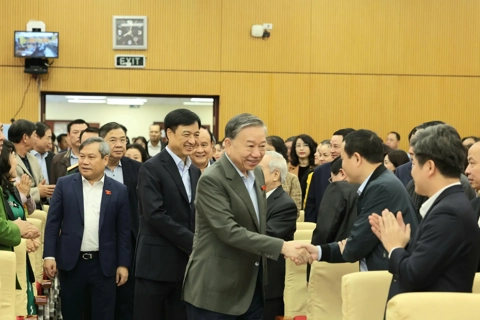
Vietnam urged to apply AI in identifying soldiers’ remains
Vietnam plans to use official development assistance (ODA) to build a database and apply advanced technologies to search and identify unknown soldiers’ remains.
Vietnamese Deputy Prime Minister Tran Hong Ha has urged local agencies to use advanced technologies, including artificial intelligence (AI), to identify the remains of fallen soldiers as more than 300,000 martyrs have yet to be identified and about 180,000 sets of remains have yet to be collected.
| Vietnamese Deputy Prime Minister Tran Hong Ha speaks at the meeting held in Hanoi on Jan 9. Photo: VGP |
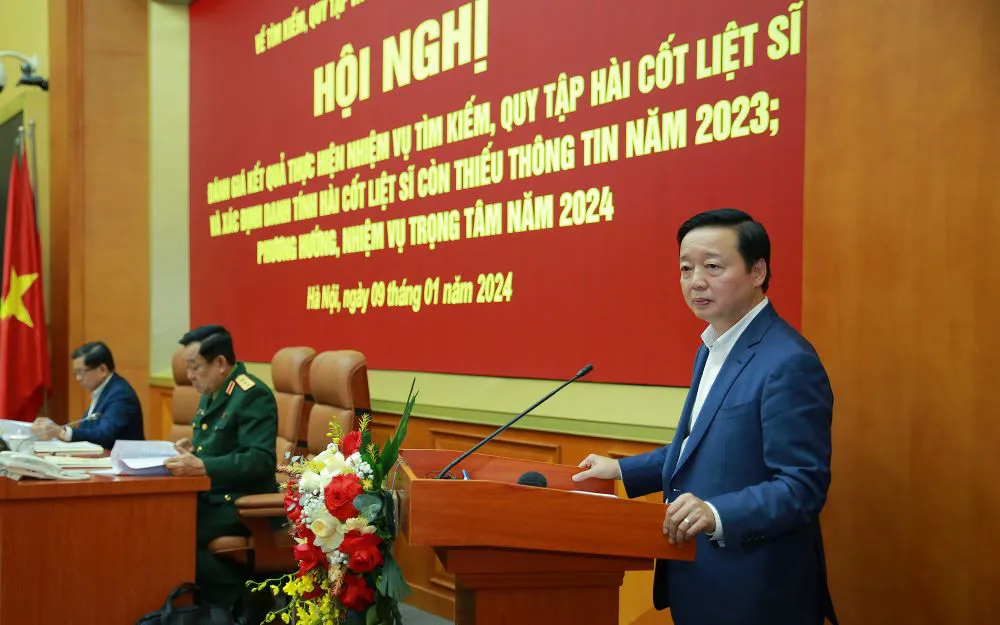
The relevant agencies need to work around the clock to make the identification effective in the context of a war that has been over for several decades, Ha told the meeting, which was attended by senior officials from the ministries of defense; labor, invalids and social affairs; finance; and planning and investment.
The Ministry of Science and Technology is tasked with developing a database and software to assist in the search, collection, and identification of remains and archiving fallen soldiers' contacts for future use.
In addition, ministries and agencies are asked to spare no effort in this “crucial mission”, said Ha, who heads the National Steering Committee for Search, Collection, Repatriation, and Identification of Fallen Soldiers’ Remains (National Steering Committee 515).
In 2024, the relevant agencies must build a comprehensive database of information on fallen soldiers and unknown martyrs and use technology to identify the martyrs’ remains to achieve the ultimate goal of obtaining the martyrs’ names.
Accordingly, the Ministry of National Defense needs to issue guidelines on the identification of remains using the DNA testing method. Meanwhile, the Ministry of Labor, Invalids and Social Affairs focuses on facilitating the involvement of various stakeholders in the search, collection, and identification of remains.
The Ministry of Finance provides financial resources for each phase of the process.
The Ministry of Foreign Affairs and the Ministry of National Defense need to work with foreign archive agencies to carry out the mission while the Ministry of Planning and Investment is asked to submit to the government a project on improving DNA testing capacity using official development assistance (ODA).
“Out of respect for those who gave their lives in defense of the nation, we need to work around the clock to search for, collect, and identify the remains of the martyrs as there isn’t much time left,” said Tran Hong Ha.
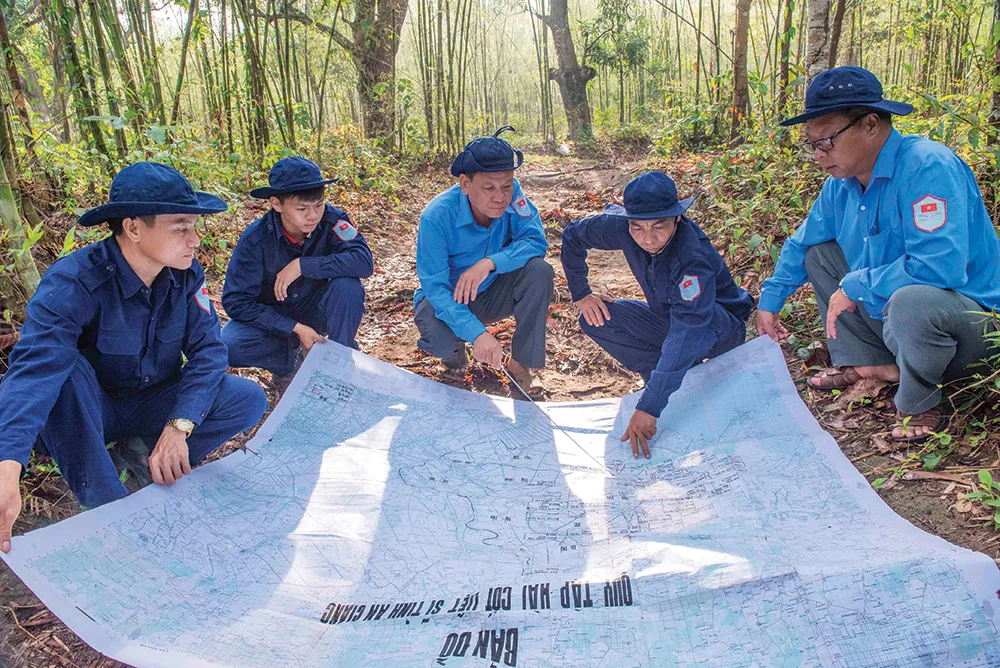
| An Giang military officers in search of fallen soldiers' remains. Photo: Huynh Thanh Tung/Baoangiang |
Results in 2023
Last year, 1,328 sets of remains were recovered, of which 559 were found within the nation, 247 in Laos, and 522 in Cambodia. Remarkably, 251 remains were identified using forensic techniques, while 9 out of 124 remains were identified through DNA testing.
In 2023, the Special Working Committee of the Government of Vietnam held talks and signed the 28th Minutes with the Special Working Committee of the Government of Laos. It also held talks and signed the 22nd Minutes with the Cambodian Government in the search for the remains of martyrs. The committee effectively deployed the Memorandum of Understanding between Office 515 and the US Office of Defense Attaché in Hanoi.
In another move, US Ambassador to Vietnam Marc Knapper visited the Center for DNA Identification (CDI) under the Vietnam Academy of Science and Technology (VAST) in July 2023 to highlight the productive cooperation between VAST, and the International Commission on Missing Persons (ICMP) to improve Vietnam's ability to identify war remains under the US Agency for International Development’s (USAID) Identification of Human Remains project.
As part of the US$7.4 million project, ICMP has been working on developing an altered nuclear-DNA extraction technique to address Vietnam’s challenges with severely degraded remains samples.
Through the ICMP, USAID plans to equip a lab at the CDI with advanced DNA equipment, techniques, and materials to enable the center to successfully extract usable DNA from highly degraded Vietnamese bone samples.
USAID's Identification of Human Remains project seeks to enhance Vietnam’s capacity for DNA analysis and help the country develop a comprehensive system for matching DNA from highly degraded remains with the DNA from families searching for loved ones.
This is a part of the US government’s Vietnamese Wartime Accounting Initiative, which is in return for the Vietnamese assistance in locating and identifying the remains of over 700 American citizens who went missing in Vietnam over three decades.
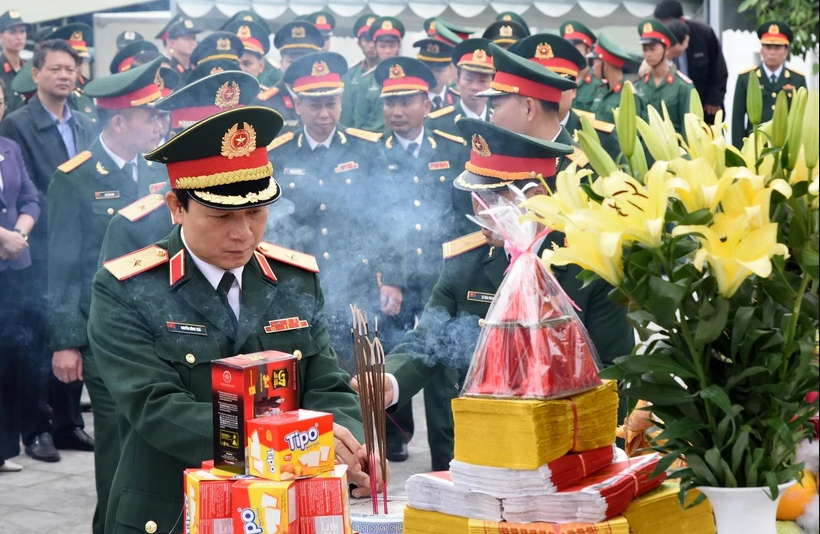
| Offering incense to fallen soldiers who lost their lives in Laos. Photo: Trung Kien/VNA |