Vietnamese Gov't urged to cut business working week to 44 hours
The Labor Code stipulates that workers should not work more than eight hours per day and 48 hours per week under normal conditions.
For the second time in six months, a local trade union has petitioned the Government for a roadmap to reduce the working week for private sector employees from 48 to 44 hours, eventually to 40 hours.
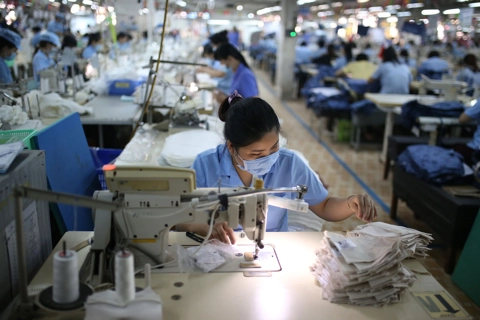
| Workers at Garment 10 Company. Photo: Thanh Hai/The Hanoi Times |

The view was expressed by Dang Tuan Tu, Chairman of the Trade Union at Changshin Vietnam Company in Dong Nai at the National Labor Productivity Enhancement Forum on May 26, adding that this adjustment was aimed at aligning with regional standards and allowing workers more rest, health recovery, and family care.
According to Tu, boosting labor productivity requires businesses to invest in modern machinery and technology rather than merely extending working hours.
The proposal to reduce the working week for private sector workers has been raised several times over the past year. At the Trade Union Congress in December 2023, union representatives expressed that a roadmap to reduce working hours to 40 per week is a major aspiration for many workers.
During the National Assembly session in late October 2023, Deputy Pham Trong Nghia, a member of the Social Affairs Committee of the National Assembly, echoed this sentiment, citing a 1947 decree by President Ho Chi Minh, which set the working limit at 48 hours per week and no more than 100 hours of overtime per year.
The Labor Code stipulates that under normal conditions, employees should not work more than 8 hours per day and 48 hours per week. Employers can set daily or weekly working hours but must inform their employees. The State encourages businesses to adopt a 40-hour working week. This regulation has been maintained through several legislative changes, against a background of low productivity and income levels, leading to longer working hours for workers in order to improve their earnings.
Meanwhile, the public sector operates under a 40-hour working week, regulated by Prime Ministerial Decision 188/1999. This regulation aims to improve the efficiency of public servants, confine administrative tasks to five days, and save on utilities and other costs borne by the state budget.
Statistics show that in 2011, Vietnamese workers produced an average of VND70.3 million (US$2,760) worth of goods, which increased to nearly VND188 million ($7,380) by 2023.
Labor productivity increased by 2.7 times between 2011 and 2023, but still lags behind other regional countries. According to the Occupational Safety Department's 2019 data, Vietnam has one of the highest working hours in Southeast Asia and the fewest public holidays. Specifically, Vietnamese workers typically work around 2,320 hours per year, less than those in the Philippines, Malaysia, and Thailand, but more than those in Singapore, Indonesia, Laos, and Cambodia.
He highlighted several fundamental issues for sustainable productivity growth, such as infrastructure, the shift of labor from rural to urban areas, and the transition from informal to formal employment, which have not yet seen significant breakthroughs.
Chinh also warned that the complex and unpredictable international situation poses challenges to development, making it vital for Vietnam to focus on improving labor productivity.
To address this, he outlined a strategy centered on "three enhancements, three pioneers, and three breakthroughs".
Three Enhancements:
Three Pioneers:
Three Breakthroughs:
|
The Prime Minister also called on all levels of government and the Vietnam General Confederation of Labour to ensure the legitimate rights and benefits of workers, including fair wages, bonuses, and social welfare. He stressed the speedy implementation of the program to build one million social housing units to provide stable living conditions for workers.