Hanoi
Vietnamese proud of Asia-Pacific region’s only “City for Peace”
Hanoi met an array of criteria such as outstanding achievements in improving people`s lives, developing education sector, solving issues of urbanization and environment to earn the title “City for Peace”.
After 20 years of being granted the title “City for Peace” by UNESCO, the Vietnamese are proud of Hanoi, the only city in Asia-Pacific region to have gained the title.
To earn the title, Hanoi met an array of criteria such as outstanding achievements in improving people's lives, developing education sector, solving issues of urbanization and environment, among others.
Hanoi completed many programs to improve its people's lives
Over the past 20 years, Hanoi has completed and put into use a series of infrastructure works, including a number of bridges namely Thanh Tri, Vinh Tuy, Vinh Thinh, Nhat Tan; and Thang Long avenue, Ring Road 3, Ring Road 2, Hanoi – Hai Phong highway, Hanoi – Thai Nguyen highway, T2 terminal of Noi Bai international airport, among others.
In addition to efforts to reduce traffic jams, the city’s authority has paid special attention to issues directly linked to people's welfare such as water supply, drainage, waste treatment and environmental sanitation.
The city has completed the goal of planting one million trees by 2020 two years ahead of the plan, which not only brings Hanoi a new facelift but also contributes to improving air quality in the capital.
People’s lives in rural areas of Hanoi have also improved consederably thanks to implementation of new-style rural building program. By the end of 2018, 324 out of 386 communes in the city have completed the program's targets.
Practical and effective welfare policy
According to the Hanoi Department of Labor, War Invalids and Social Affairs, in 2008, the rate of poor households in the city was 5.72%.
Ten years later, under the National Target Program on Sustainable Poverty Reduction, Hanoi supported house reparation and construction for more than 4,000 poor households, with more than VND420 billion (US$18.06 million).
The rate of poor households in the whole city has been cut to 1.16%, thus the goal of reducing poverty was fulfilled two years ahead of the plan.
The capital’s healthcare towards patients’ satisfaction
20 years after Hanoi was awarded the title "City for Peace", the capital's health sector has made great progress in people’s healthcare.
Since 2016, many hospitals in Hanoi have been built with modern, spacious and clean premises, the quality of medical examination and treatment has been improved, and the procedures have been trimmed off.
Moreover, by the end of 2016, the city put into operation the Hanoi High-tech & Digestive Center at Saint Paul General Hospital, the first center in Hanoi meeting European standards.
Over the past years, the city has also invested in developing many specialized techniques for hospitals, including some techniques which are on par with central and regional hospitals.
Hanoi’s science and technology adopts a right direction
In the past 20 years, the focus on researching and developing high-tech agriculture towards serving urban area, tourism and industrial zones has been considered a right direction in Hanoi’s science and technology development.
Besides, Hanoi has actively implemented many activities to tap the scientific potential as well as streamlining scientific and technological human sources.
Trend of smart technology is the direction for the capital’s economic and social development. Thus, Hanoi has formed high-tech parks and incubator for innovative enterprises.
Focusing on improving the quality of education
After two decades solving many changes and challenges, the capital’s education sector always holds the leading position in Vietnam.
Hanoi always pays attention to improving the system of schools, raising the quality of education, and creating generations of knowledgeable students.
In addition, developing a system of national standard schools is Hanoi’s key target, contributing to significant changes in the capital’s quality of education. As of 2018, the city built 1,500 national standard schools, reaching 151% of the plan. Compared to 2008, the number of schools increased by more than 900 schools.
Besides, Hanoi attaches special importance to training a contingent of competent teachers. So far, 100% of the city’s 100,000 teachers are qualified.
In the academic year of 2018-2019, Hanoi continues to affirm its leading position in education quality by earning 134 national awards. At international exams, the capital’s students won 197 prizes and medals.
With both professionalism and hospitality, Hanoi’s education sector successfully organized the 16th Hanoi Open Mathematics Competition in April 2019, with 14 delegations from Indonesia, Malaysia, China, Nepal, Philippines, Hungary, Iran, Myanmar, Poland, Spain, Taiwan, Thailand, United Arab Emirates (UAE) and Vietnam.
To earn the title, Hanoi met an array of criteria such as outstanding achievements in improving people's lives, developing education sector, solving issues of urbanization and environment, among others.
Hanoi completed many programs to improve its people's lives
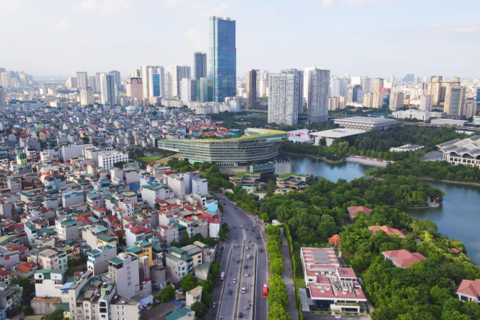
Over the past 20 years, Hanoi has completed and put into use a series of infrastructure works, including a number of bridges namely Thanh Tri, Vinh Tuy, Vinh Thinh, Nhat Tan; and Thang Long avenue, Ring Road 3, Ring Road 2, Hanoi – Hai Phong highway, Hanoi – Thai Nguyen highway, T2 terminal of Noi Bai international airport, among others.
In addition to efforts to reduce traffic jams, the city’s authority has paid special attention to issues directly linked to people's welfare such as water supply, drainage, waste treatment and environmental sanitation.

Hanoi city completes a series of modern transport infrastructures. Photo: Ba Hoat
|
People’s lives in rural areas of Hanoi have also improved consederably thanks to implementation of new-style rural building program. By the end of 2018, 324 out of 386 communes in the city have completed the program's targets.
Practical and effective welfare policy
According to the Hanoi Department of Labor, War Invalids and Social Affairs, in 2008, the rate of poor households in the city was 5.72%.
Ten years later, under the National Target Program on Sustainable Poverty Reduction, Hanoi supported house reparation and construction for more than 4,000 poor households, with more than VND420 billion (US$18.06 million).
The rate of poor households in the whole city has been cut to 1.16%, thus the goal of reducing poverty was fulfilled two years ahead of the plan.
The capital’s healthcare towards patients’ satisfaction
20 years after Hanoi was awarded the title "City for Peace", the capital's health sector has made great progress in people’s healthcare.
Since 2016, many hospitals in Hanoi have been built with modern, spacious and clean premises, the quality of medical examination and treatment has been improved, and the procedures have been trimmed off.
Moreover, by the end of 2016, the city put into operation the Hanoi High-tech & Digestive Center at Saint Paul General Hospital, the first center in Hanoi meeting European standards.
Over the past years, the city has also invested in developing many specialized techniques for hospitals, including some techniques which are on par with central and regional hospitals.
Hanoi’s science and technology adopts a right direction
In the past 20 years, the focus on researching and developing high-tech agriculture towards serving urban area, tourism and industrial zones has been considered a right direction in Hanoi’s science and technology development.
Besides, Hanoi has actively implemented many activities to tap the scientific potential as well as streamlining scientific and technological human sources.
Trend of smart technology is the direction for the capital’s economic and social development. Thus, Hanoi has formed high-tech parks and incubator for innovative enterprises.

A primary school in Hai Ba Trung district is built with spacious and modern facilities. Photo: Hoang Hung
|
After two decades solving many changes and challenges, the capital’s education sector always holds the leading position in Vietnam.
Hanoi always pays attention to improving the system of schools, raising the quality of education, and creating generations of knowledgeable students.
In addition, developing a system of national standard schools is Hanoi’s key target, contributing to significant changes in the capital’s quality of education. As of 2018, the city built 1,500 national standard schools, reaching 151% of the plan. Compared to 2008, the number of schools increased by more than 900 schools.
Besides, Hanoi attaches special importance to training a contingent of competent teachers. So far, 100% of the city’s 100,000 teachers are qualified.
In the academic year of 2018-2019, Hanoi continues to affirm its leading position in education quality by earning 134 national awards. At international exams, the capital’s students won 197 prizes and medals.
With both professionalism and hospitality, Hanoi’s education sector successfully organized the 16th Hanoi Open Mathematics Competition in April 2019, with 14 delegations from Indonesia, Malaysia, China, Nepal, Philippines, Hungary, Iran, Myanmar, Poland, Spain, Taiwan, Thailand, United Arab Emirates (UAE) and Vietnam.