Why are we unsettling kids development subjecting them to commercial spotlights?
Welcome back to Words on the Street on The Hanoi Times. Today, we will discuss the ethical implications of using images of children in advertisements, emphasizing the importance of respecting their rights.
THE HANOI TIMES — In a recent interview, the Vietnamese singer-songwriter Nguyen Thanh Tuan (JustaTee) offered a rare and sensible view on one of today's most controversial parenting trends: treating children as a means to achieve fame and fortune.
When asked if he had ever involved his daughter in brand endorsements or commercials, JustaTee categorically said no. He added that he hadn’t earned a penny from using his child in advertising, despite receiving lucrative offers whose total value could buy four houses.
He also stressed that he always asks his daughter if she wants to perform. If her answer is no, then that’s the end of it. No lights, no cameras, no performance.
At first glance, this may seem like a simple, responsible parenting choice. However, in today's social media–driven world, JustaTee's decision is a rare act of decency and discernment, given a culture that is increasingly comfortable with turning childhood into content.
While some parents fight to protect their children's right to play, rest, and grow at their own pace, others groom them to be unpaid spokespersons for candy, toy, and lifestyle brands before they even start elementary school. The line between caring and exploitation blurs every day.
Picture this scenario: At a high-profile event, a social media–famous little girl is whisked away by her parents. As soon as she enters the venue, she bursts into tears, overwhelmed and overstimulated.
Instead of pulling her out of the chaos, her parents stoop to coax her into cooperation. They promise her treats, whisper words of comfort, and encourage her to be brave. Eventually, she's back in the spotlight, posing for cameras, performing for strangers, her discomfort hidden behind a forced smile.
Meanwhile, on a dusty sidewalk under a scorching sun, a barefoot girl sits next to a cardboard sign, begging for mercy. Behind her, a parent-or worse, a stranger-watches from a short distance, making sure everything is in its place.
The child's tearful face, her tired eyes, and her silence are all part of the script. This time, not for fame, but for donations.
What’s the difference?
Not much, really. One child is wearing designer clothes; the other, rags. One scene takes place in a five-star hotel; the other, on the sidewalk next to a traffic light. Both scenes reveal the same heartbreaking truth: children are used as a means to an end. Whether for profit, compassion, or prestige, their emotional well-being is ignored.
From family-only to profitable videos
JustaTee’s refusal to commercialize his daughter's image contrasts sharply with this troubling trend.
By declining advertising contracts and asking for his child’s consent instead, he is making a fundamental statement: Children are not an extension of their parents' ambitions.
The backlash against such exploitation isn’t limited to offline critics. Online communities have increasingly rallied against the monetization of childhood. Viral clips of toddlers crying during filming are often met with outrage.
YouTube “family channels” that post daily videos of their children, many of whom show signs of stress, fatigue, or confusion, have come under fire for prioritizing views and sponsorships over their children’s well-being.
“Stop exploiting your kids for clout.” “Let them live a childhood, not act in a reality show.” “Where’s their right to say no?”
Such are the recurring sentiments in comment sections today.
Many parents defend their decisions by claiming it's "for their children's future." More money means better schools, dream vacations, and a head start in life. But that reasoning ignores a crucial question: at what cost?
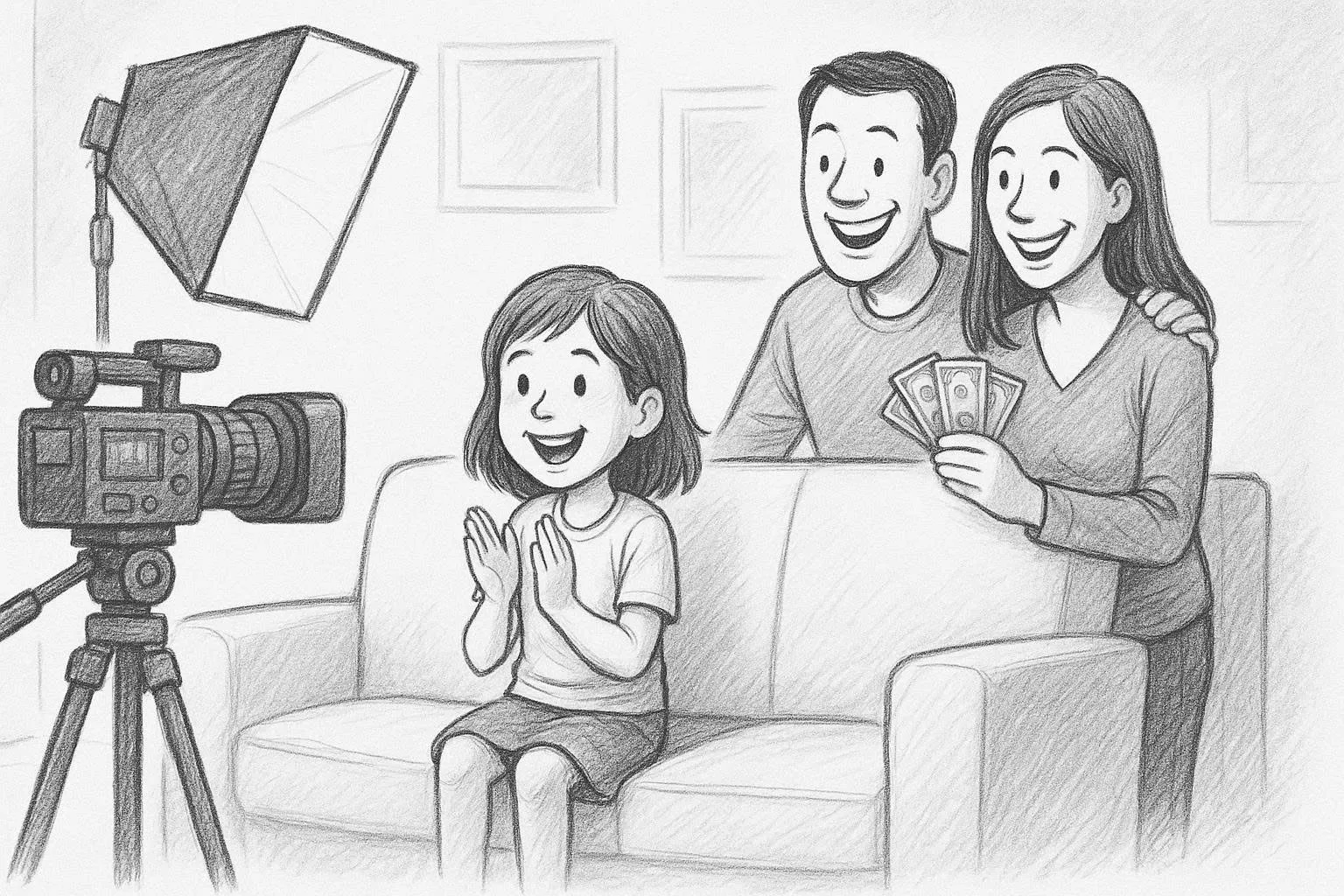
Children may smile in videos, enjoy new toys, or say sweet things when asked. Is that joy real or a learned behavior to please the camera? When the camera is always rolling, children are forced to act rather than simply exist. When every achievement becomes content and their privacy is auctioned off to the highest bidder, it's clear something is lost.
Even the most loving parent can harm if they fail to recognize their child’s right to say no. Affection, without awareness, easily turns into control. Care, without caution, risks crossing into exploitation.
The digital world only heightens this danger. With each post, a child’s image is shared and potentially stored forever. What starts as an innocent video of a toddler throwing a tantrum could become a meme. Parental pride can turn into digital regret.
Yes, the law may still be catching up. In many countries, including Vietnam, regulations on child labor in digital spaces are still vague. However, just because something isn’t illegal doesn’t mean it’s right. In the absence of strict legal boundaries, moral clarity becomes essential.
It is our collective responsibility to set the standard. If the law is slow to protect children from commercial overexposure, society must lead with empathy and ethics.
The camera doesn't just record; it reshapes. If we’re not careful, we risk raising a generation of children who see themselves as products rather than people.
That's why JustaTee's question, "Do you want to?", should become a mantra. Before recording, signing a contract, or putting a child in the spotlight, every parent should stop and ask themselves that question. Before recording, signing a contract, or putting a child in the spotlight, every parent should stop and ask themselves that question.
They should be prepared for a "no." They should be prepared to stop recording. They should be prepared to walk away. They should be prepared to protect their child's right to simply be a child.
Sometimes, the bravest and most loving thing you can do is let your child cry in private instead of making them smile in front of the camera.