Amended Capital Law - a boost for social housing development
The amended law allows for breakthrough mechanisms, preferential policies, and strong investment support for social housing projects.
The recent passage of the amended Capital Law, emphasizing decentralization and empowerment, is essential to establishing a clear and efficient legal framework. It makes it possible for Hanoi to prioritize housing development, including social housing initiatives.
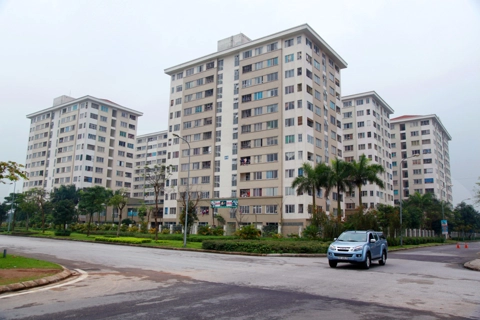
| A social housing project in Kim Chung Ward, Dong Anh District, Hanoi. Photo: Pham Hung/The Hanoi Times |
Lack of supply
The Government’s initiative to build at least one million social housing units in the period 2021-2023 identified Hanoi, along with Ho Chi Minh City, as the two focal points for implementation. Specifically, during this period, Hanoi aimed to complete 56,200 units (18,700 units from 2021-2025 and 37,500 units from 2026-2030).
According to a report from Hanoi's Department of Construction, during the 2021-2023 period, there were five fully completed social housing projects and two partially completed projects, with a total floor area of about 0.41 million square meters, equivalent to 5,200 units. There are currently 54 ongoing projects with about 3.1 million square meters of floor area, equivalent to 46,700 units.
"In 2024, Hanoi plans to complete around 10,000 social housing units in seven projects, including three ongoing projects expected to complete 78,000 square meters of floor space with 1,180 units, and four new development projects with 0.7 million square meters of floor space, approximately 9,000 units,” stated the report.
Thus, from 2021 to 2030, Hanoi has been and is implementing 63 investment projects in social housing, totaling about 61,900 units. Consequently, the city is largely meeting the targets set by the Government," noted a representative from Hanoi's Department of Construction.
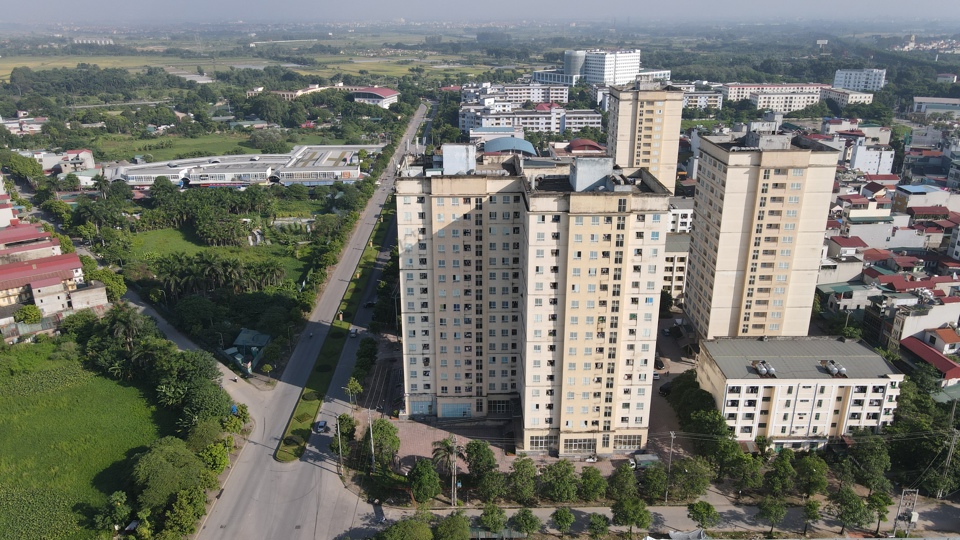
However, rapid urbanization has led to an increase in the mechanical movement of the population, causing housing issues in general and social housing in particular, putting significant pressure on the capital's authorities to address social housing needs for low-income earners and industrial workers.
As of now, there are about 170,000 workers employed in the city's industrial zones and export processing zones, 80% of whom come from outside the province and a majority of them have housing needs. However, only three industrial zones in Hanoi (Thach That, Thang Long, and Phu Nghia) have social housing projects for workers, providing 1,532 units (approximately 11,520 accommodations), meeting about 6.8% of the demand.
"The issue of social housing for low-income earners and industrial workers has become extremely urgent in the capital city. Over 80% of the workers in the industrial zones and export processing zones have to rent rooms in residential areas. Due to low-income levels, many people have to accept living in substandard, unsafe, and poorly serviced accommodations," said Ta Van Duong, head of the Legal Policy and Labor Relations Committee under the Hanoi Federation of Labor.
Promoting deregulation
The development of social housing has faced many difficulties and obstacles, including lengthy and complex investment procedures, as well as delays in the purchase and sale of real estate compared to commercial housing development. Pricing in advance of sales, rentals, and lease-purchase agreements for social housing projects financed by extra-budgetary funds by provincial authorities also adds time and costs for businesses.
In addition, policies have been put in place to incentivize developers of social housing and housing for industrial workers, but in practice, they are not attractive enough to encourage investors.
The situation has been exacerbated by delays in approving investment decisions and investor permits. The state also faces a shortage of initial capital to implement policies aimed at incentivizing social housing development.
Although they share the same difficulties in developing social housing, while Ho Chi Minh City has been granted a special mechanism by the National Assembly (through Resolution No. 54/2017/QH14) to fast-track the implementation of urban and housing development projects, the capital city of Hanoi has not. To create conditions and realize the development vision and aspirations of the capital in the coming time, recently, the National Assembly officially passed the revised Capital Law with 7 Chapters and 54 Articles.
Particularly, the law has devoted an article, Article 30, to regulate general housing development issues and social housing in particular. Especially, detailed provisions on decentralization, delegation to the People's Council and People's Committee of the city in adjusting the plan, and creating a land fund for social housing development.
Architect Tran Tuan Anh emphasizes the revised Capital Law's significant impact, which introduces breakthrough mechanisms, preferential policies, and strong investment support.
“It aims to enable the city government to adopt preferential mechanisms to attract resources, leverage strengths, and effectively address pressing challenges and longstanding issues,” Anh said.
Regarding housing, the city has decentralized the power to build detailed planning projects and allocate land for commercial and social housing. The resettlement and renovation of old apartment buildings is expected to accelerate housing projects. He expected this strategic approach to alleviate the current supply shortage and mitigate the ongoing rise in housing prices.
The recently approved amended Capital Law is widely anticipated not only by the political system but also by Hanoi’s people and the whole country, to help unleash the capital's resources, create a spiral effect, and lead the entire Capital Region and the country's development.
The revised Capital Law provides for strong decentralization, innovative management models, and increased autonomy and responsibility for the capital city's government in all aspects of economic and social life.
| "Although Hanoi has a cumulative land reserve of several hundred hectares, the allocation of such land for social housing is not easy, hindering Hanoi's intensified efforts to develop social housing projects. Now, the provisions on social housing in the revised Capital Law is a big step forward to create superior mechanisms to draw resources into social housing development in the future" - Vice President of the Real Estate Club of Hanoi Nguyen The Diep said. |