Hanoi saves land for social housing
Hanoi is expected to require capital of VND12.5 trillion (US$508 million) to develop social housing projects by 2025.
Hanoi will set aside more than 400 ha of land to develop social housing to meet the city’s target of building 1.25 million square meters (sq.m) of low-cost housing floor by 2025 and 2.5 million sq.m by 2030.
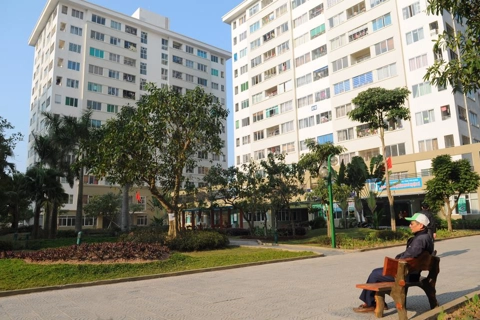
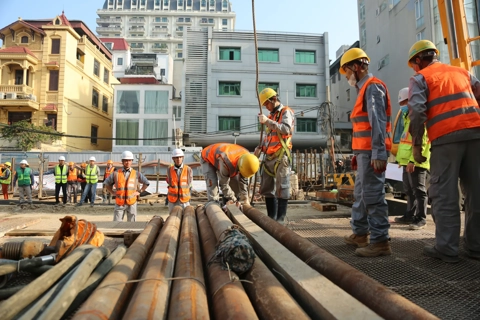
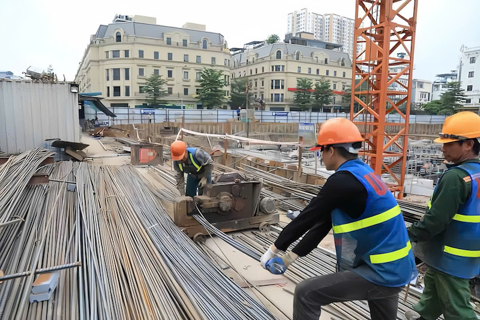
| A social housing project in Dang Xa Commune, Gia Lam District, Hanoi. Photo: Pham Hung/The Hanoi Times |
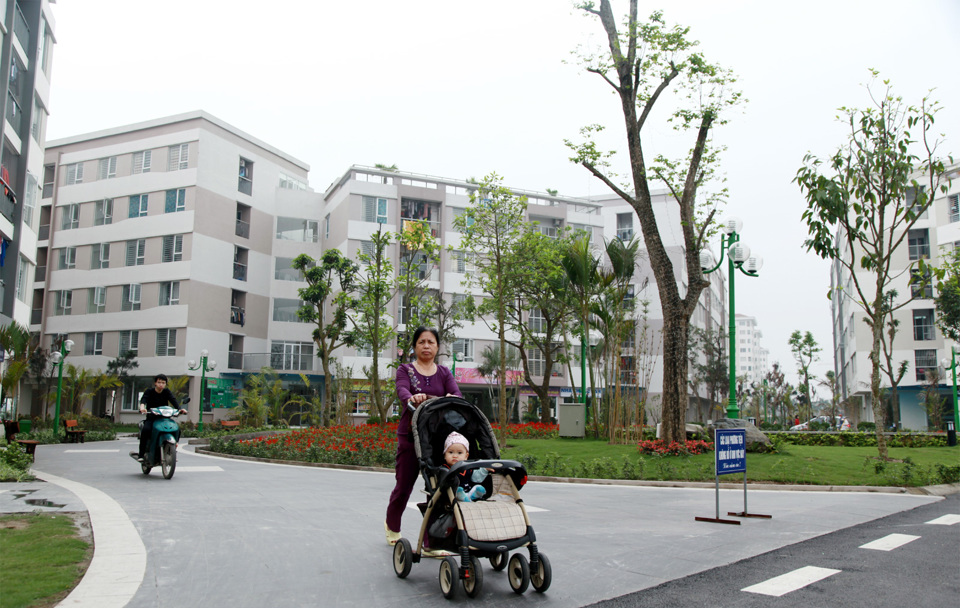
The news was provided by Director of the Hanoi Department of Construction Vo Nguyen Phong at a recent conference on the implementation of the government’s project on building at least one million social housing units for low-income earners and workers at industrial parks for the 2021-2030 period.
Accordingly, Hanoi has also planned to build five social housing areas on an area of 270 ha, providing approximately 15,000 units totaling more than one million sq.m of floor. As a result, four out of five projects have been approved in principle and sought investors.
The city, additionally, has asked district authorities to review the commercial house projects to find out those with 20-25% of land to be used for social housing.
Under the national project of building one million social housing units, Hanoi has so far completed five projects providing 5,200 apartments. In 2024-2025, it continues to finish an additional 17 projects having over 15,000 units.
Between 2026 and 2030, the city will remove barriers related to investment procedures, site clearance, and allocating investment capital.
The city needs an estimated amount of VND12.5 trillion (US$508 million) to develop social housing projects by 2025.
Long-term mission
Vietnam plans to build one million low-cost houses with the government’s support by 2030. The program aims to build worker housing and social housing at costs that are affordable for urban middle- and low-income earners, as well as for laborers in industrial parks and processing zones.
The government holds all economic sectors accountable for developing social housing. At the same time, it has policies to support low-income, impoverished, and social beneficiary housing in order to ensure social security, promote political stability, and develop both urban and rural areas.
The program, which costs an estimated amount of VND850 trillion (US$35 billion), includes two phases with the first set for 428,000 units by 2025 and 634,000 units by 2030.
To support investors and purchasers of social and worker housing, the government has mandated that the State Bank of Vietnam (SBV) execute a loan program worth VND120 trillion ($5.1 billion) and other credit packages. The loans will have interest rates that are 1.5-2% less than the average rates of medium- and long-term loans offered by state-owned commercial banks.
It is anticipated that by 2030, the nation will require 2.4 million units of social housing. In addition, half of the 2.7 million workers at industrial parks nationwide need low-cost housing.
According to the Ministry of Construction, 499 social housing projects providing 411,250 apartments have been developed, including 71 completed projects with 37,868 units available; 127 projects having 107,896 apartments have been kicked off construction; and 301 projects with 265,486 units have got approval in principle.
National target for 2024
Vietnam’s Prime Minister Pham Minh Chinh has asked relevant agencies to complete the construction of 130,000 social housing units this year as part of efforts to fulfill the socio-economic development mission.
To make the goal attainable, the Ministry of Construction and localities have closely worked to carry out the construction plans following the prime minister’s request.
The mission this year is part of the government’s program to build one million affordable housing apartments by 2030.
In the latest move, 27 cities and provinces have announced a list of 63 projects that are subject to the VND120-trillion stimulus package and need an amount of VND28 trillion ($1.13 billion)
Statistics by the Ministry of Construction showed that the area planned for social housing nationwide has reached 8,390 ha, including 1,063 ha in Dong Nai, 608 ha in Ho Chi Minh City, Long An 577 ha, Haiphong 471 ha, Hanoi 412 ha.
Six localities have attracted investment in this housing segment namely Bac Ninh with 15 projects providing 6,000 apartments; Bac Giang five projects having 12,475 units; Haiphong seven projects with 11,678 units; Binh Duong to supply 6,557 units; Dong Nai to have more than 9,000 apartments available; and Thanh Hoa with nearly 5,000 units.
In the latest government meeting held on February 22, Deputy Prime Minister Tran Hong Ha asked the Ministry of Construction to work with relevant ministries to tackle problems facing the development of social housing projects while enforcing regulations regarding the groups who are subject to buy and rent social houses, investment procedures, and access to preferential loans,
At the same time, the ministry needs to closely cooperate with functional agencies to build documents guiding the enforcement of Law on Doing Business on Real Estate; revised Law on Land, revised Law on Credit Institutions, and tax regulations to go well with revised Law on Housing.