Amended Capital Law expected to provide groundbreaking solutions for Hanoi rural areas
In the midst of rapid urbanization and modernization, sustainability is becoming a top priority for Hanoi's rural areas.
The draft amended Capital Law, now submitted to the National Assembly for review and approval, is expected to be a major boost for Hanoi's agriculture and rural areas.
| A grape farm in Phuc Tho district, Hanoi. Photo: The Hanoi Times |

Since the Capital Law came into effect in July 2013, Hanoi has seen a significant improvement in socio-economic conditions in all sectors.
In rural Hanoi, concrete roads are being built and widened, small towns and new industrial parks are being developed, and people's living standards are rising year by year.
According to the Hanoi Department of Agriculture and Rural Development, the value of agricultural production in the first nine months of 2023 increased by 2.5% year on year.
The question is how to ensure stable growth while making the agricultural sector sustainable in the long run. The amended Capital Law seems to be the answer.
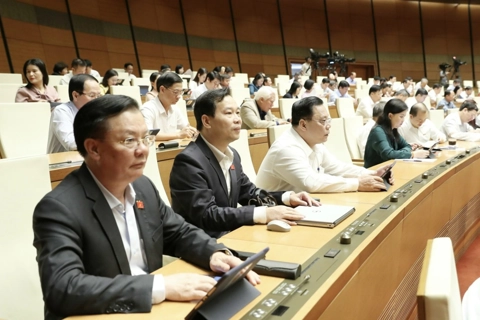
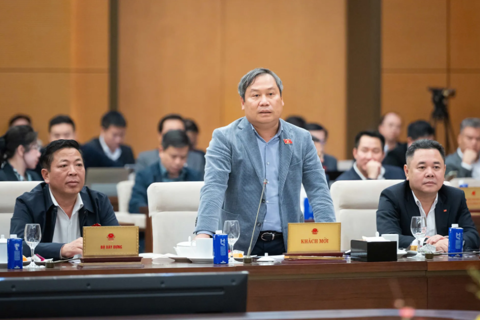
At a group discussion during the 6th session of the 15th National Assembly, Secretary of the Hanoi Party Committee Dinh Tien Dung spoke about the significance and importance of the agricultural sector to the economic structure of the capital.
He said rural areas undergo significant urbanization, and coordination between municipal and sub-municipal authorities is needed to make proper plans for rural areas.
"Hanoi must focus on sustainable agriculture and achieve a balance between the environment, society and economic development to better protect the environment and generate safe, high-quality products," he said at the group discussion on November 10.
The amended Capital Law should make it easier for Hanoi to preserve local cultures in rural areas amid rapidly changing socio-economic conditions, Dung said.
He noted that local authorities must strive to preserve the city's cultural values as Hanoi is home to more than 1,300 craft villages, most of which are in rural areas.
The city Party chief stressed that the amended Capital Law must enable the city to develop its tourism industry and attract more visitors to rural areas, thus increasing income for local people and the city budget.
"Preserving rural culture must be a high priority for the city, no matter how much the urban landscape improves," he said.
Deputy Nguyen Thi Lan of Hanoi said the capital needs breakthrough solutions to ensure sustainable growth in rural areas.
"The city should be able to become the supplier of high-quality, science-based breeds for neighboring provinces," Lan said. In the near future, the Hanoi authorities must take drastic measures to create breakthroughs in agriculture and inspire its neighboring provinces and cities to grow together, she advised.
| A Cuban delegation visits a high-tech farm in Hanoi's Me Linh district. Photo: The Hanoi Times |

According to a February 28 report by the Ministry of Justice on the impact of the amended Capital Law, the existing legal framework for Hanoi's agricultural sector is not enabling enough for innovation and new production methods, including the value chain model.
In addition, vague land management regulations are the main obstacle to the modern operation of high-tech, organic farms. This hinders the ability of producers to adopt the value chain model and causes the waste of land resources.
The 2012 Capital Law also lacks solutions to attract non-state resources into eco-friendly and high-tech agriculture, modernize and protect the rural environment, and help farmers master modern production methods and apply science and technology in their work.
Deputy Chairman of the Hanoi People's Committee Nguyen Manh Quyen said that Hanoi's agriculture needs financial, intellectual and technological support to build its value-added production chains.
"The draft amended Capital City Law if approved, will pave the way for Hanoi authorities to further perfect our rules for agricultural growth, with the expectation that the capital will become a model for other provinces and cities to follow," he said.
Dung, the city's Party secretary, said the capital needs a special policy to set its own cost and technical benchmarks for projects that meet the city's practical needs and socio-economic conditions.
Hanoi lawmakers will further refine the amended Capital Law after taking note of the results of the National Assembly debate, he said.
"It is important that the amended Capital Law gives Hanoi more power to fulfill tasks and achieve projected plans, as many policies and regulations are still half-baked and unrealistic," he said.