Bach Mai Hospital pioneers Vietnam’s first paperless smart hospital model
Founded in 1911, Bach Mai Hospital, the cradle of modern Vietnamese medicine, has led key specialties and gained regional acclaim for its advances in transplants and robotic surgery.
THE HANOI TIMES — Bach Mai Hospital, Vietnam’s first special-class general hospital, has officially launched a comprehensive paperless smart hospital management system and the “Bach Mai Care” application integrated with VneID.
It marks a milestone in the nation’s healthcare digital transformation journey.

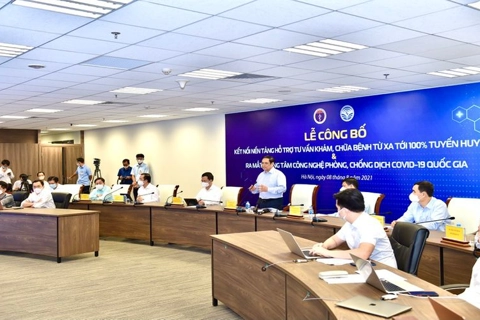
The launch of a comprehensive paperless smart hospital management system at Bach Mai on October 4. Photo courtesy of the hospital
Speaking at the launch ceremony last weekend, Associate Professor Dao Xuan Co, Director of Bach Mai Hospital, said that digitalization is a strategic breakthrough toward a modern, efficient and patient-centered healthcare system.
“The integration with VNeID provides a legally verified digital identity for every patient, ensuring secure, synchronized medical records and forming part of the national health data platform,” Co said, adding that transitioning from paper-based to electronic medical records helps the hospital save about VND100 billion (US$3.9 million) each year, while enabling smooth connectivity across the healthcare network.
The “Bach Mai Care” app allows patients to book appointments, access test results, manage medical records and consult doctors online. The hospital’s new AI-powered management system provides real-time alerts and big data analytics to assist clinicians in diagnosis and treatment decisions.
Bach Mai is also the first hospital nationwide to implement VNeID verification, ensuring maximum security and integration with Vietnam’s national digital ecosystem.
The shift to a paperless model means that all administrative, medical and financial processes, from patient registration to billing, are now fully digitalized.

Bach Mai Hospital takes the lead in advanced checkup and treatment technologies.
Brings specialized care to remote areas
As a leading national hospital, Bach Mai Hospital has taken the lead in advancing telemedicine (Telehealth) through the application of augmented reality (AR) technology to connect with medical facilities in remote and disadvantaged areas.
AR technology enables local doctors to “communicate directly” and “make joint ward rounds” with top professors and specialists at Bach Mai, creating real-time collaboration that bridges the physical gap between urban and rural healthcare systems.
This innovation addresses one of Vietnam’s biggest healthcare challenges, which is the shortage of specialized expertise in remote regions.
The technology was demonstrated at the Exhibition on National Achievements celebrating Vietnam’s 80th anniversary of National Day in Hanoi in early September.
Bach Mai Hospital showed the AR telehealth system at the Ministry of Health’s booth, linking live to a healthcare center in Mu Cang Chai District. Minister of Health Dao Hong Lan joined the virtual ward round, interacting with local doctors and patients as if she were on-site. Many medical staff, citizens and local leaders also experienced this new model of digital healthcare.
While traditional telemedicine is effective for routine consultations and follow-up care, Bach Mai’s AR-enhanced telehealth proves especially valuable for complex cases. It allows senior doctors to visualize patients’ conditions more precisely and provide accurate, real-time assessments.
The model also serves as an interactive training platform, helping transfer knowledge and medical techniques and narrowing the expertise gap across Vietnam’s healthcare system.
Comparable to advanced international initiatives such as Atrium Health’s “Hospital at Home” program in the United States, Bach Mai’s model opens new opportunities for comprehensive, technology-driven care that potentially reshapes Vietnam’s approach to modern healthcare delivery.
Moreover, AR technology offers transformative applications in medical education and training, including anatomy simulation, intensive care and surgical training.
By optimizing expert resources and providing immersive, high-quality learning experiences, AR-based training represents a forward-looking model of future medicine, reaffirming Bach Mai Hospital’s pioneering role in digital healthcare transformation.

Bach Mai's medical expertise has reached different parts of Vietnam and saved many lives.
A symbol of medical excellence
The leading role of Bach Mai has been praised by Prime Minister Pham Minh Chinh. In his visit to the hospital on the occasion of Vietnamese Doctors’ Day in February, he appreciated its transformation from a hospital once heavily affected by the Covid-19 pandemic into a pioneer of digital transformation and financial autonomy.
Chinh said Bach Mai is a source of national pride, a fortress of medicine in both war and peace. “I hope the hospital continues to innovate, promote advanced medical research, build a fully smart hospital and put patients at the center of all services.”
He also tasked the hospital with collaborating with the Ministry of Health to develop a National Smart Hospital Model, serving as a blueprint for replication across the country in line with the Politburo’s Resolution No. 57 on science, technology, innovation and national digital transformation.

The hospital experts have for years shouldered to provide the best treatment to patients across the country.
From a century-old legacy to the future of medicine
Founded in 1911, Bach Mai Hospital has long been regarded as the cradle of modern Vietnamese medicine, pioneering key specialties such as emergency care, neurosurgery, cardiology, oncology, diagnostic imaging and organ transplantation.
During wartime, the hospital stood as a resilient “white fortress” amid bombings. In peacetime, it became Vietnam’s largest national referral center, serving over 6,000 patients daily.
Its numerous breakthroughs in multi-organ transplants and robotic-assisted surgeries have placed Bach Mai on par with leading medical institutions in the region.
Today, the hospital’s long-term vision rests on six strategic pillars, namely multi-organ transplantation, robotic surgery, stem cell therapy, gene therapy, 3D printing and digital transformation, with digital innovation acting as the connective tissue of an intelligent healthcare ecosystem.
Minister of Health Dao Hong Lan recognized Bach Mai’s achievements, describing it as “a true frontrunner in healthcare digital transformation from electronic medical records to smart hospital governance and patient experience.”
She urged the hospital to continue developing a comprehensive smart hospital model, setting an example for other medical institutions nationwide.
With its guiding vision “Patients at the center, physicians as the core, technology as the driving force,” Bach Mai is shaping a next-generation healthcare ecosystem where data becomes insight, every citizen has a unified electronic health record and all medical operations are transparent, efficient and connected.