Belt and Road cooperation expected to support green economy
Green growth and the public healthcare system are highlighted at the conference.
Representatives of the Asia and Pacific stressed the need to shift focus on the green and inclusive economy in the region in the post-pandemic era at a high-level conference on belt and road cooperation, which was held online on June 23.
| Participants at the conference on June 23. Photos: Baoquocte |
.jpg)
The participants argued that the pandemic has increased the burden on communities and vulnerable groups in developing countries as they are facing the existing long-term impacts of climate change. These countries are now experiencing the risk of a multi-speed recovery across the region, because of the different levels of containment and management of the Covid-19 outbreak.
The focus on green recovery should be directed towards decarbonizing the regional economies in a certain timeline, ending fossil fuel subsidies, tackling air pollution, stepping up ambition in the Nationally Determined Contributions, and accelerating the energy transition.
Governments’ policies must be encouraged to step up efforts to manage marine resources sustainably, reducing single-use plastics waste, scaling up efforts to rely on a safe, secure and efficient international shipping industry, and providing comprehensive decision-making supported by integrated oceans data solutions.
According to Armida Salsiah Alisjahbana, incumbent Executive Secretary of the United Nations Economic and Social Commission for Asia and Pacific (ESCAP), governments can further mainstream finance and digitalization across their strategic policy formulations towards the achievement of the SDGs by prioritizing this green-blue approach to recovery.
The participants agreed that the regional states must take urgent actions to enhance policy coordination and coherence in ensuring equitable procurement and distribution of vaccines, promote partnerships for vaccine production, enable affordable therapeutics and medicines as well as expanding investment in strengthening the resilience of health care systems.
| Vietnam's Foreign Minister Bui Thanh Son at the conference. |
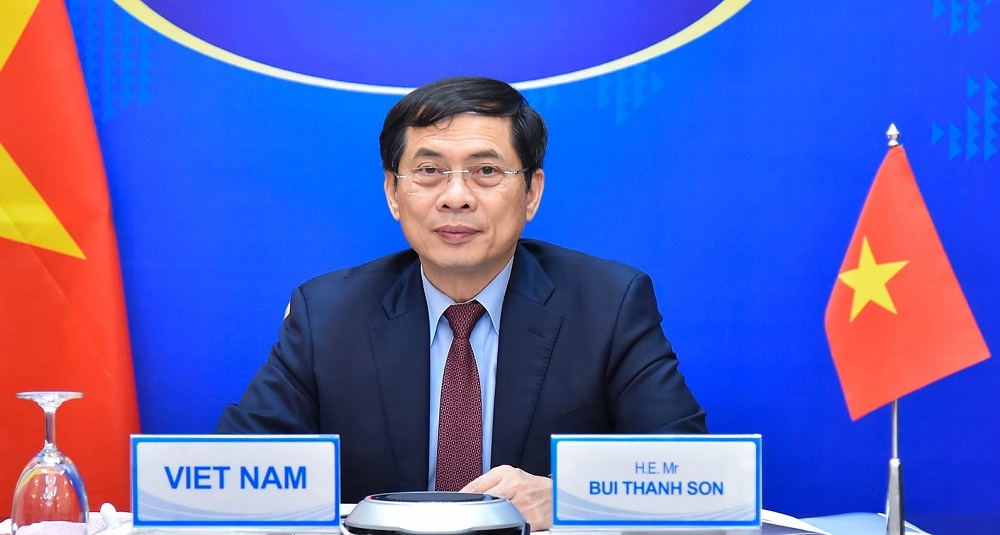
Stressing that regional cooperation is very important for the Asia-Pacific to recover and adapt to the rapid changes of the world economy, Vietnam’s Foreign Minister Bui Thanh Son raised three important issues that countries need to pay attention to.
The first is to strengthen multilateral cooperation in pandemic prevention, promote the transfer of vaccine production technology, and ensure that all countries can access vaccine supplies quickly, timely with reasonable prices.
Secondly, it’s better to promote regional cooperation frameworks and initiatives such as APEC, ASEAN, Belt and Road, facilitating market access for businesses and connecting transport and logistics in the region in line with the development of the digital economy.
The third is to enhance support for developing countries to implement the 2030 SDGs fully and timely, sharing experiences and transferring technologies to a green economy.
The Belt and Road Initiative (BRI) is a global infrastructure development strategy adopted by the Chinese Government in 2013, investing in nearly 70 low- and lower-middle-income countries. To date, up to 140 partner countries have signed documents on Belt and Road cooperation with China, according to the Chinese Ministry of Foreign Affairs.