Capital Law lays foundation for Hanoi’s infrastructure development
Capital Law 2024 introduces various special mechanisms and policies to increase the attractiveness of strategic investors.
The newly passed Capital Law 2024 introduces exceptional and distinctive policies for Hanoi, effectively addressing practical challenges and laying a crucial foundation for infrastructure development, especially in the city's transportation sector.
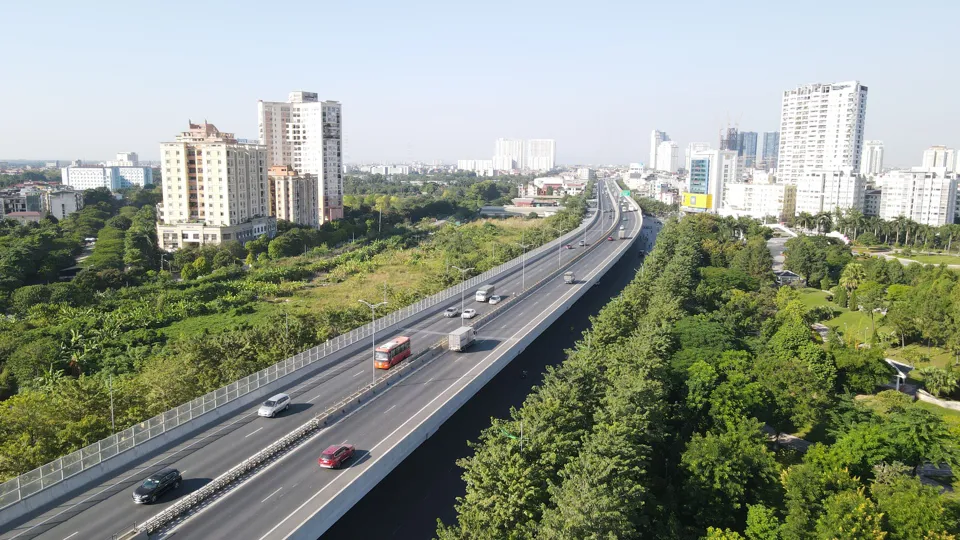
| A section of the Ring road No.3 in Hanoi. Photo: Hai Linh/The Hanoi Times |
One of Hanoi's biggest challenges over the years has been the insufficiency of investment capital for infrastructure development, including transportation infrastructure. To unlock resources, it is essential to establish a favorable and reliable legal framework to attract investors while enhancing state management efficiency. These practical requirements have been met thanks to the Capital Law 2024, scheduled to take effect in early 2025.
Specifically, the Capital Law 2024 allows Hanoi to enter into build-transfer (BT) agreements, which are contracts between an authorized agency and an investor to build infrastructure, with the latter receiving ownership of the finished project. The investor's investment can be repaid with state budget funds or land. This type of contract is not regulated in the current PPP law, creating obstacles to implementing new projects and ongoing ones in the city.
The law allows the Hanoi People's Council to approve investment policies for public investment projects and PPP projects with unlimited total investment capital. It also allows the adjustment of investment policies for public investment projects and PPP projects already approved by the National Assembly or the Prime Minister, provided there is no increase in investment capital from the central budget, ODA, or preferential foreign loans.
These provisions are expected to facilitate Hanoi's plans to develop urban railways and mass public transportation within and between regions and to attract strategic investors in the p production of locomotives, carriages, signaling and control systems for railways, and urban traffic control systems, which are priorities for the city.
The Capital Law 2024 introduces various special mechanisms and policies to increase the attractiveness for strategic investors, such as ten-year land and water surface lease exemptions and 50% reductions for the remaining lease period, customs and tax priorities for exported and imported goods related to investment projects by strategic investors.
Organizations and individuals investing in underground car parks and multi-story car parks are entitled to incentives, including exemptions from land and underground space rental fees for the duration of the project, full support for import taxes on equipment and technology used for these projects, and permission to use up to 25% of the project's total floor area for commercialization, as permitted by the Capital Law.
These policies play a crucial role in resolving difficulties, alleviating regulatory concerns for investors, and increasing the attractiveness of transportation infrastructure projects.
Promoting TOD-focused urban development
For the first time, Hanoi has a clear, codified concept of transit-oriented development (TOD). The Capital Law 2024 dedicates an entire article (Article 31) to outlining the basic content on implementation methods, authorities, and policies for this model, providing a significant legal basis for urban development linked to TOD. These are crucial prerequisites for integrating urban development with the TOD model.
Article 31 of the Capital Law 2024 specifies the implementation of the TOD model along with necessary policies, initially addressing existing issues by establishing a strategic framework for TOD, seeing it as a key solution for sustainable urban development.
The inclusion of TOD regulations in the Capital Law 2024 demonstrates Hanoi's commitment to implementing the Politburo’s Resolution No. 15-NQ/TW on the development of the capital city until 2045.
The city will review and adjust the urban railway network plan combined with the TOD model in station and depot areas, focusing on land acquisition feasibility and urban development. The full realization of underground space in station and depot areas within the historical inner city (within Ring Road 3) is crucial as this area has largely utilized above-ground space with high urban density.
The legal framework for the TOD model will be reviewed and completed in related laws such as Land, Planning, Investment, and Construction to ensure consistency. This includes prioritizing land use connected with public transportation through planning and management tools. Land acquisition for TOD development or capturing land value for sale post-development, and setting construction criteria for station locations, will be clearly defined.
The Capital Law also outlines specific mechanisms and policies to encourage investors to participate in TOD projects, emphasizing balanced benefits and risk-sharing with investors. The city will explore and invest in TOD development along urban railway lines through PPP with three components: (i) State investment in transportation infrastructure (tunnels, elevated roads, railways); (ii) Private investment in locomotives, carriages, and operational systems, with cost recovery through passenger ticket sales based on auction prices within state-regulated price ranges; (iii) Real estate investors developing station buildings and surrounding high-density urban areas, selected through land auction for modern, multifunctional urban development.
Planning along the 14 proposed urban railway lines includes around 91 TOD points or areas covering approximately 6,072 hectares of land. The Capital Law 2024 and the two Hanoi planning projects approved by the National Assembly during the 7th Session will provide a legal foundation and favorable conditions for Hanoi to develop on par with the region and the world, reaffirming its role as the heart of the nation.