Capital Law revision removes roadblocks to Hanoi’s development: Parliament chairman
The law enables Hanoi to mobilize, manage and utilize resources efficiently.
The amendment of the Capital Law will provide Hanoi with a solution to a range of pressing issues, including the relocation of office buildings and old apartments and tackling environmental pollution, which has been a cause of concern for the city.
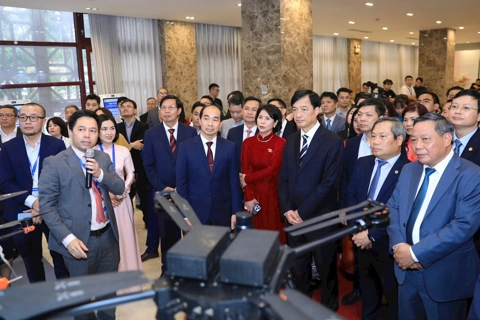
| Chairman of the National Assembly Vuong Dinh Hue at the meeting. Photos: Thanh Hai/The Hanoi Times |

Chairman of the National Assembly Vuong Dinh Hue made the remarks at a meeting with Hanoi's leaders on July 25.
Hue stressed that the revised law, which will be submitted for review at the 6th National Assembly session in October, is of great importance to the long-term development of the capital. It serves as an important tool for Hanoi to mobilize, manage and utilize resources efficiently. It also facilitates the establishment of a government suitable for a specific urban area.
"This law provides a legal basis to address various existing challenges and bottlenecks, such as developing infrastructure mechanisms and policies, tackling environmental pollution, relocating medical and educational institutions from the city center, revitalizing and reconstructing old residential blocks, and resolving pending projects," he noted.
| Secretary of the Hanoi Party Committee Dinh Tien Dung. |
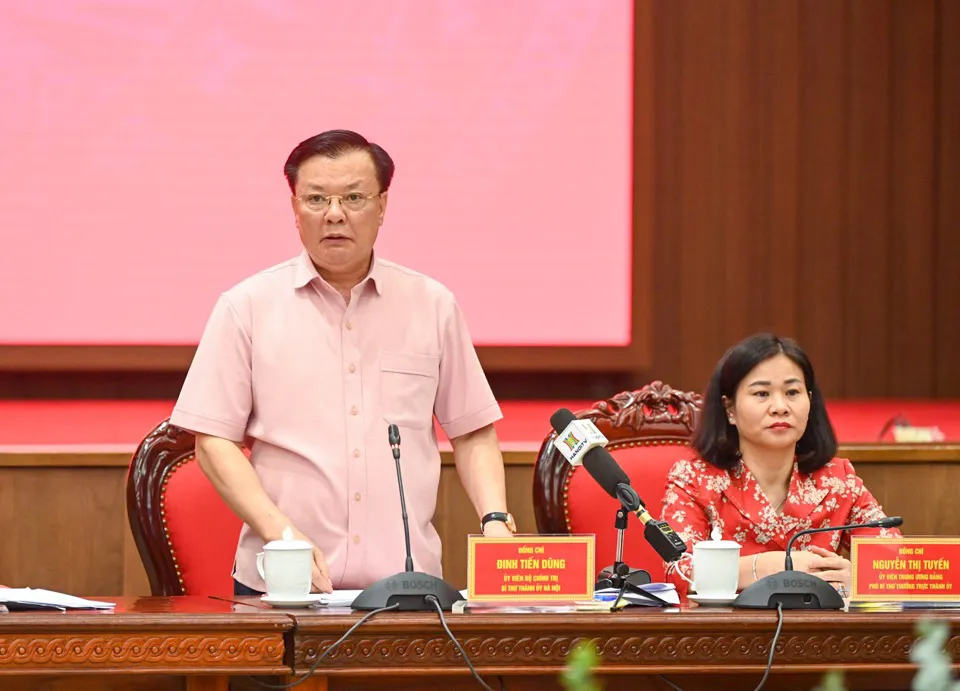
Dinh Tien Dung, Secretary of the Hanoi Party Committee, praised the positive results achieved so far in the city's socio-economic development, which reflects the effectiveness of the National Assembly's resolution to pilot the city management model and specific financial and budgetary policies.
Among those, Resolution No.15 issued on May 29, 2008, of the National Assembly regarding the adjustment of administrative boundaries of Hanoi and surrounding provinces/cities played a vital point in the city's development process.
However, in order to further improve the city's institutions and overcome obstacles hindering its development, Dung called for support from the government and the National Assembly and close coordination with the Hanoi People's Committee in formulating the revised Capital Law.
He also expressed hope for support from relevant agencies in the expeditious issuance of the adjusted master plan for the construction of Hanoi by 2030 with a vision to 2050, along with the Planning of Hanoi Capital from 2021 to 2030 with a vision to 2050.
Dung stressed the timely implementation of Ring Road No.4 in the Capital region and the adherence to the set schedule.
The Capital Law, which was passed by the National Assembly in late 2012, was intended to have a transformative effect and provide a solid institutional foundation for Hanoi's development.
However, after more than a decade of implementation, the law has shown several limitations, with relatively low effectiveness and efficiency.
Critics argue that the law is principled and provides a general direction, but it lacks specific regulations to address long-standing problems (traffic congestion, drainage, sewage treatment, old housing, relocation of polluting facilities, hospitals, and university institutions from the central area) as well as new challenges that have emerged in various sectors of the capital's management and development.
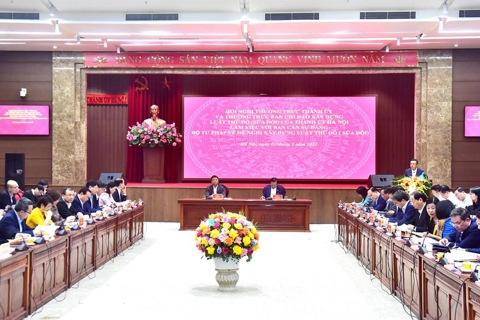
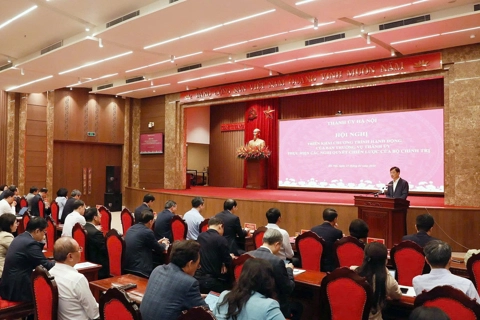
| Overview of the meeting. |
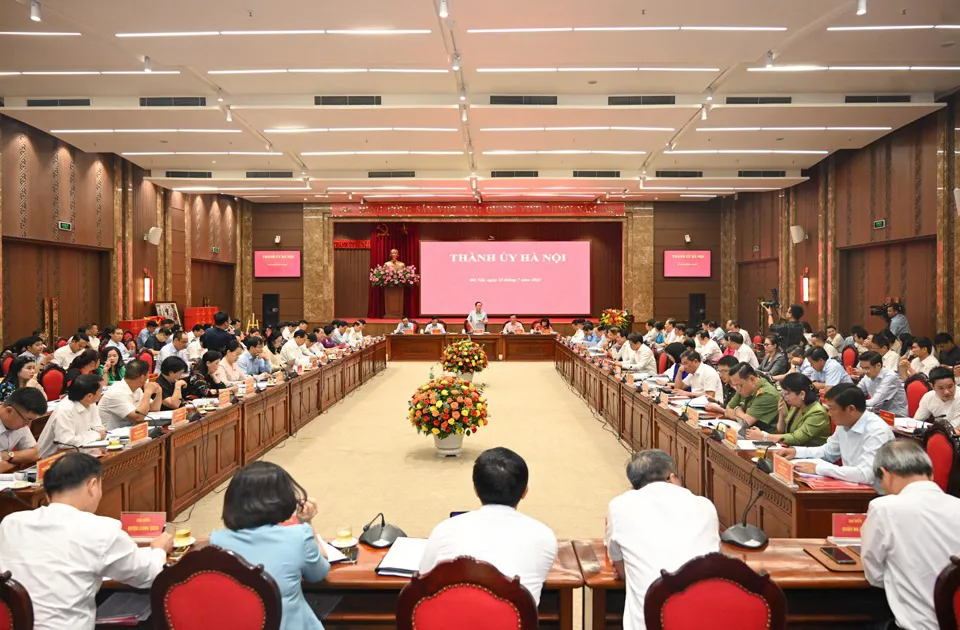
To address these shortcomings, the Ministry of Justice has proposed several major policy groups during the revision process to overcome bottlenecks in the capital's development. These policy groups cover areas such as streamlining and improving the efficiency of Hanoi's government organization, attracting and utilizing high-quality human resources, improving financial capacity and budget management, effectively mobilizing resources, urban development, and infrastructure improvement, and establishing a modern healthcare system along with comprehensive social security measures.
The Hanoi People's Committee has also made specific policy proposals, including the creation of specialized agencies at the city level, such as the Department of Food Safety and the Management Board of the Hi-Tech Park, as well as a dedicated construction order management team.
There is also a proposal to increase the number of deputies and full-time deputies in the city council from 95 to 125. Hanoi also recommended that the city be given the authority to decide on the staffing of cadres and civil servants, including the number of civil servants in public non-business units.
Hanoi has also submitted requests to assume certain investment powers currently held by the National Assembly, the Government, and the Prime Minister. Under these proposals, Hanoi seeks the authority to make investment policy decisions for projects with total investment capital of VND10 trillion (US$422 million) or more, which currently fall under the jurisdiction of the National Assembly.
In addition, the city aims to assume the authority to make investment policy decisions on projects funded by the central budget, official development assistance (ODA) capital, and foreign concessional loans, which currently fall under the Prime Minister's jurisdiction.
Hanoi also proposes that the Prime Minister be granted the authority to approve investment policies for private investment projects and projects related to betting and casino businesses; to handle investment projects related to the construction of residential houses and urban areas covering an area of 300 hectares or more, or projects with a population of 50,000 people or more.