

Revision of Capital Law a key priority for Hanoi's long-term development
Upon completion, the revised capital law would provide groundbreaking mechanisms and policies to facilitate Hanoi's rapid and robust development.
Amending the Capital Law remains a critical task for Hanoi to ensure its long-term and sustainable development.
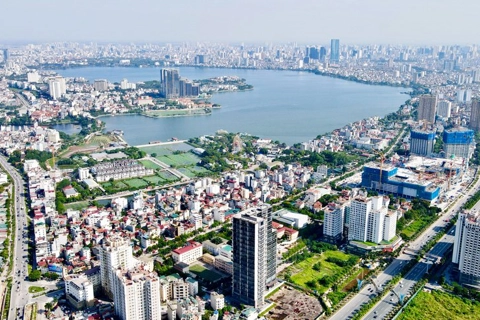
| Hanoi from above. Photo: Pham Hung/The Hanoi Times |

The Hanoi People's Committee reiterated this view in its latest report on the progress of drafting the revised Capital Law.
The National Assembly approved the Capital Law on November 21, 2012, which came into effect on July 1, 2013. This important legal document outlines the status, roles, responsibilities and policies for the construction, development and protection of the capital.
After nearly 10 years of implementation, the specific mechanisms outlined in the Capital Law have brought positive results to Hanoi's development process. However, it has also revealed shortcomings and limitations that require amendments and additions to meet the demands of the current situation.
Recognizing the importance of amending the Capital Law, the Hanoi People's Committee has identified it as a key task and breakthrough for the 2020-2025 term, as stated in the resolution of the 17th Party Congress of the Hanoi Municipal Party Committee.
So far, the Municipal People's Committee has successfully prepared the revised version of the Capital Law, which includes nine major policy groups. These policies aim to establish an efficient, modern, and professional administration in Hanoi, attract and utilize high-quality human resources, and facilitate urban development, including technical and transportation infrastructure.
At a meeting held in February 2023, the Government expressed its strong approval and agreed on the need to enact the proposed legislation.
The Government recognized the importance of implementing specific and groundbreaking mechanisms and policies to promote the rapid and robust development of Hanoi, in line with the unique requirements and responsibilities of the capital.
In order to ensure the timely submission of the amended Capital Law project to the National Assembly at the upcoming 6th session in October 2023 for consideration and approval at the 7th session in May 2024, the Municipal People's Committee has been working with National Assembly agencies to collect feedback on the draft law.
In addition, the Municipal People's Committee is making efforts to raise public awareness and disseminate information about the revised Capital Law.
Local authorities are encouraged to participate in the law drafting process and contribute their suggestions to refine the amended Capital Law project.
The Municipality is also working with the Ministry of Justice to establish a drafting team for the amended Capital Law. This team is responsible for translating approved policies into institutionalized provisions, with the aim of promptly preparing the necessary documents to support the work of the Drafting Committee and the Law Project Editing Team.
Hanoi has outlined nine key policy directions for the revised Capital Law to speed up the city's sustainable development. These directions cover various areas, such as restructuring the local administration to improve efficiency, modernization and professionalism. Another priority is to attract skilled professionals to support Hanoi's progress, while strengthening the city's financial and budgetary capacity for development purposes. The proposals also focus on improving urban infrastructure, technological advancement, and transportation systems. In addition, there is an emphasis on promoting modern agriculture, fostering rural development with educated and responsible farmers, and enhancing cultural and educational efforts. Unleashing the potential of science, technology and innovation is another key aspect of the policy directions. In addition, the proposals advocate the establishment of a modern health care system and the development of a comprehensive and inclusive social welfare system. At the same time, efforts will be made to improve connectivity within the Hanoi Capital Zone, with the ultimate goal of transforming it into a prominent economic hub in Vietnam. The envisioned economic hub aims to have a dynamic, environmentally friendly, and rapidly growing economy. |

![[Infographic] Hanoi proposes policies for Capital Law amendments](https://cdn-media.hanoitimes.vn/2022/11/08/hanoi1.jpeg?w=480&h=320&q=100)







