Revising the Capital Law: further step for Hanoi to harness untapped potential
Refining the Law is essential for Hanoi to remain the engine of the Capital Zone, the Red River Delta, and realize its potential for sustainable and rapid development.
An effective Capital Law is a prerequisite for Hanoi to create legal breakthroughs and realize its untapped potential.
| Overview of the meeting. Photos: The Hanoi Times |
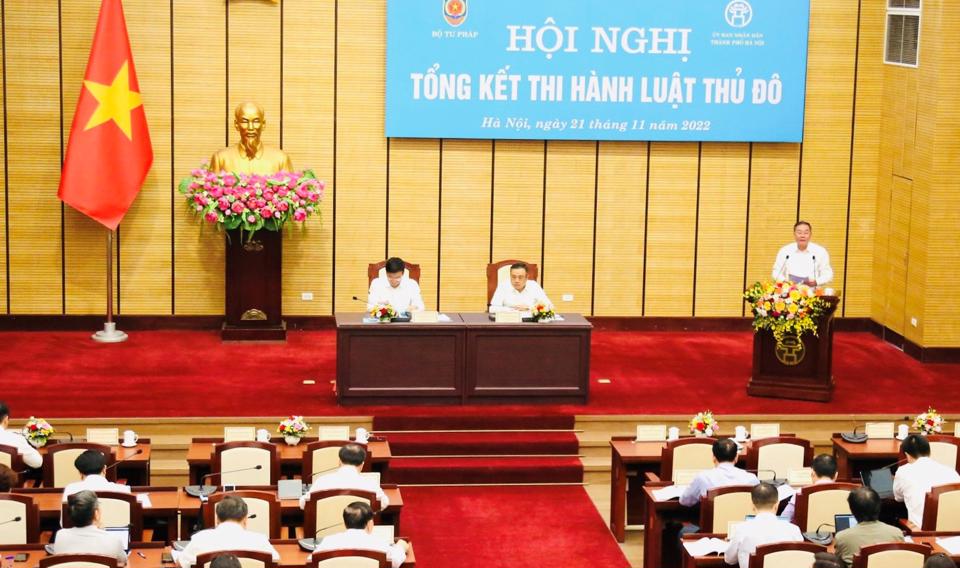
Experts shared this view during a conference held jointly by the Ministry of Justice and the Hanoi People's Committee on November 21, which discussed the implementation of the Capital Law over the past nine years.
Director of the Ministry of Justice's General Affairs Department of Legislation Nguyen Hong Tuyen said the Capital Law, since its introduction in 2012, has endowed Hanoi with a unique mechanism for development and reflects the capital's status as the country's political-administrative, economic, cultural and educational center.
“In particular, the Capital Law has created a basis for Hanoi to ensure consistency in construction and urban development under the overall planning until 2030, with a vision to 2050,” Tuyen said.
Over the years, the city’s transport and technical infrastructure have seen a big transformation, along with considerable investments in developing modern and large urban residential areas.
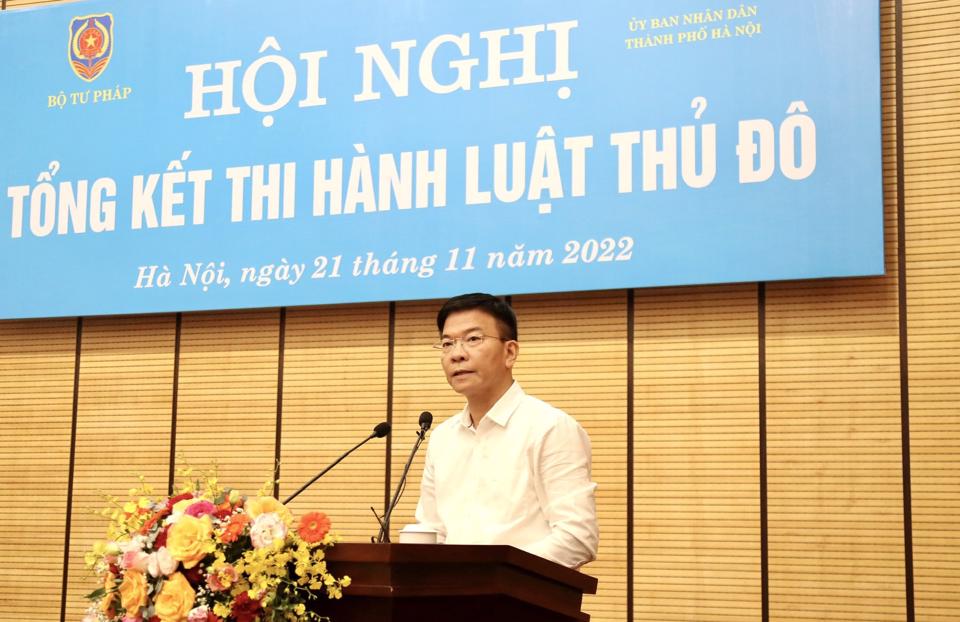
| Minister of Justice Le Thanh Long. |
Besides urbanization, Hanoi has also focused on rural development; preserving and promoting cultural-historical heritage; raising people’s living standards; improving efficiency in training – education, and staying atop the nation in terms of the number of educational institutions with quality.
Tuyen also highlighted the flexibility of the Capital Law that allows Hanoi to increase budget revenue while simultaneously improving the business investment environment.
“The size of Hanoi’s economy has been increasing. The city serves as a national hub regarding the economy and international transactions. Hanoi continues to play a key role in the development of the Red River Delta and the country overall,” Tuyen said.
Tuyen, however, pointed out shortcomings in implementing the Capital Law and stressed that the current economic development pace has not fully reflected the city’s potential and advantages.
“Hanoi has not tapped into its potential in capital access, science-technology, and high-quality workforce,” he said.
Regarding the ongoing revision of the Capital Law, Vice Chairman of the Hanoi People’s Committee Le Hong Son said the city has proposed nine major orientations for drafting the revised law.
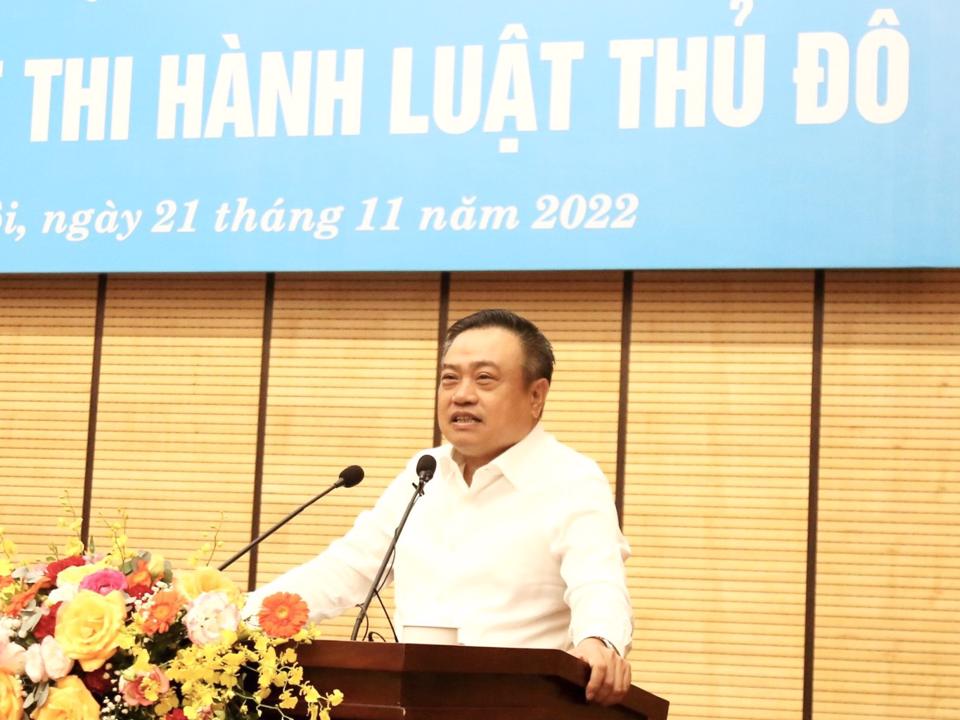
| Chairman of the Hanoi People's Committee Tran Sy Thanh. |
“The law's main objective is to ensure greater administrative decentralization, along with extraordinary mechanisms for Hanoi during its next development process,” Son said.
He expects close collaboration between Hanoi and government agencies in revising the law so that it is submitted to the government and the National Assembly for approval as scheduled.
Sharing Son's view, Minister of Justice Le Thanh Long said the Capital Law had been key to Hanoi's development in recent years, facilitating the city to achieve strong results in socio-economic development, maintaining social welfare and social-political order.
Long stressed the necessity for Hanoi to continue working with the Ministry of Justice and other agencies to ensure an effective and quality revision of the Capital Law, meeting the city’s requirements for development under the Politburo’s resolution No.15 on visions for Hanoi until 2030, with a vision to 2045.
On behalf of the local authorities, Chairman of the Hanoi People’s Committee Tran Sy Thanh expressed his appreciation for the support of Government agencies for Hanoi during the law-revising process.
“The completion of the Law is essential for Hanoi to remain the driving force for the Capital Zone, the Red River Delta, and realize its potential for sustainable and rapid development,” Thanh stressed.
Hanoi proposed nine major policy orientations for revised Capital Law, including the first on streamlining local apparatus toward greater efficiency, modernization, and professionalism; the second on attracting a high-quality workforce for Hanoi’s development. The third one is to enhance Hanoi’s finance-budget capabilities for development. The next ones include developing urban, technical, and transport infrastructure; promoting modern agroecosystem, rural areas, and civilized farmers; developing culture and education; realizing science, technology, and innovation potential. In addition, the suggestions also cover developing a modern healthcare system and a comprehensive and inclusive social welfare system while promoting linkage within the Hanoi Capital Zone to make it one of Vietnam’s major economic hubs with a rapid, dynamic, and green economy. |