Citizen engagement makes Covid-19 fight successful in Vietnam: PAPI
Improving governance will prove extremely useful in managing other unexpected emergency situations in Vietnam, said Australia’s Ambassador to Vietnam Robyn Mudie.
Citizen engagement and anti-corruption efforts have a positive correlation with Vietnam’s ability to respond to the Covid-19 pandemic.
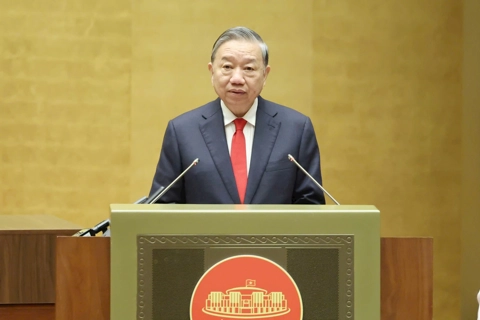
| UNDP Resident Representative in Vietnam Caitlin Wiesen at the launch |

UNDP Resident Representative in Vietnam Caitlin Wiesen made the comment at the launch of the 2020 Provincial Governance and Public Administration Performance Index (PAPI) report today [April 14], assessing citizen experiences with national and local government performance in governance, public administration, and public service delivery.
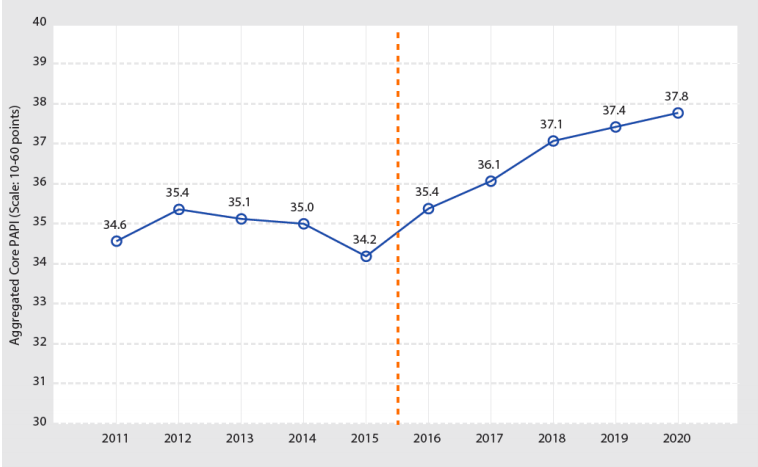
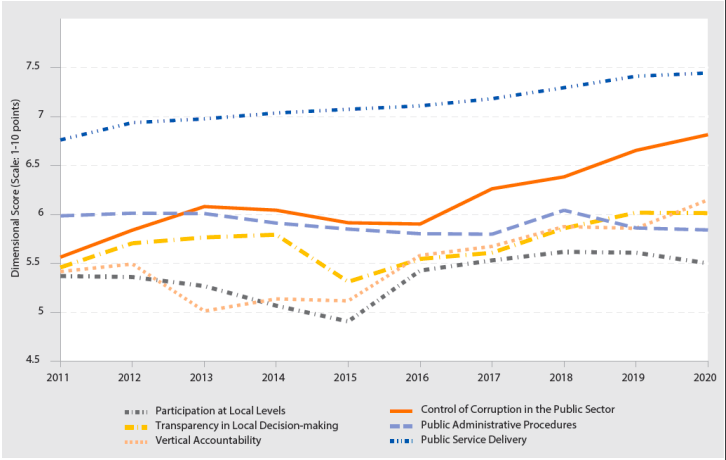
Wiesen referred to the incremental improvement in national governance and public administration performance from an average score of 35.4 in 2016 to 37.8 in 2020, with Control of Corruption in the Public Sector showing the strongest improvement.
| Steady improvement of PAPI scores in the 2016-2020 period. |
“Bribes seemed to reduce for state employment, public health-care services, land use rights certificates, fair treatment by primary school teachers and construction permits,” said Dr. Paul Schuler, professor of Political Science at University of Arizona, on this subject.
Schuler, however, warned more citizens saw incidents of diversion of state funds for own use by public officials in 2020.
| Control of Corruption in the Public Sector shows strongest improvement. |
Robyn Mudie, Australia’s Ambassador to Vietnam, also suggested good governance matters, referring to a correlation between good governance and effective pandemic responses.
“Looking ahead, improving governance will prove extremely useful in managing other unexpected emergency situations in Vietnam,” said Mudie.
| Australia’s Ambassador to Vietnam Robyn Mudie. |

According to the report, the dimension on Vertical Accountability Towards Citizens also steadily improved during the 2016-2021 term, mainly because an increasing number of citizens have contacted local officials, in particular village heads and People’s Council delegates. Dimensions that show declines include Participation at Local Levels and Public Administrative Procedures.
Looking ahead to the 2021 National Assembly and People’s Council elections, the 2020 PAPI Report includes a section analyzing voter’s preferences of candidates at national and provincial level. The findings indicate that voters prefer men over women candidates, particularly for village head positions. In addition, while voters prefer men candidates with families, women candidates are less likely to win support if they have families.
The report also demonstrates that women have different areas of concern from men, with women far more concerned about poverty reduction, health care and education than men. In addition, women are less engaged in local decision-making and have less access to the Internet and e-government services. These differences highlight the need for equitable representation in elected bodies.
Equal treatment needed to support internal migrants
Over 14,700 citizens were interviewed for the 2020 PAPI Report. This is the largest number of samples since the survey was first conducted nationwide in 2011.
For the first time, the survey also gathered responses from citizens with temporary residence registration status. Nearly 300 migrants were surveyed in six centrally governed municipalities and provinces (Hanoi, Ho Chi Minh City, Bac Ninh, Danang, Dong Nai and Binh Duong).
Responses by non-permanent residents provided a better understanding of the effect of internal migration on provincial performance in governance and public administration. The analysis shows that migrants tend to be poorer and have fewer household assets and less income than permanent residents and they tend to be women. Correspondingly, there is a significant gap in migrants’ experience with governance compared to permanent residents in the same village. This data is critical for the design of inclusive governance solutions which aimed not to leave the migrant population behind.
“In order to narrow these gaps, provinces receiving internal migrants need to focus on addressing the information needs and expectations of both permanent and non-permanent residents. The current efforts to create national database systems on population and issue digitized citizen identification cards are steps in the right direction. Having a universal identification number will enable citizens to access governance and public services equally regardless of their place of residence within the country,” Caitlin Wiesen said.
| Similar to previous years, the 2020 PAPI Report presents detailed findings on how provinces performed across the eight PAPI dimensions (Participation at Local Levels, Transparency in Local Decision-making, Vertical Accountability, Control of Corruption in the Public Sector, Public Administrative Procedures, Public Service Delivery, Environmental Governance, and E-Government), as well as in the aggregate PAPI scores. In 2020, none of the 63 provinces were in the top performing group across all eight dimensions. |