Comprehensive strategy for urban railways to form backbone of Hanoi mass transit network
Passenger traffic of public transportation makes up only 17% of the total volume of passenger transport in Hanoi, which should be doubled in the coming time to keep up with the city’s rapid urbanization rate.
Comprehensive strategy and large-scale investments are required to turn urban railways into the backbone of Hanoi’s transport network.
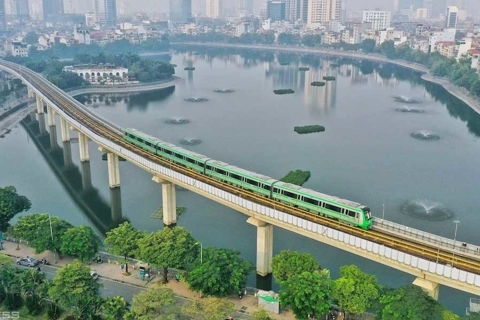
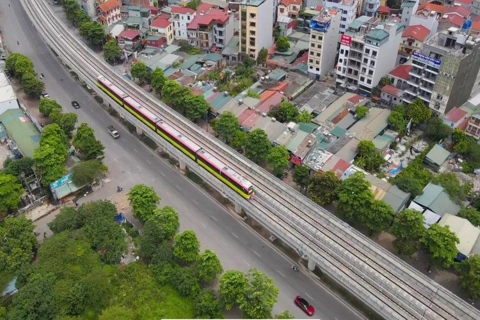
| Hanoi's first urban railway route of Cat Linh – Ha Dong. Photo: Duy Linh |
.jpeg)
Under Hanoi’s transport master plan until 2030, the city would have at least 10 mass rapid transit lines to form a complete network of the public transportation system.
However, lessons from the first urban railway route of Cat Linh – Ha Dong that was put into operation only some weeks ago after nearly 10 years of construction showed such a vision would be challenging without a consistent plan, strong determination, and flexible legal framework.
International experiences suggested every urban city with a population of at least two million would need an urban railway to address traffic congestion, or in the case of Japan, cities of one million people or above would have a mass rapid transit (MRT) network.
Vice-Chairman of the Hanoi People’s Committee Duong Duc Tuan said the passenger traffic of public transportation to total passenger volume in Hanoi remains only at 17%, which should double in the coming time to keep up with the city’s rapid urbanization rate.
In this regard, additional urban railway lines could be the solution. These large-scale projects, however, would pose huge challenges for the local authorities, ranging from a legal perspective, lack of capital, difficulties in site clearance, and high-quality human resources.
Le Trung Hieu, vice director of the Metropolitan Railway Management Board (MRB) noted Hanoi in particular, and Vietnam, in general, is lacking suitable legislation for these kinds of projects.
“The use of ODA funding for urban railway projects means Vietnam is bound for contract commitments, including the selection of contractors,” Hieu told The Hanoi Times.
“There have been cases of disputes that are not regulated in local laws, which takes time to settle and severely affect the progress of projects,” Hieu said.
In this regard, Vice Chairman Tuan referred to the ongoing urban railway project No.3, section Nhon – Hanoi station that is being delayed due to the lack of legal solutions to address site clearance issues.
“Dozens of households are subject to relocation as they are within the safe corridor of the urban railway route. However, the 2013 Land Law does not have specific procedures for land compulsory acquisition in this case,” Tuan told The Hanoi Times.
Meanwhile, transport expert Vu Hoang Chung identified the most challenging issue for urban railway projects is the lack of investment capital and human resources, with the latter affecting the construction and subsequent project management.
“The nature of borrowing funds would result in the dependence on the lenders, from contractor selection to technologies and other issues. On the other hand, the lack of a quality workforce means mistakes are unavoidable and that could significantly impact the success of the projects,” Chung told The Hanoi Times.
Hieu from the MRB said to speed up the construction of urban railway projects, Hanoi should take thorough preparation in four key areas of planning, site clearance, funding, and human resources.
According to Hieu, the master plan for Hanoi’s transportation has been drafted years ago, which needs modification to reflect the actual situations.
“Such process, however, would take time and involve different Government agencies,” Hieu said.
Hanoi’s Vice Chairman Tuan expected a diversification in funding sources for urban railway projects, including the state budget, ODA, and social resources.
“The city is set to allocate state budget to finance the upcoming urban railway route No.5, section West Lake – Hoa Lac with a length of nearly 30 kilometers,” Tuan said, expecting a better control in terms of technology and investment procedures could ensure smooth implementation of the project.
Expert Chung added the local authorities should take drastic efforts in tackling issues related to site clearance, which has been the most common hindrance for infrastructure projects in Hanoi.
“For large scale and complicated projects such as urban railway, site clearance should be one step ahead and needs the involvement of the entire political system. The ideal scenario would be to hand over cleared sites for contractors to avoid any delay,” Chung noted.
He suggested the Government should soon provide a specific mechanism for site clearance in urban railway projects while stressing the necessity to tighten disciplines in urban management.