Cultural values key to shaping identity of Hanoi’s urban architecture
Hanoi - a city that embodies the essence of the nation’s rich culture - requires greater rigor in creating a modern, civilized urban landscape that reflects the “spirit of the thousand-year-old mountains and rivers.”
Experts suggested that architecture should inherit the values and identity of the nation while also integrating global excellence to create a unique style for Vietnamese architecture.
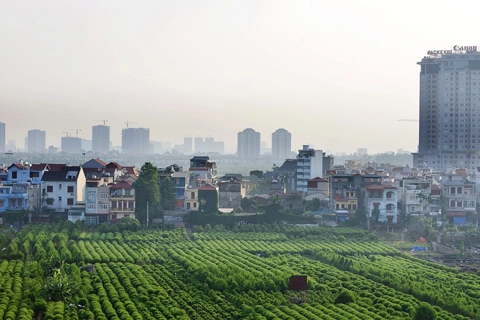
| Linh Dam urban residential zone. Photo: Nhat Quang |

Throughout its long history, Hanoi has been a “melting pot” of various architectural styles.
However, in the current context of integration, the unbridled and unplanned adoption of numerous design trends—especially the “nostalgic” and “neo-classical” movements—has led to a chaotic urban landscape in Hanoi, resulting in many structures that are “visually appealing but devoid of aesthetics.”
In Hanoi, it is not difficult to find majestic “castles” adorned with intricate patterns and designs, some even gilded, along with many new buildings mimicking foreign architecture. Yet, the striking and distinctive look that captivates public curiosity only leaves a transient impact. Many have wondered whether these structures are truly beautiful and in harmony with their surroundings or if they clash with contemporary life by embodying “echoes of the past” while fulfilling modern functions.
According to Dr. Nguyen Tri Thanh, Deputy Head of the Department of Architecture at Hanoi Architectural University, many people see French architecture as a paradigm of beauty.“Indeed, it is appealing because it is classical architecture, refined over thousands of years, dating back to ancient Greece and Rome, and has become a standard today. However, it must be executed with the right proportions rather than distorted and claimed as beautiful. Many people misunderstand this and adapt or modify it, which ruins the original aesthetic value,” he said.
Experts in architecture argue that mimicry is part of architectural creativity; however, it should be applied judiciously rather than excessively. Additionally, the introduction of French architecture into Vietnam in the early 20th century incorporated the traditional Vietnamese experience to create buildings suited to the local climate and environment rather than simply transplanting their architectural style to the colonies.
In the past, government buildings frequently featured classical or neo-classical architecture with harmonious aesthetics, standardization, proportions, and materials. However, during construction, simpler designs began to emerge, a trend that spread to residential buildings.
| The house named "Bac Hong," located in Dong Anh, Hanoi, is a project that won the Gold Medal at the National Architecture Awards in 2018. |

Especially since the onset of renewal in 1986, as the economy improved and the standard of living rose, opting for classic architectural styles seemed to become a preference. Initially, it involved minor details such as columns, roofs, arches, and cornices to create a classic appearance. This trend then gained momentum and spread to rural areas, where many homes are likened to “castles,” featuring abundant classical details, intricate patterns, and depictions of deities that seem quite alien to Vietnamese culture. Many families believe that the more decorative elements a building has, the greater its prestige and the homeowner’s status.
Recently, not only public buildings and residences but also entertainment venues, tourist spots, and new urban areas in Hanoi seem to be replicating architectural elements from abroad. However, this trend has generated mixed feelings and even sparked debates in various architectural forums.
According to architect Le Luong Ngoc, Chief Architect at V-Architecture (Hanoi), the imitation of foreign architectural styles shows that many have not sufficiently considered the ultimate purpose.
“The simplest comparison is to observe nature. Westerners observe their environment and incorporate its ‘flora and fauna’ into their homes. Things got ugly when we tried to ‘plant’ this ‘flora and fauna’ in Vietnam. It's beautiful when it thrives in its native context of culture and society, but it becomes problematic when it is transplanted into a different environment where it cannot flourish. This is a form of coercion,” said Ngoc.
| A building of French-style architecture. |

The act of copying and the “nostalgic” mindset in architecture not only lead to chaos in the finished works but also impact the creation and sustainable development of each locality’s cultural identity, he noted.
“If we are not cautious, we run the risk of being swept up in this current, of people mistaking these representations for symbols of a comfortable and quality life, of misunderstanding cultural values and of fostering a cycle of “successors imitating predecessors,” where “classical” or “neo-classical” styles are erroneously equated with sophistication and comfort,” he said.
Meanwhile, some young architects working to revive traditional Vietnamese architecture continue to face challenges and may feel isolated in the face of a dominant movement that favors “classical” and “neo-classical” styles.
Associate Professor Bui Hoai Son, Standing Member of the National Assembly’s Committee on Culture and Education, believes that architecture needs to inherit the values and identity of the nation while integrating global excellence to create something unique for Vietnamese architecture.
Son added that historically, Vietnam can take pride in the Indochinese architectural style, with buildings such as the University of Natural Sciences in Hanoi (Le Thanh Tong Street), the National History Museum, and the Government Guesthouse, which instantly convey the cultural values of Vietnam.
“We often say: ‘Eat Chinese food, live in Western houses, marry Japanese.’ Thus, ‘Western houses’—Western architecture—are still viewed as the standard model for most Vietnamese. Consequently, many buildings have been constructed using Western architecture as a benchmark. This is a reality, but gradually, I believe Vietnamese elements will be integrated to suit the lifestyle habits, natural conditions, and social context of Vietnamese people, resulting in architectural works that reflect our cultural values and pride in front of the world,” Son said.
“It may be time for us to return to Indigenous architecture, drawing on design and construction experience based on listening to the climate and culture of specific locations and learning from local building traditions. Especially in Hanoi—a city that embodies the essence and continuity of the nation’s long-standing culture—greater rigor is required in creating an urban landscape that is modern and civilized while still embodying the “spirit of the millennia-old mountains and rivers,” said Son.
“We cannot replace a distinctive architecture of a place with something that does not represent it,” he stressed.