English to be Vietnam’s second language by 2035
The project seeks to develop a generation of citizens who can meet Vietnam's requirements on global integration in the new era.
THE HANOI TIMES — English will officially become the second language in Vietnam’s education system by 2035 under a new national project approved early this month, marking a major step toward global integration and workforce competitiveness.
Approved on October 30, the project titled “Making English the Second Language in Schools for 2025–2035, with a Vision to 2045” aims to make English a common means of communication in classrooms, from preschool to university.
Deputy Minister of Education and Training Pham Ngoc Thuong highlights the role of digital transformation in improving efficiency.
"Learning foreign languages, especially English, is a crucial for deeper international integration. Digital transformation and technology application in teaching can bridge regional gaps and save time," said Thuong.
He added that key solutions include raising public awareness, training more English teachers, modernizing teaching and assessment methods, using AI and advanced technology in classrooms and boosting global partnerships.
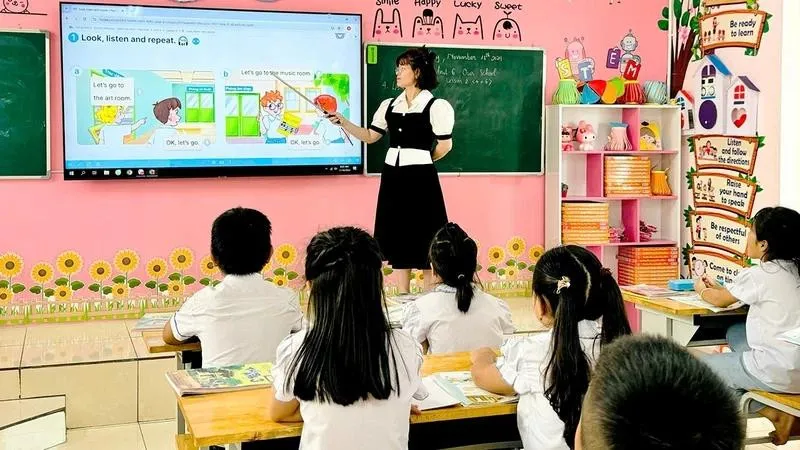
An English class at Chau Son Primary School in Ba Vi Commune on the outskirts of Hanoi. Photo courtesy of the school
English teaching will be integrated into general education to strengthen students’ cognitive and communication skills for social and cultural engagement.
By 2035, all students from grade one to 12 will study English under levels one to three of the national program. By 2045, English as a second language will be taught at levels four to six in every school.
Teaching standards will be evaluated based on the learning environment, curriculum, materials, digital transformation, AI use, teacher quality and international cooperation.
Universities are encouraged to expand English-medium programs and develop lecturers capable of teaching in English. English will serve as a tool for knowledge transfer and daily communication, not only as a subject.
Vocational schools will prioritize English for workplace communication, targeting 50% of institutions to offer some courses in English.
The project emphasizes building public awareness of English as a tool for global integration, improving teacher training, updating curricula and modernizing assessment methods. AI and digital tools will support personalized learning and help bridge regional gaps, especially in remote areas.
The plan includes incentives for high-achieving students and measures to attract qualified graduates to underserved regions. It also allows foreign English speakers to teach in public schools and mandates nationwide teacher proficiency assessments.
Assoc. Prof. Nguyen Van Trao, Vice Rector of Hanoi National University of Education, highlighted the need to define the role of higher education institutions, especially pedagogical universities, in training teachers and supporting implementation.
He said that Vietnam will need 12,000 more preschool English teachers, 10,000 primary English teachers and at least 200,000 teachers qualified to teach in English by 2030.
Trao stressed that the project should ensure accessibility for students in remote and mountainous areas, address disparities in teacher qualifications across different localities nationwide.