First Vietnamese-language newspaper in history
The Gia Dinh Bao was born in Cochinchina in mid-19th century, greatly contributed to spreading and perfecting the national language in the development of Vietnamese historical fiction.
THE HANOI TIMES — As the first Vietnamese newspaper to chronicle current events, Gia Dinh Bao or Gia Dinh Newspaper holds an important place in the popularization of the Latin alphabet in Vietnam.
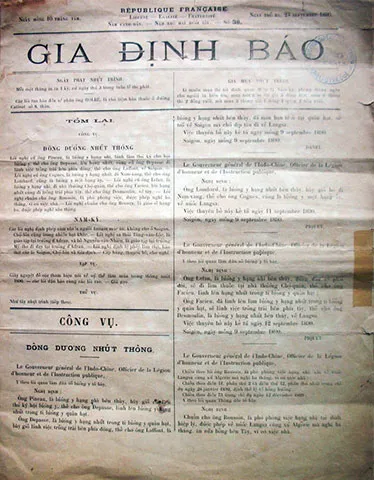
A piece of Gia Dinh Bao, the first Vietnamese language newspaper. Photo: National Museum of France
The history of the newspaper is thoroughly documented in the book series "History of Journalistic Regimes in Vietnam," co-authored by Phan Dang Thanh and Truong Thi Hoa and published by the Ho Chi Minh City General Publishing House.
French colonial-era advertising posters still visible on the streets of Hanoi show that the French colonial government in Vietnam in the mid-19th century used two modern Western communication channels - the mail and the press - in propaganda to establish and consolidate its control over the new territory of Cochinchina.
Newspapers in Vietnam in the early days
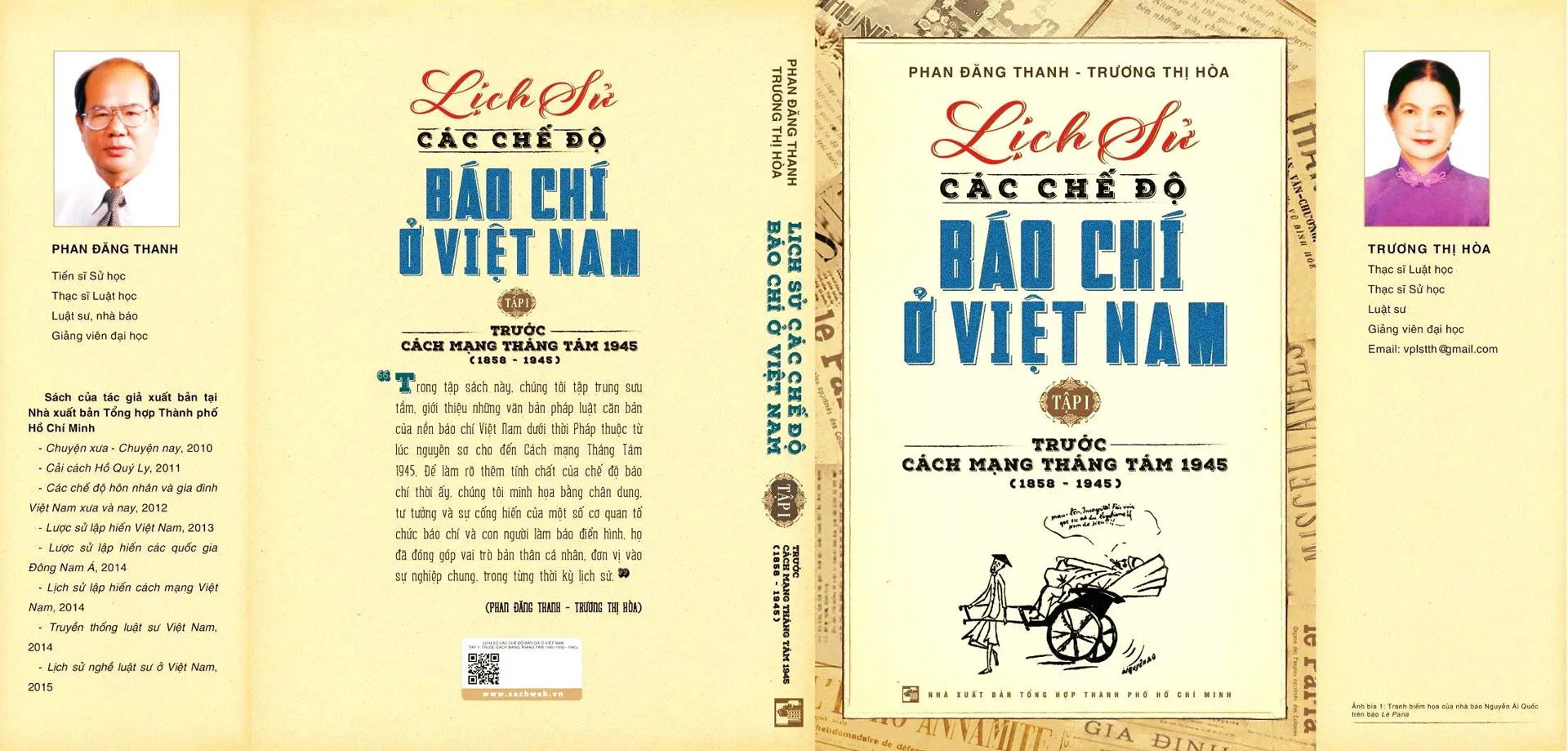
Book covers and authors of the book series “History of Journalistic Regimes in Vietnam”, co-authored by Phan Dang Thanh (left) and Truong Thi Hoa (right). Photo: Ho Chi Minh City General Publishing House
Before 1881, newspapers in colonial Vietnam were printed in one of three specific languages, whose readership consisted mainly of French officers, soldiers in the French army, local officials working for the colonial government, and a few natives who knew the language.
In addition, Sino-Vietnamese newspapers catered to the mandarins of the Nguyen Dynasty as well as native Confucian scholars and intellectuals who had been trained in the local feudal system. Finally, Vietnamese-language publications emerged to reach a broader native readership.
The first newspaper, published in Cochinchina and Vietnam, was the French-language Le Bulletin Officiel de l'Expédition de la Cochinchine (BOEC). Launched in Saigon on September 29, 1861, the weekly paper measured 14 by 21.5 cm and functioned primarily as an official gazette for French officers, soldiers, and colonial administrators. In addition to government notices, BOEC included a separate page for advertisements and commercial announcements.
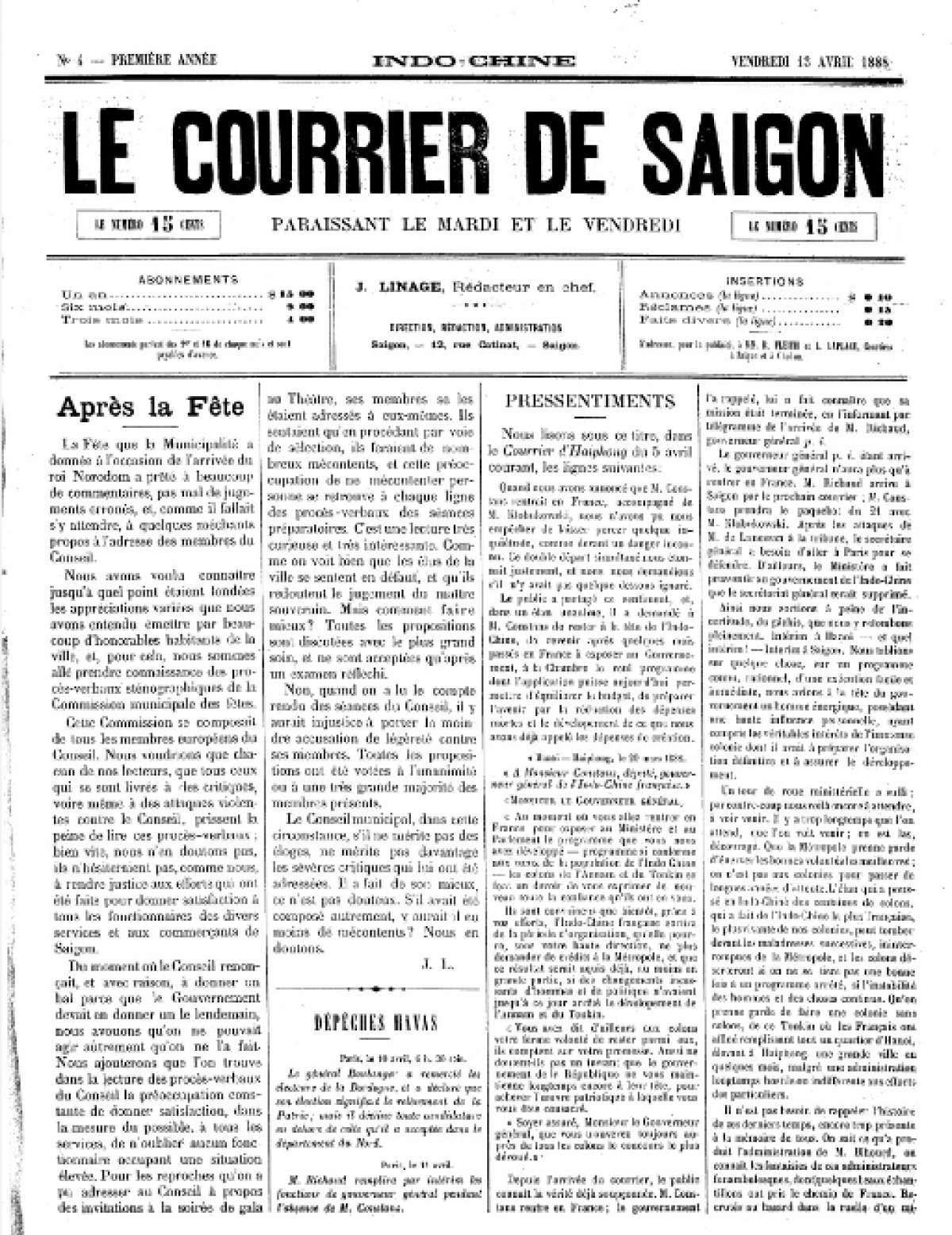
A page from the Courrier de Saigon newspaper. Photo: National Museum of France
The "Courrier de Saigon" (Saigon Mail) was the second French newspaper in Vietnam, founded on January 1, 1864, and published twice a week. It was also an official gazette, but in addition to government dispatches, decrees, and directives, it also featured articles on economic, social, cultural, and historical topics, local news, and news from countries such as China, Japan, and Thailand.
Another French newspaper at that time was "Le Bulletin du Comité Agricole et Industriel de la Cochinchine" (Bulletin of the Cochinchina Agricultural and Industrial Committee). Established according to a decree of June 16, 1865, by the governor Pierre Gustave Roze, it's a collection of research works of the committee, specializing in researching the economic exploitation plan of Cochinchina.
Meanwhile, the Sino-Vietnamese newspaper "Xa Thon Cong Bao" (Le Bulletin des Communes) was the second newspaper established in Cochinchina by the French government (in 1862) after the BOEC. It aimed "to help the people understand their rights and duties and the measures taken by the Governor - Commander-in-Chief to ensure security and order in the country and to bring common prosperity to all the people..."
The first Vietnamese newspaper: “Gia Dinh Bao"
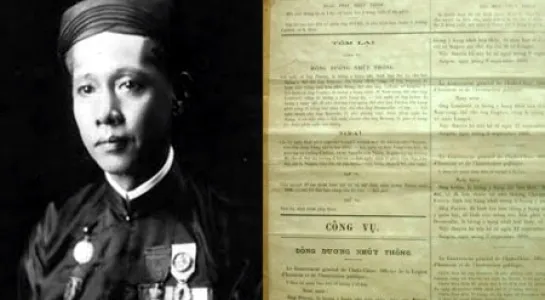
Journalist Truong Vinh Ky and a page from Gia Dinh Bao. Photo: truongvinhky.edu.vn
Gia Dinh Bao (1865-1909) was known as the first Vietnamese-language newspaper in Cochinchina and the whole country. Its office was located at 59-61 De La Grandière Street (the corner of now Dong Khoi Street and Ly Tu Trong Street, District 1, Ho Chi Minh City), in the translating division of the Cochinchina Department of the Interior (Direction de l’Intérieur). Its first issue reached readers on April 15, 1865.
The newspaper was born out of a decree issued on April 1, 1865, by Pierre Gustave Roze, Rear Admiral, Commander-in-Chief, Acting Governor of Cochinchina. Ernest Potteaux, a French interpreter for the Cochinchina governor's office, was appointed editor-in-chief of the newspaper.
In September 1869, a Vietnamese scholar named Petrus Truong Vinh Ky was put in charge of the newspaper as "rédacteur en chef" (editor-in-chief) with an annual salary of 3,000 francs, according to a decision dated September 16, 1869, by Rear Admiral, Commander-in-Chief, Acting Governor of Cochinchina Marie Gustave Hector Ohier.
The Gia Dinh Bao was probably initially an organ of the French colonial government in Cochinchina. "From 1865 to 1869, under the control of Potteaux, this newspaper played the role of an official gazette, consisting of two parts: one for official dispatches, decrees, and documents; another, miscellaneous section for domestic news.
At first, the newspaper came out monthly on the 15th, consisting of four pages that were 25 x 32 cm in size. Later, it became a semi-monthly, and then a weekly publication.
With a longevity of over 44 years, Gia Dinh Bao ranks among the oldest newspapers in Vietnam in the second half of the 19th century and early 20th century. A decree dated September 21, 1909, from the Governor of Cochinchina Jules Maurice Gourbeil set the date of its official suspension on January 1, 1910.
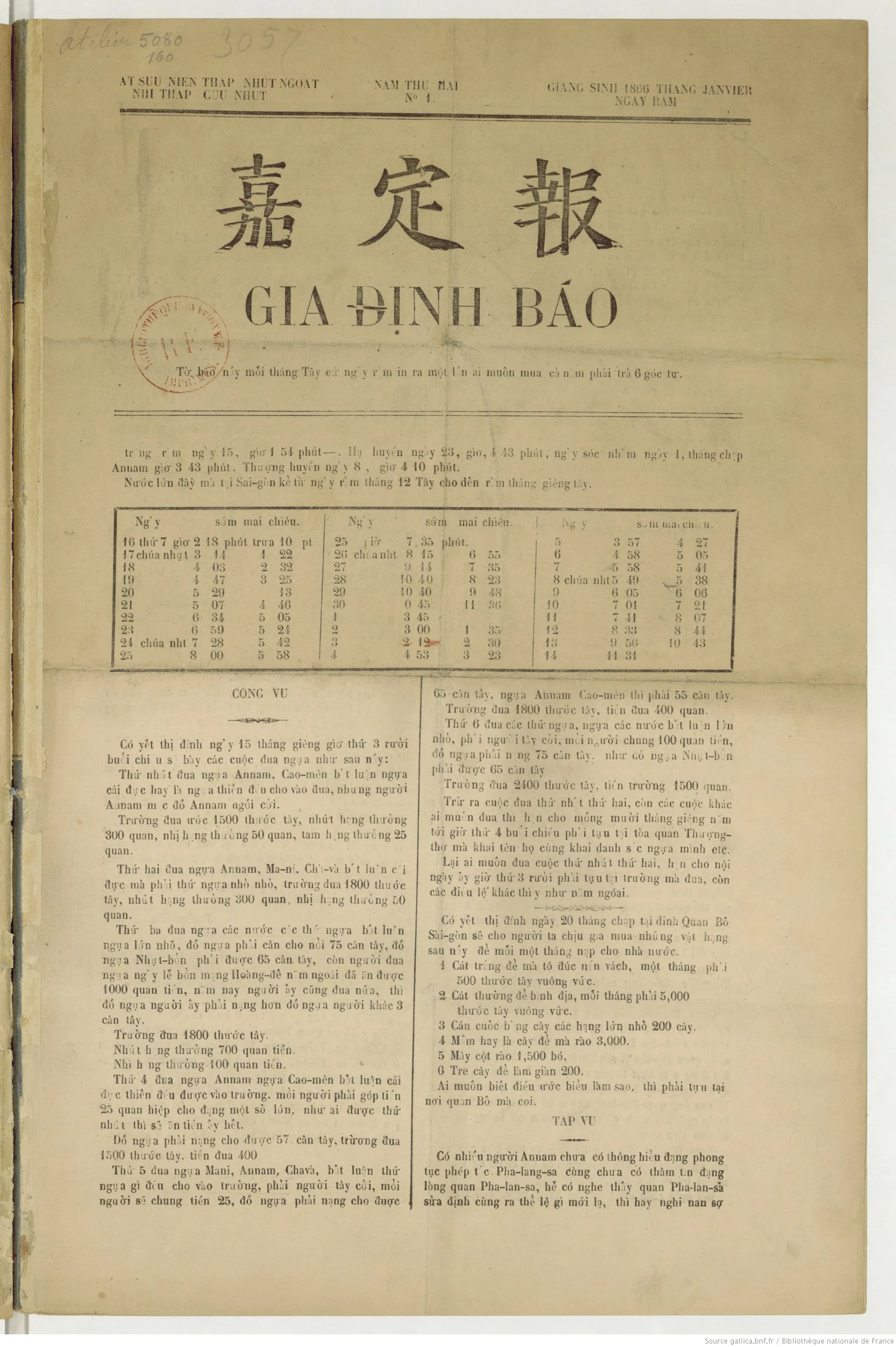
Gia Dinh Newspaper - Issue 1, 2nd, printed in 1866. Photo: National Library of Vietnam
In general, Gia Dinh Bao, from its inception until it "completed its mission," served as a propaganda agency to disseminate laws enacted by the French colonial government in southern Vietnam. Its writers were all officials working for the government.
Beyond its political purpose, Gia Dinh Bao paved the way for the growth of national-language journalism in Vietnam while helping to improve people's knowledge in various fields.