Fitch issued BB+ rating for Vietnam's sovereign debt
“Vietnam's 'BB+' rating reflects the country's solid medium-term growth outlook.
THE HANOI TIMES — Fitch Ratings has maintained its long-term foreign-currency issuer default rating (IDR) for Vietnam at BB+ and has given it a stable outlook.

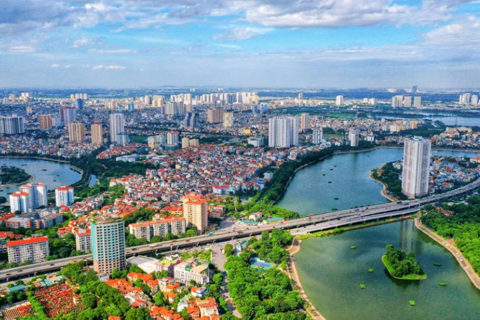
Hanoi from above. Photo: Pham Hung/The Hanoi Times
The rating agency noted that “Vietnam's 'BB+' reflects the country's solid medium-term growth outlook, a lower government debt-to-GDP ratio than the 'BB' peer median, and a favorable external debt profile.”
However, the rating is constrained by a relatively underdeveloped policy framework, high and rising leverage in the economy, and lagging structural features, such as a lower GDP per capita compared with peers.
Uncertainty surrounding global trade policies, pending negotiations with the US, and the government's policy response represent a risk to Vietnam's credit profile.
Fitch forecasts that Vietnam's growth will decelerate to 5.6% in 2025 and 5.3% in 2026, down from 7.1% in 2024. This reflects the agency's baseline assumption that external headwinds will increasingly weigh on the country's growth prospects, despite the robust performance of manufacturing exports in the first half of 2025, driven by frontloading during the 90-day pause on US reciprocal tariffs.
Due to its heavy dependence on merchandise exports, accounting for 83% of GDP in 2024, Vietnam is particularly exposed to the risk of US trade actions, with the US representing 30% of total exports and significant Chinese inputs.
Nevertheless, Fitch expects that Vietnam's robust manufacturing infrastructure, cost competitiveness, relatively educated workforce, and participation in numerous regional and global trade agreements will continue to attract foreign direct investment (FDI) inflows.
However, uncertainty remains over the potential impact of high tariffs on global trade volumes, supply chains, and investment flows. The US has announced a 46% reciprocal tariff on Vietnam. A significantly less favorable outcome for US tariffs on Vietnam, relative to its key export competitors, poses a risk to the country's current growth model's viability.
Fitch's baseline assumes that Vietnam's medium-term growth outlook will remain robust at roughly 6%, outperforming many "BB" category peers. This is contingent on continued solid foreign direct investment (FDI) in export-oriented industries, favorable demographics, an expanding service sector, increasing urbanization, and reform initiatives.
Ongoing reform initiatives, such as reorganizing administrative frameworks to enhance governance efficiency and regional development and fostering private-sector growth, could improve growth prospects.
Fitch expects Vietnam to take countercyclical policies to mitigate tariff impacts, including easing credit, accelerating public investment, and maintaining an 8% growth target for 2025 despite new US tariffs.
Fitch forecasts the government debt-to-GDP ratio to rise from 32.2% in 2024 to 34.2% in 2026, driven by a widening fiscal deficit and rising public investment in infrastructure. The debt ratio will remain well below the projected "BB" median of 53.3% and the official 50% government debt ceiling.