General Secretary To Lam calls on Hanoi to rethink growth model, urban planning
Hanoi must redefine its growth model and embrace high-tech innovation and urban planning in order to continue leading the nation and grow as one of Asia's top cities.
THE HANOI TIMES — General Secretary To Lam urged Hanoi to redefine its approach to development, reframing satellite cities such as Son Tay, Hoa Lac, Xuan Mai, and Phu Xuyen as new growth engines.

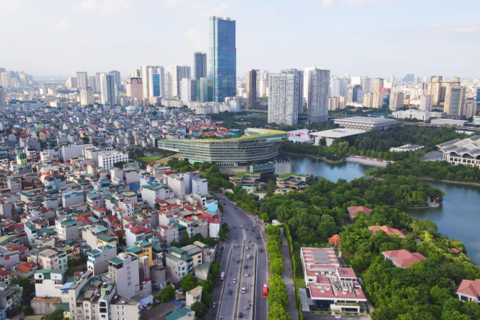
This is a bird's-eye view of Thang Long Boulevard from central Hanoi to its western periphery, including Hoa Lac and Thach That. Photo: Pham Hung/The Hanoi Times
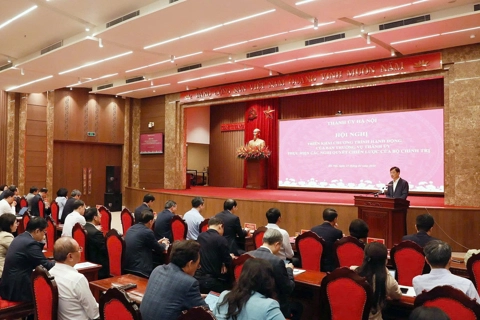
He made this request during a working session with the Hanoi Party Committee’s Standing Committee on June 16.
He told the city leaders to ensure that the capital continues to play a leading role in the country’s new development phase. “Hanoi must restructure its growth space toward openness, multi-centered urbanization, and regional integration,” said Lam.
He pointed out that the traditional inward-focused model has led to overloaded infrastructure and a declining quality of life in the inner city.
"Hanoi should develop satellite cities into regional centers of economy, culture, and technology that offer strong governance and high-quality job opportunities," said Lam.
He also suggested that Hanoi develop a more diverse and interconnected infrastructure system that encompasses urban railways, smart logistics, regional economic corridors, and digital networks.
In addition, Hanoi must transform rural areas from passive urban support zones into a “smart green belt” featuring high-tech agriculture, ecological preservation, rural heritage, and new circular economy and experiential tourism models, he said.
"This green space should serve not only as the city’s ecological lungs, but also as a cradle for spirit and identity in a modern capital," said Lam.
The General Secretary also emphasized the importance of shifting Hanoi’s economic growth to be driven by knowledge, technology, and innovation. Creative industries, fintech, smart logistics, high-quality healthcare and education, and experiential tourism will be the future pillars of Hanoi’s growth.
Lam also encouraged the city to develop its nighttime economy and adopt green and circular development models and creative urban zones while attracting domestic and international talent.
"This is the moment for Hanoi to look beyond national borders, learn from global cities, and develop its own distinctive identity," said Lam. “The capital must not only lead Vietnam, but also become a pioneering and attractive city in Asia.”
To achieve this, he called on Hanoi to leverage its dense network of universities, research institutes, and dynamic businesses to build a world-class innovation hub connecting academia, technology, and venture capital.
He also stressed the need to remove regulatory barriers for the private sector and transition to a government-business relationship model of “partnership, co-creation, and shared responsibility.”
Lam set an ambitious goal for Hanoi: to rise into the ranks of the leading Asian capitals and compete with cities such as Bangkok, Kuala Lumpur, Jakarta, and Seoul.
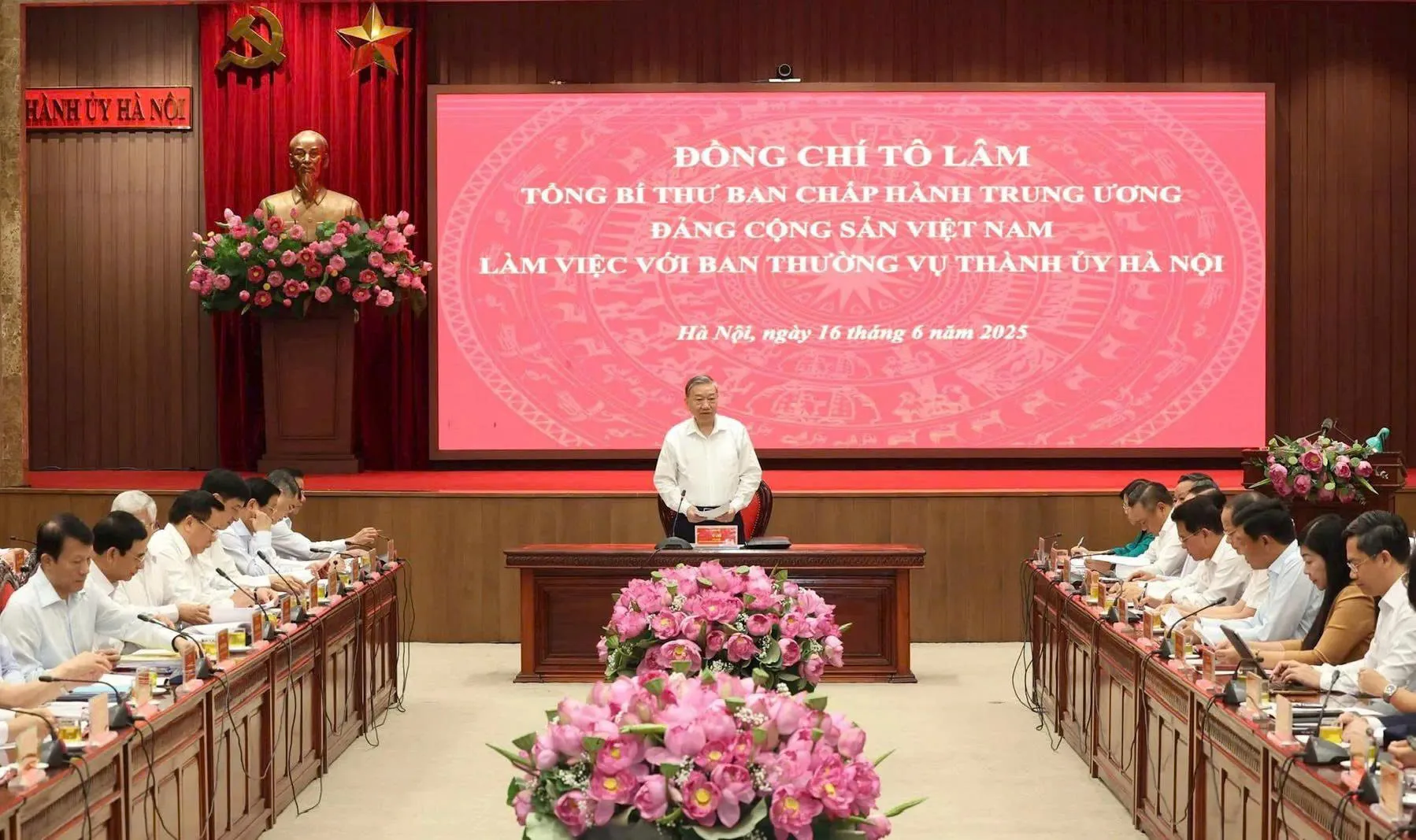
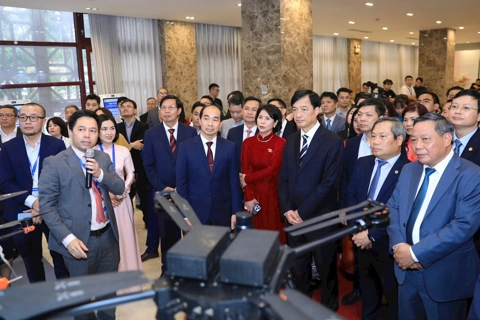
General Secretary To Lam chairs the meeting with the Hanoi Party Committee to discuss issues related to Hanoi's future socio-economic growth. Photo: Thanh Hai/The Hanoi Times
Regarding governance reform, he said that Hanoi's two-tier local government must be lean, transparent, and efficient. Its administrative structure must ensure coherence, reduce intermediate layers, and encourage innovation.
Streamlining the apparatus must preserve political unity and social stability while strengthening national defense and security, he added.
Highlighting the importance of assigning the right person to the right position, the General Secretary said, "Appointments must be based on integrity, competence, reputation, and performance. A wrong choice can be very costly."
He wanted Hanoi to take bold regulatory reform steps, especially with regard to the revised Capital Law, which serves as a legal and political foundation for breakthrough development.
"Rather than waiting for central guidelines, Hanoi should proactively propose special mechanisms for decentralization, budgeting, land use, and planning," he added.
He said that Hanoi should proactively propose special mechanisms for decentralization, budgeting, land use, and planning instead of waiting for central guidelines. "The city should pilot flexible land use, performance-based budgeting, and public-private innovation partnerships."
Emphasizing long-term governance reform, Lam also stressed that upcoming Party congresses at all levels must address regulatory, planning, and digital transformation roadblocks while ensuring that cadres are selected based on talent and dedication.
Hanoi Party Secretary Bui Thi Minh Hoai presented the Central Party Committee and the government with five key policy proposals to boost the city’s development.
She called for the provisions of the revised Capital Law to be transposed into relevant sectoral laws to improve enforcement.
Hoai also proposed allowing Hanoi to pilot a smart urban governance system that uses big data and AI, as well as introducing a transparent governance index based on citizen satisfaction.
She requested that the Government revise the city’s public investment and budget allocations to suit the peculiarities of the two-tier local government and the capital.
On the issue of the environment, the Hanoi Party Chief urged for more central support in addressing air and water pollution, as well as traffic congestion.
Hoai asked the government to remove regulatory obstacles to accelerate development in key wards and communes along the riverbanks to bring the Red River development axis plan to fruition and establish it as a new growth symbol.

Secretary of the Hanoi Party Committee Bui Thi Minh Hoai makes her remarks at the meeting. Photo: Thanh Hai/The Hanoi Times
Reports at the meeting showed that Hanoi has completed the reorganization of its two-tier local government system.
After restructuring, the city trimmed one Party commission from the municipal Party Committee, 11 Party executive committees, three Party committees, and six departments. A total of 526 commune-level units were consolidated into 126 new wards and communes.
The trial operation of the two-tier government is set for June 20–26, with full adoption on July 1.
Hanoi has also launched eight digital platforms shared by all administrative levels. Thus far, the city has integrated 2.5 million electronic health records and over 21 million medical visits into a centralized system and issued 27,000 judicial records via the VNeID platform.
Hanoi is the first city to pilot public services regardless of jurisdiction or residential location within a centralized administrative center.
It also leads the implementation of the national digital ID program and introduced the iHanoi app, which has 5.7 million users and delivers 478 digital services.
To support technology-driven development, Hanoi is accelerating major projects, such as the Hoa Lac Hi-tech Park, which houses 110 projects with nearly VND116 trillion (US$4.4 billion) in registered capital, and the Hanoi Biotech Park, which has received $250 million in funding, as stipulated in the Capital Law and Party resolutions.
Looking ahead, Hanoi plans to complete the infrastructure of the Hi-tech Park by 2030, attract strategic investors, and open the Biotech Park in time for National Day on September 2, 2025. The city is also exploring the development of a high-tech industrial zone in Thanh Oai District.
Hanoi’s GRDP is estimated to grow by 7.6% in the first half of 2025, surpassing forecasts. State budget revenue reached nearly VND370 trillion (US$14.2 billion), or 73% of the annual target.
Exports totaled $10 billion, up 13.8%, while imports rose 12.6% to $22 billion. Foreign direct investment reached $2.9 billion, the highest nationwide total, and total social investment rose 11.6%.