Green transportation: Pioneering solution for Hanoi’s infrastructure
By 2025-2030, all newly invested or replaced buses must run on green energy, with a market share of 45-50% in public transport in Hanoi.
Hanoi is opting for a green and environmentally friendly transportation system as a pioneering solution to enhance the city's infrastructure network and ultimately contribute to socio-economic development.
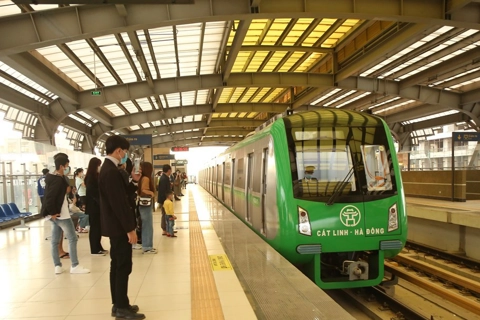
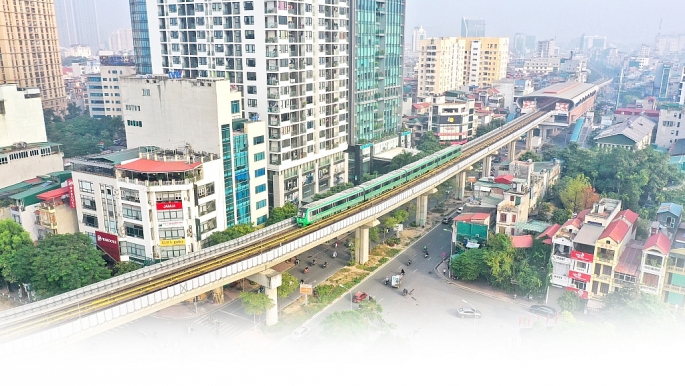
| The Cat Linh - Ha Dong urban railway. Photo: Nguyen Vu/The Hanoi Times |
To date, the city is leading the nation in the transition to green energy in the transportation sector. According to the municipal Department of Transport, Hanoi has 132 subsidized bus lines with over 2,000 buses, including 277 electric and CNG (Compressed Natural Gas) buses, accounting for 13.6% of the fleet.
This ratio of green to conventional transport reflects the concerted efforts of both bus operators and the city government, noted the agency.
Additionally, eight units are piloting the operation of four-wheeled electric vehicles with 223 vehicles servicing the Old Quarter, Hoan Kiem Lake, West Lake, Duong Lam Ancient Village, Huong Pagoda, and Noi Bai International Airport. These vehicles primarily cater to tourists and airport staff.
Vice Chairman of the Hanoi People’s Committee Duong Duc Tuan stated that the city aims to move towards clean, green vehicles. “By 2025-2030, all newly invested or replaced buses must use green energy, with the public transport market share in Hanoi reaching 45-50%. By 2030, at least 50% of vehicles will run on electric or green energy, and 100% of new or replaced taxis will use electric or green energy. By 2050, all buses and taxis will be electric or green energy vehicles,” he noted.
These objectives align with the national green growth strategy, which aims to promote the greening of various sectors, including transportation. To achieve this, there is a goal to increase the use of clean-energy buses.
Dr. Bui Quang Tuan, Director of the Vietnam Institute of Economics, noted that the transition from fossil fuel vehicles to those powered by renewable energy and electricity remains a key part in the country’s quest for sustainable development.
“However, a significant challenge is the high cost of electric vehicles. To address this, two approaches are needed: improving technology, particularly battery technology, to reduce production costs and vehicle prices; and providing financial tools to support domestic manufacturers to enable greater investment in infrastructure, technology, and services for electric vehicles,” Tuan said.
He added that other countries have successfully implemented such policies by investing heavily in infrastructure, enhancing technological capabilities, and fostering innovation, including in services like payment systems and human resources. Furthermore, domestic electric vehicle manufacturers should be encouraged and supported to contribute to the growth of Vietnam's electric vehicle market.
Prioritizing urban railway development
The draft revised Capital law prioritizes the development of urban railways in Hanoi, applying the Transit-Oriented Development (TOD) model. As such, it sets fundamental principles for urban development oriented towards public transportation and facilitates the construction of high-capacity public transit routes.
In the immediate term, priority will be given to the urban railway system in Hanoi, streamlining procedures for planning and investment decisions, and making effective use of the urban railway and TOD areas.
In line with the strategic breakthrough in infrastructure as directed by Conclusion No.80-KL/TW of the Politburo on visions for Hanoi’s development, the draft revised Capital Law stipulates numerous mechanisms and policies that prioritize the planning and construction of the urban railway system and the transition to green transportation by 2035, with a vision extending to 2050.
Cities developed under the TOD model are designed to maximize the use of public transportation, promoting urban growth while balancing community benefits. Urban renewal combined with major transportation projects has succeeded in Europe and the Americas and has achieved significant success in Asian countries such as Japan, South Korea, and Singapore. These efforts have not only advanced not only transportation but also the urban and socio-economic development of these nations.
According to Nguyen Phi Thuong, Director of the Hanoi Department of Transport, four fundamental factors are essential for the success of the TOD model:
|