Hanoi affirms leadership role in new era of national development: Municipal Party Chief
The mettle, intellect and stature of a cultured and heroic Hanoi will remain a steady anchor as the capital writes new pages in the country’s next stage of development.
THE HANOI TIMES — Hanoi Party Secretary Nguyen Duy Ngoc sat down with local media ahead of the Lunar New Year of the Horse 2026 to outline the capital’s responsibilities and ambitions in what he called a defining new era for Vietnam.
2025: Growth, reform and institutional breakthroughs
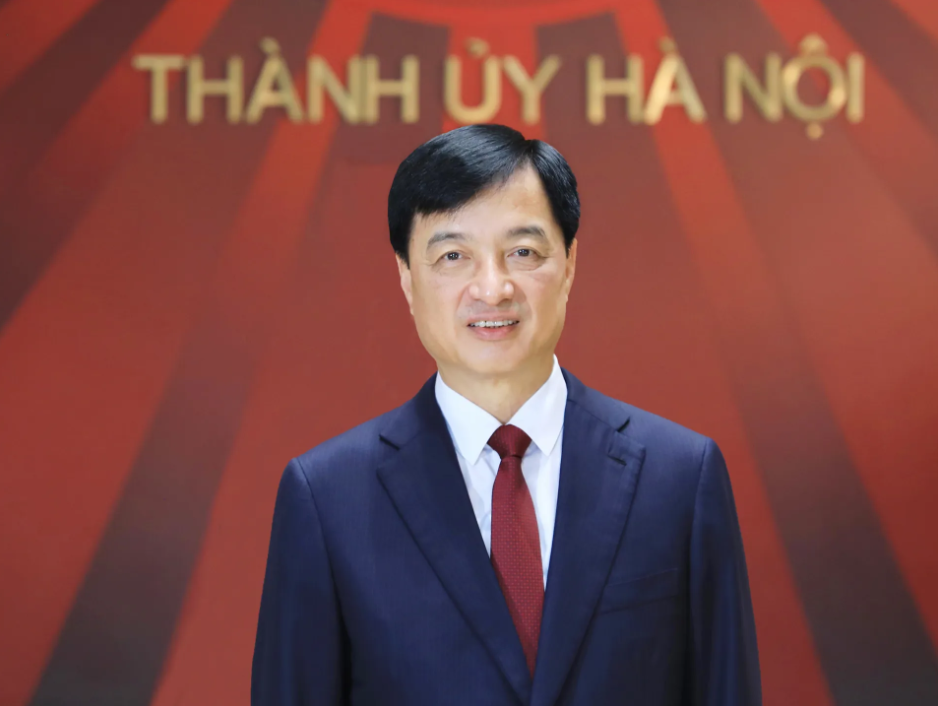
Secretary of the Hanoi Party Committee Nguyen Duy Ngoc. Photos: The Hanoi Times
How do you assess Hanoi’s role and stature in this new era, in light of its history and recent development?
Thang Long-Hanoi, the thousand-year capital that is both cultured and heroic, has long been the area where the nation’s finest values converge, crystallize and shine. As the heart of the country, Hanoi has been reaffirming its mettle, intellect and development stature as Vietnam enters an era of greater prosperity and a better life for people.
The depth of Hanoi’s history carries the Thang Long spirit. It reflects values that are rising with the times. The city continues to grow and deserves to stand as a symbol of trust, will and national aspiration in the new era.
However, Hanoi cannot lead by following familiar paths. A capital that seeks strength and prosperity must break new ground and take on unprecedented challenges. What matters is persistence, seeing it through and delivering results.
To achieve that, the 18th Hanoi Party Congress identified three development breakthroughs: strengthening and completing the capital’s institutional framework, developing and effectively using high-quality human resources while attracting talent and building a modern, smart and connected infrastructure system.
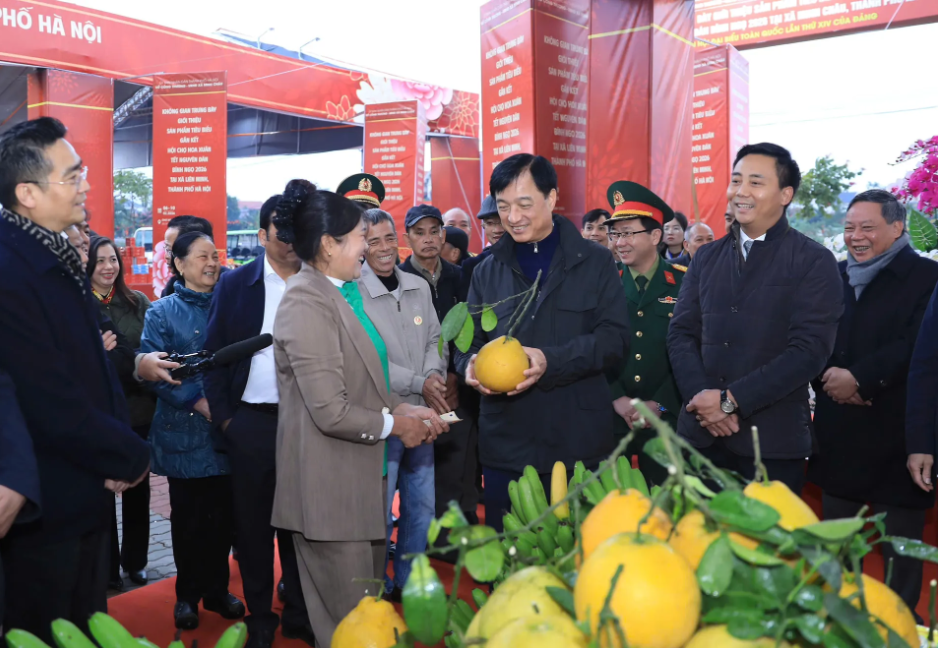
Secretary of the Hanoi Party Committee Nguyen Duy Ngoc learns about local agricultural products at the Tet market in Minh Chau Commune.
2025 was seen as a special year for Hanoi with many major milestones. What stood out most?
Despite fast-moving and unpredictable global and regional developments, Hanoi stayed firm on its development goals and fully mobilized its tradition of culture and resilience, its spirit of unity and innovation and its sense of responsibility.
Hanoi closed 2025 with notable milestones. GRDP expanded by 8.16%, surpassing the 8% target and significantly higher than 2024’s 6.52%. The economy reached an estimated US$63.5 billion, with per capita income at roughly US$7,200.
State budget revenue totaled VND711 trillion (US$28.8 billion), equal to 138.4% of the plan and up 38.4%, the highest in many years. Public investment disbursement reached nearly VND90 trillion (US$3.6 billion), or 106.8% of the plan assigned by the prime minister. Social welfare work continued. Disaster prevention and climate adaptation were strengthened to reduce losses and help keep social stability.
Equally significant was a shift in governance under a clear principle: “Say it, then do it fast, right, effectively and to the end.”
Administrative discipline tightened through the “six clear” approach: clear person, clear task, clear timeline, clear responsibility, clear output and clear authority.
The city also addressed long-running bottlenecks, from congestion and pollution to flooding, urban order and food safety, accelerating site clearance and infrastructure delivery.
Hanoi proactively proposed a 100-year master plan, aimed at institutional reform, resource mobilization and a new growth model capable of sustaining double-digit expansion aligned with science, technology, innovation and digital transformation.
How did administrative reform and streamlining translate into concrete change?
Hanoi successfully held Party congresses at all levels and the city's 18th Party Congress for the 2025-2030 term. The city also moved early on reorganizing and streamlining the political system with strong determination and a methodical approach.
The city streamlined 526 wards, communes and townships into 126 units, with broad public consensus. From July 1, 2025, a two-level local government model began operating smoothly, designed to be leaner and more effective. In practice, the model has started to remove obstacles and improve service quality for residents and businesses.
Hanoi restructured 293 key administrative procedures, advancing data-based governance with fewer pre-checks and stronger post-checks. The goal is seamless online public services and lower compliance costs.
The city also piloted integrating Party administrative procedures into the National Public Service Portal and accelerated digital transformation within Party agencies and the broader political system. These shifts helped Hanoi rank first nationwide for three consecutive years, 2023, 2024 and 2025, in the local-level innovation index.
Science, technology and infrastructure as growth engines
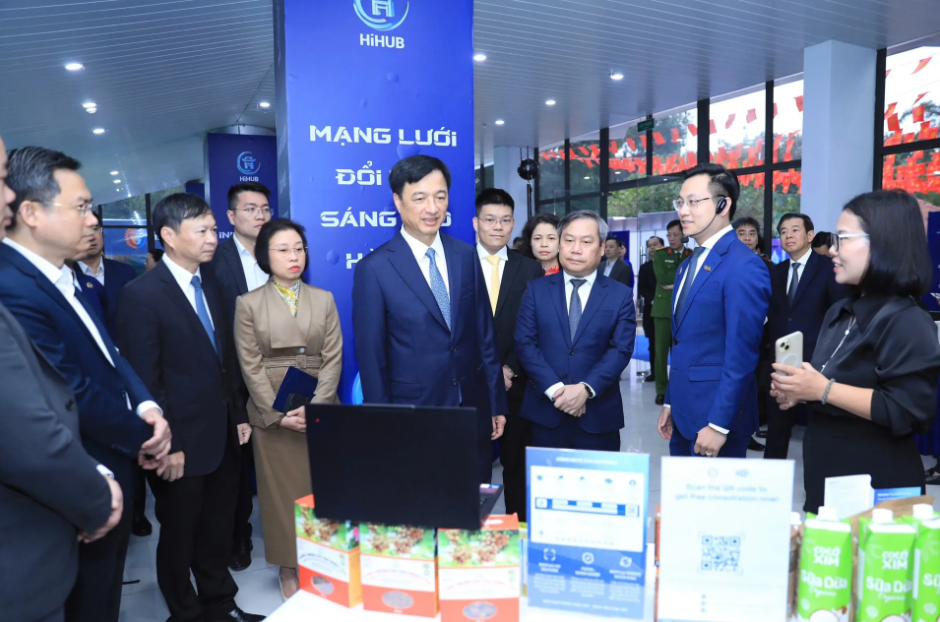
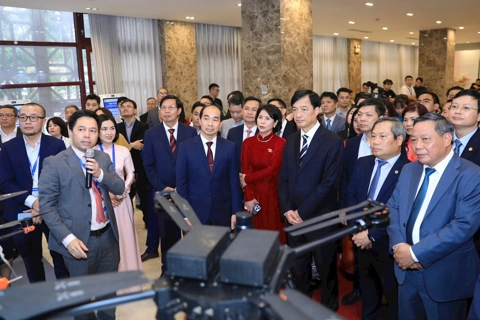
Secretary of the Hanoi Party Committee Nguyen Duy Ngoc and Chairman of the municipal People’s Committee Vu Dai Thang visit exhibition booths at the city Innovation Network showcase.
How is Hanoi implementing Politburo Resolution 57 on science and technology?
Hanoi views breakthroughs in science and technology, innovation and national digital transformation as astrategic steps across socio-economic fields. Improving the performance, effectiveness and efficiency of the two-level local government remains an ongoing mission with no finish line.
The city assigned 230 specific tasks under Resolution 57, strengthening governance effectiveness and productivity. These tasks shape the city’s pathway for applying science, technology, innovation and digital tools to Hanoi’s socio-economic development.
We also focus on improving governance effectiveness and productivity. The city treats an “AI First” mindset and stronger digital capacity across the civil service as key solutions to reduce manual work, cut costs and shorten processing time while improving service quality for residents and businesses.
In parallel, administrative reform is being redesigned in a more substantive way. Processes are being restructured on shared data foundations, with a higher share of cases handled end-to-end online and a sharp reduction in compliance costs for society.
In public investment management, the city emphasizes transparency and performance. Technology will be used to monitor progress, give early warnings of bottlenecks, shorten project preparation time and improve the efficiency of public capital while activating social resources.
What is the broader governance shift Hanoi is aiming for in this transformation?
A consistent thread is shifting the city’s governance from experience-heavy administration and qualitative reporting that mainly ensures procedures to governance based on digital data, technology, real-time management and outcome effectiveness. Decisions should be faster, more accurate and verifiable through data.
The foundation is built on three pillars: infrastructure, people and technology. Hanoi will develop shared digital infrastructure, open data and common AI platforms, build high-quality human resources and gradually master selected strategic core technologies to strengthen long-term competitiveness.
The city also emphasizes an inclusive and secure digital society. People must have fair access to online public services and social welfare. At the same time, digital trust must be strengthened and safety and security ensured throughout the transition so digital inequality is narrowed rather than widened.
The “Make in Hanoi” innovation ecosystem is being promoted through research ordering, outcome-based contracting and commercialization mechanisms to boost domestic technology development.
Science and innovation are expected to support a 2026 GRDP growth target of at least 11%, expand the digital economy and increase total factor productivity.
Beyond growth, Hanoi stresses social welfare and defense and security. What stood out in 2025?
Hanoi consistently links economic development with social progress and fairness, while maintaining defense and security. These are three inseparable pillars in the capital’s development.
A meaningful point for the Party organization, government and people of Hanoi was the city’s role in successfully supporting the 80th anniversary of Vietnam’s National Day, leaving a strong impression on people nationwide and visitors. In 2025, Hanoi also ensured absolute safety for more than 2,800 events of different sizes across the city.
The city’s urban and rural landscape continued to improve, becoming more civilized and modern. Hanoi reached its new rural development goals one year ahead of schedule. Defense and security tasks were maintained. Social welfare and benefits were safeguarded and gradually improved. The city reported no poor households, with vulnerable groups supported under the principle of leaving no one behind.
The municipal People’s Council adopted policies on tuition levels and compensation for tuition exemptions for public early childhood, general education and continuing education institutions that implement the general education program. It also approved tuition support for children and students in Hanoi from the 2025–2026 school year, lunch support for students and wider social welfare policies, especially for disadvantaged groups during Tet and in the years from 2026 onward.
Hanoi also continued to strengthen its profile as a safe and increasingly attractive destination, supported by the growth of cultural industries and innovation.
Reinforcing political resolve and governance discipline
After the city's 18th Party Congress, what changed in the city’s leadership style and working method?
Following the direction of General Secretary To Lam at the 18th City Party Congress and after leadership consolidation, the Standing Committee, the Standing Board and the Executive Committee of the city Party organization showed strong determination to renew leadership methods and working style.
The consistent spirit is to dare to think, dare to act and dare to take responsibility, and to carry work through to the end. Effectiveness, concrete outputs and service quality for residents and businesses are the measures. This new leadership mindset and working style has been strongly transmitted from the city level to the grassroots, creating a more urgent and decisive working tempo anchored in the “six clear” approach.

Secretary of the Hanoi Party Committee Nguyen Duy Ngoc inspects progress on the Ring Road 2.5 project in Cau Giay Ward. Photo Thanh Hai/The Hanoi Times
Can you give an example where this new approach produced visible results?
A clear example is the progress in site clearance for Ring Road 1, the Hoang Cau–Voi Phuc section, a long-standing congestion hotspot. Removing this bottleneck is especially important because it supports synchronized technical infrastructure upgrades, improves travel and daily life, supports production and business activities and raises the value and efficiency of urban land use.
With close direction from the city Party organization and strong involvement across the political system, site clearance is largely complete. The recovered area reached 153,341 square meters, involving 1,983 households and organizations. In just over five months, wards including O Cho Dua, Giang Vo and Lang completed compensation, support, resettlement and land recovery for 1,295 households. In the previous seven years, districts had resolved 686 households.
On January 15, 2026, Hanoi opened the road section to technical traffic, marking progress toward completing the corridor as required, improving connectivity and creating new development momentum for the city.
What other major developments were highlighted as Hanoi entered 2026?
Alongside that, on January 16, 2026, at Hoa Lac Hi-Tech Park, General Secretary To Lam and Prime Minister Pham Minh Chinh attended the groundbreaking of Vietnam’s first semiconductor chip manufacturing plant. On January 17, 2026, the project for a healthcare complex for older people linked to Hanoi Medical University was launched. On February 2, 2026, two multi-purpose urban areas were also launched.
Urgent tasks are being carried out under a “countdown” approach, with a determination not to allow new complications, not to avoid difficult or sensitive work and to keep delivery on track.
Traffic and infrastructure are often called Hanoi’s biggest bottlenecks. What concrete steps did the city take in 2025?
Hanoi treats transport and infrastructure issues as urgent but also strategic and long-term. In 2025, the city focused on flood prevention, drainage and building scenarios to respond to climate change and extreme weather. The city issued 10 emergency construction orders, with total investment of about VND5.579 trillion (US$226.0 million), prioritizing key areas.
For congestion, Hanoi developed and implemented a comprehensive plan for 2026–2030 and beyond, with 10 long-term solutions and six immediate ones. The priority is stronger inspection and monitoring, quick handling of emerging congestion points and ensuring traffic order and safety. A near-term focus is meeting travel demand during Tet and the spring festival season of the Lunar New Year of the Horse 2026.
Alongside removing bottlenecks, Hanoi is pushing large strategic projects. What are the key highlights?
In late 2025, many key transport and infrastructure projects saw more momentum. Ring Road 4 completed site clearance and the parallel road section in Hanoi is expected to open in the second quarter of 2026. Projects such as Ring Roads 2.5 and 3.5, National Highway 1, National Highway 6 and Metro Line 5 from Van Cao to Hoa Lac also have clearer roadmaps and firm commitments to accelerate progress.
The city is also moving urgently, preparing procedures in line with legal requirements, for major projects with strategic impact, including the Olympic sports urban area, the Red River landscape boulevard, Metro Line 5, the road linking Gia Binh Airport with Hanoi, the rehabilitation and redevelopment of parks along both sides of the To Lich River and seven new bridges across the Red River.
Two projects in particular, the Red River boulevard axis and the Olympic sports urban area, are described as especially important for Hanoi, the Red River Delta and the country. They are linked to the ambition to create a “Red River miracle” and shape a new image for Hanoi as a cultured city with identity and creativity, rising as a green, smart, globally connected creative metropolis.
Environmental pollution, urban order and food safety are constant public concerns. How is Hanoi approaching them?
Hanoi’s position is clear: development must be fast but sustainable. Growth must go with environmental protection and improved quality of life. Issues like pollution, urban order and food safety are not only management requirements. They are measures of governance capacity and the government’s sense of responsibility to residents.
The city has focused on addressing five major bottlenecks: traffic congestion, urban order, environmental pollution, flooding and food safety. It has also built roadmaps and specific measures to improve urban order, including model wards and communes for order and civility. The Standing Board of the city Party organization issued Directive 44 on July 24, 2025 to strengthen leadership on environmental sanitation and urban order management, with clearer directions, timelines and a strong action mindset for a brighter, greener, cleaner and more beautiful capital.
On pollution, especially air pollution and waste, Hanoi is advancing a set of measures such as low-emission zones, stronger delegation of waste collection and treatment responsibilities to wards and communes, safer and more effective operation of treatment facilities and faster development of waste-to-energy projects. The city aims to eliminate pollution sources at their roots, gradually revive polluted rivers and coordinate with neighboring provinces to reduce cross-boundary air pollution sources.
Food safety is also being tightened, especially in school kitchens and industrial zones. The city is decentralizing food safety certification and implementing Plan 336 issued on December 8, 2025 to address persistent gaps.
What key lessons does Hanoi take from 2025?
The city Party organization and Party agencies acted as pioneers and a coordinating core that mobilized the strength of the whole political system. They set clear directions for key tasks, implemented strategic Politburo resolutions and followed guidance from General Secretary To Lam, including the approach to reducing the five bottlenecks without allowing them to worsen and aiming for steady improvement over time.
The Standing Committee and Standing Board proactively set directions on many strategic issues and new mechanisms and policies, including those without precedent, providing a legal basis for implementation.
In the final two months of the year, under direct direction from the Standing Committee, the Standing Board held regular and extraordinary working sessions to steer key tasks. It also established two new steering bodies on institutional completion and planning, reinforcing a strategic vision for the capital’s development along three axes of momentum, creation and growth.
The municipal People’s Council showed a reform-minded and development-oriented approach, working closely with the municipal People’s Committee on mechanisms and policies.
The municipal People’s Committee also demonstrated clear management capacity, issuing implementation plans for congress resolutions and city Party programs and delivering outcomes across three key tracks: socio-economic development, defense and security and social welfare.
The Vietnam Fatherland Front and socio-political organizations played a role in building consensus, strengthening unity and contributing through supervision, social feedback and Party and government building.
The most consistent lesson is that every development decision must aim to improve quality of life and the investment and business environment. It requires strong public communication and consensus-building, timely understanding of public concerns, active dialogue with residents to resolve problems and full use of available mechanisms and policies while protecting legitimate public interests.
Strategic directions for 2026 and beyond
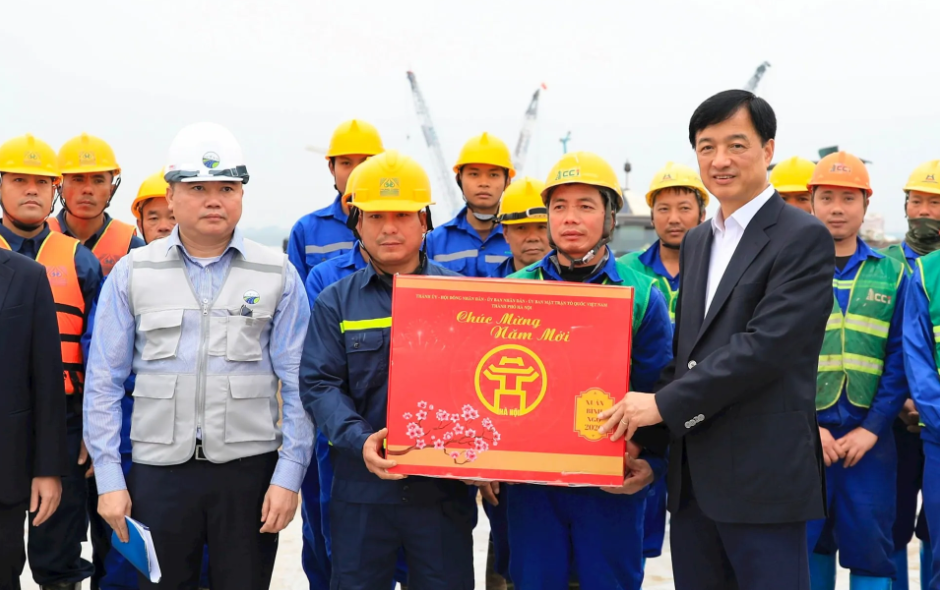
Secretary of the Hanoi Party Committee Nguyen Duy Ngoc encourages workers at the Hong Ha Bridge construction site ahead of Tet.
2026 is the first year of implementing major Party Congress resolutions. What are Hanoi’s key priorities for this pivotal year?
2026 comes amid complex and unpredictable global risks. World growth is expected to slow. Major-power competition remains intense. Armed conflicts persist with risks of wider spillover. Digital inequality is growing. Non-traditional security challenges and extreme disasters are increasingly unusual.
2026 is also the first year of implementing the 18th City Party Congress and the 14th National Party Congress resolutions, with clear targets and requirements. Hanoi is targeting economic growth of at least 11% in 2026 and across the 2026–2031 term.
The city is also advancing major work on institutions, a 100-year planning horizon and a new development model tied to sustained double-digit growth. Large strategic projects raise expectations for leadership capacity, execution management and maintaining major balances of resources.
The 2026 action theme is “Discipline and professionalism, breakthrough and creativity, effectiveness and sustainability.” The core directions include renewing Party leadership methods, improving working practices and reinforcing the role and responsibility of leaders.
The city will implement the action program for congress resolutions and strategic central resolutions, aligned with guidance from General Secretary To Lam for the capital. Party building will be strengthened in politics, ideology and ethics and organizational restructuring will continue to make the system leaner and stronger.
Governance will continue shifting from administrative management to development creation and service delivery. Supervision will be expanded and inspection will be focused. The city aims to move toward “data-based inspection and supervision,” including quarterly evaluations of cadres under Regulation 366 dated August 30, 2025 and Conclusion 198 dated October 8, 2025 of the Politburo alongside regular monitoring.
Institutional work and the 100-year master planning agenda will be pushed in line with central conclusions, Resolution 15 dated May 5, 2022 and the Capital Law 2024. The city will also implement National Assembly Resolution 258 dated December 11, 2025 on piloting specific mechanisms and policies for major projects in the capital.
Hanoi will advance its new growth model, with science and technology, innovation, digital transformation and high quality human resources as central drivers. The city will attract investment across society, including foreign investment and high quality private capital. Public investment will be used to lead private investment, with early-year assignment and control to avoid slow starts and rushed ends.
Strategic infrastructure development remains central. Hanoi will create new development space and accelerate key projects including the Red River landscape boulevard, the Olympic sports urban area, rehabilitation of the To Lich River and other polluted rivers, urban rail lines, seven river-crossing bridges and ring roads 2.5, 3, 3.5 and 4.
It will also advance radial corridors and major upgrades, along with flood control projects and solid and liquid waste treatment. For strategic projects, the city will focus on institutions, mechanisms and policy to manage the entire project lifecycle, maintain resource balances, assess social and environmental impacts and anticipate risks with flexible and timely adjustments.
A public transport ecosystem is also part of the foundation, combining buses and urban rail to shift public awareness and travel habits.
On strategic Politburo resolutions, Hanoi aims for measurable progress each month and quarter. For Resolution 57 dated December 22, 2024, the city defined three core guiding views: treating science, technology and digital transformation as both required inputs and value-creating outputs, using data as the foundation for renewing leadership and management and emphasizing discipline and accountability tied to quantified results.
Implementation must avoid dispersion. Tasks must be quantified with indicators and evaluated by real outcomes. Linkages among the state, institutes, universities and businesses will be strengthened. Resources will be allocated by output effectiveness, with tighter discipline and responsibility for leaders.
Building shared digital platforms, open data and common AI remains a key solution for resolving core governance bottlenecks. A major task is full-process online public services, aiming to reduce paper use so people and businesses do not need to visit government offices.
For Resolution 72 dated September 9, 2025 on health protection, priority will be given to commune-level health stations and facilities so they can operate effectively with adequate infrastructure, equipment and staffing.
For Resolution 71 on education and training, Hanoi will use the capital’s advantages to raise education quality across public and private systems, address shortages of schools and classrooms in the 2025–2026 school year and correct long-standing “achievement chasing,” while moving toward national-standard public schools.
Culture is treated as identity and internal strength, not only potential. After the Politburo issued Resolution 80 on cultural development, Hanoi aims to lead and create strong spillover effects, starting with an action program that is substantive, innovative and capable of producing real outputs and measurable impact.
The city will continue addressing the five bottlenecks with month-by-month, quarter-by-quarter improvement and accountability for leaders responsible for assigned tasks. It will also prepare and deliver elections for the 16th National Assembly and People’s Councils for the 2026–2031 term, with an emphasis on personnel preparation, democracy and unified Party leadership in cadre work.
Hanoi will remain firm in maintaining defense and security, protecting key targets, major projects and important political events. Social welfare work will continue through regular reviews of vulnerable groups and policy implementation to improve benefits, ensuring no one is left behind.
The city will also carry out post-14th Congress tasks and prepare to serve people during Tet 2026 in a way that is joyful, safe, rich in identity and creative, creating momentum and inspiration for the new year and the new era. This includes gratitude activities for people with revolutionary contributions, urban beautification and absolute safety for Tet activities.
Finally, the city’s experience and the five lessons from 2025, especially the leadership renewal and the stronger role of leaders in the last two months of 2025, are expected to serve as a foundation for refining leadership thinking and execution in 2026 and throughout 2026-2031.
City departments and localities are expected to study and apply these lessons to produce real change, with greater creativity, professionalism and effectiveness.
As Hanoi welcomes the Lunar New Year of the Horse 2026, what message would you like to send to officials, businesses and residents?
Hanoi is stepping into the new era together with the country. The trust and expectations placed in the capital are enormous. They are both an honor and a responsibility.
The Party organization, government, armed forces and people of Hanoi will continue to uphold the tradition of a cultured and heroic capital. We will live up to President Ho Chi Minh’s guidance to build a capital that is peaceful, beautiful and strong in both material and spiritual life.
With unity, intellect and resolve, with the deep attention of the central leadership and General Secretary To Lam and with the spirit of “Hanoi says it then does it, fast, right, effective and to the end,” the city will strive to complete its 2026 goals.
We will build a strong foundation to fulfill the objectives of the city's 18th Party Congress and the 14th National Party Congress and contribute to the country’s path toward a more prosperous future.
The mettle, intellect and stature of a cultured and heroic Hanoi will remain a steady anchor as the capital writes new pages in the country’s next stage of development.
Thank you for your time!