Hanoi considers collecting entrance fee
Under the plan, Hanoi would set up 87 tollbooths in ring road No.3 leading to the downtown areas, with the entrance fees varying based on the hours of low or peak traffic.
With traffic congestion long seen as an urgent issue in Hanoi that causes environmental pollution and financial losses of up to millions of dollars, the city is now considering introducing an entry fee scheme to reverse the situation.
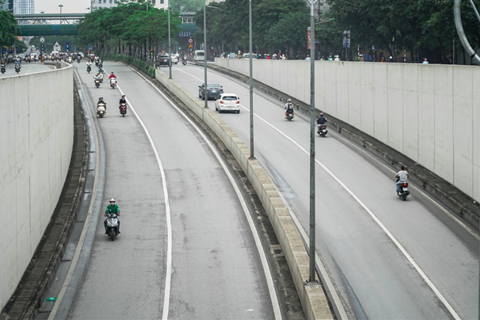
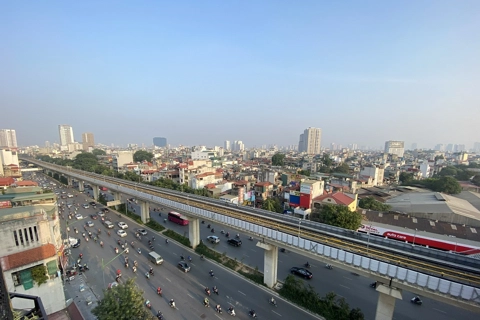
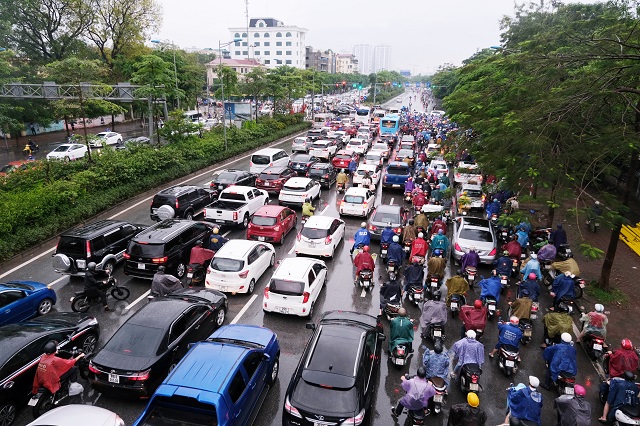
| Traffic congestion has been one of Hanoi's most pressing issues. Photo: Pham Hung |
Hanoi, as one of Vietnam’s main economic hubs, has witnessed rapid urbanization over the years.
As of July 2021, Hanoi’s population exceeded the eight-million-mark, but the proportion of lands allocated for transportation reached only 9.75%, significantly lower than the target of 20-26%.
Meanwhile, the number of cars and motorbikes expanded by an average rate of 10.2% and 6.7% per year, respectively. Statistics from the Police Traffic Department of the Hanoi Police revealed over 7.6 million vehicles hit the roads in the city every day, not to mention another 1.2 million from other provinces/cities commuting daily to the capital.
“The slow pace of expansion of transportation area compared to the growing number of vehicles has led to overloaded urban infrastructure, traffic congestion, and air pollution,” stated the Police Department.
As part of the city’s efforts to improve the traffic situation, the municipal Department of Transportation is in the process of drafting a proposal on entrance fees to charge any motorized vehicle entering the metropolitan area, which is scheduled to be submitted to the Hanoi People’s Committee for approval by late October.
Under the plan, Hanoi would set up 87 tollbooths in ring road No.3 leading to the downtown areas from 2025. These booths are expected to operate from 5.00-21.00 daily and are equipped with electronic toll collection (ETC) technology, with fees varying depending on the hours of low and peak traffic.
Dubbed as a kind of congestion and environmental pollution charge, the plan noted the public may evade the fee by choosing another route or using public transportation services that are not subject to payment of such a fee.
“The charge is not compulsory,” it added.
Transport expert Phan Le Binh noted such a method has been widely adopted in cities around the world as a way to reduce traffic congestion.
“In the long term, a congestion charge would change the people’s habit of movement and promote the development of public transport,” Binh told The Hanoi Times.
Binh gave as an example a number of major urban cities in Japan or England that are charging expensive rates on parking or collecting fees for entering downtown, resulting in higher public transit use.
Nguyen Hoang Mai from Quoc Oai District, however, expressed concern about whether the current public transport system is able to meet growing demands.
“Commuting to work on bus is not a viable option for me at the moment due to the slow travel time and lack of direct routes. The city’s authorities should pay more attention to improving the mass transit network,” Mai told The Hanoi Times.
Transport expert Dang Minh Tan added the location of tollbooths are mainly at crowded residential areas or in congested roads with a high concentration of office buildings and schools, namely at sections of Nguyen Trai – Khuat Duy Tien, Co Linh – Hanoi highway – Haiphong, or at interchanges of Big C Thang Long, Le Van Luong, Xuan Thuy, Giai Phong.
“Without careful consideration, these tollbooths may cause congestion in certain periods,” Tan told The Hanoi Times, noting technological application and a scientific approach are required to avoid inconvenience for the people.
Tan shared the public’s view that greater efficiency of the mass transit system would convince the people to leave their private vehicles at home, along with efforts in raising public awareness towards the use of environmentally-friendly transport means.
“Hanoi is in need of drastic measures to reduce privately-owned vehicles to address traffic congestion and environmental pollution. Such policies would require high determination and a scientific approach to convince the public to use public transport,” Expert Dang Minh Tan told The Hanoi Times. “The entry fee scheme would be divided into three phases. The authorities would study and finalize the proposal during the 2021-2025 period. The next five years (2025-2030) would be for pilot implementation at certain areas for review and adjustment. Starting from 2030, the city would include more locations in the congestion pricing areas as suggested under the proposal. No doubt the move is necessary to curb traffic congestion. On the other hand, however, Hanoi needs to allocate land funds to build parking lots surrounding ring roads and a complete network of mass transit for the public,” Transport Expert Bui Danh Lien told The Hanoi Times. |