Hanoi economy sustains higher growth in 2024
Hanoi aims to drive comprehensive economic, cultural, and social development, with a focus on infrastructure investment in 2025.
Hanoi's economy is projected to sustain an estimated GRDP growth rate of 6.52% this year, up from 6.27% on year, and a total economic size of US$58 billion.
| Vice Chairman of the Hanoi People's Committee Ha Minh Hai at the session. Photos: Thanh Hai/The Hanoi Times |
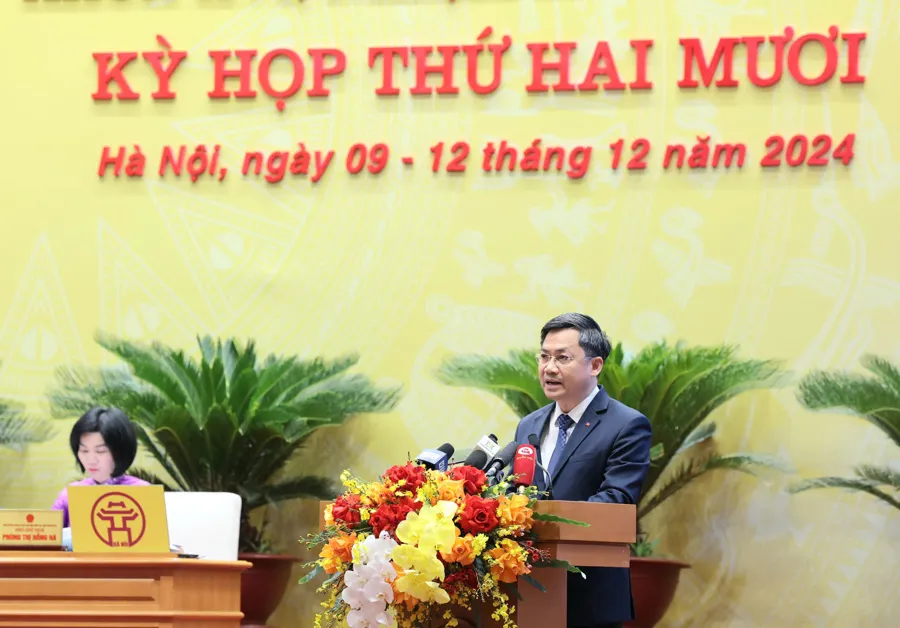
Vice Chairman of the Hanoi People’s Committee Ha Minh Hai revealed the figures at the 20th session of the 16th municipal People’s Council held today [December 9].
At the session, Hai reported that the city has fostered growth by effectively mobilizing and utilizing resources for investment. “With decisive measures tailored to the city's realities, Hanoi has ensured balanced revenues and expenditures for its budget and development investment capital,” Hai said.
Total state budget revenue is estimated at 120.5% of the forecast, or approximately $20.2 billion, of which domestic revenue accounts for around $18.9 billion, representing 93.8% of total revenue. Financial and credit policies have been effectively implemented to meet the capital needs for production and business activities on time.
Export and import turnover have shown a strong recovery. Exports reached $19.4 billion, up 16.7%, while imports amounted to $41.1 billion, up 9.6%. Foreign investment inflows are projected to exceed $2 billion.
Total development investment capital in the city reached nearly $22.6 billion, up 10.5%. Retail sales of goods and consumer services exceeded $36.3 billion, increasing by 10.5%. The average consumer price index for the year is estimated to range between 4.2% and 4.6%.
During the year, Hanoi successfully organized activities to commemorate the 70th anniversary of the Capital's Liberation Day, making a significant impression on citizens and international friends. These included three major events: the “Cultural Festival for Peace,” a national-level commemoration ceremony, and a scientific conference, alongside 35 other meaningful activities.
The city has also won three prestigious awards: “Asia’s Leading Tourist Destination,” “Asia’s Leading City Break Destination,” and “Vietnam’s Leading Cultural Destination” from the World Travel Awards organization.
Social welfare has been ensured, with proactive efforts to improve living standards and provide timely support to policy beneficiaries. Employment was created for over 196,000 people, achieving 118.9% of the annual target.
Over $81 million in assistance was provided to those in need, with 714 poor and near-poor households receiving housing improvements.
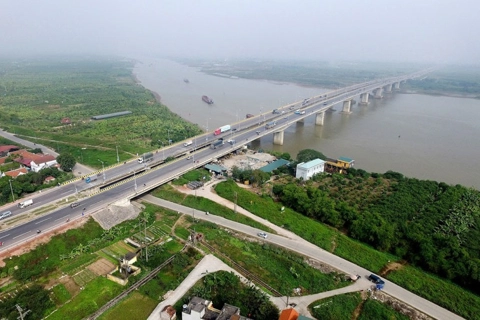
Hanoi emphasized intellectual resources, particularly contributions from the academic and research communities, and fostered a robust ecosystem of 124 higher education institutions, 113 research institutes, and 14 national key laboratories. Infrastructure development focused on building synchronized, highly interconnected transportation systems, including highways, belt roads, and major interchanges, in tandem with urban development.
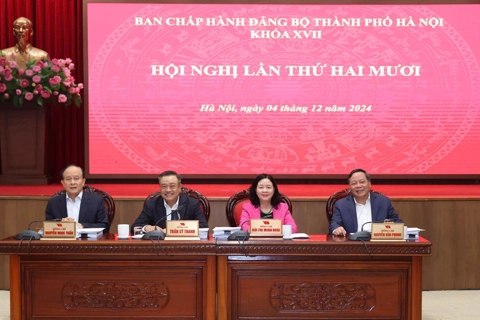
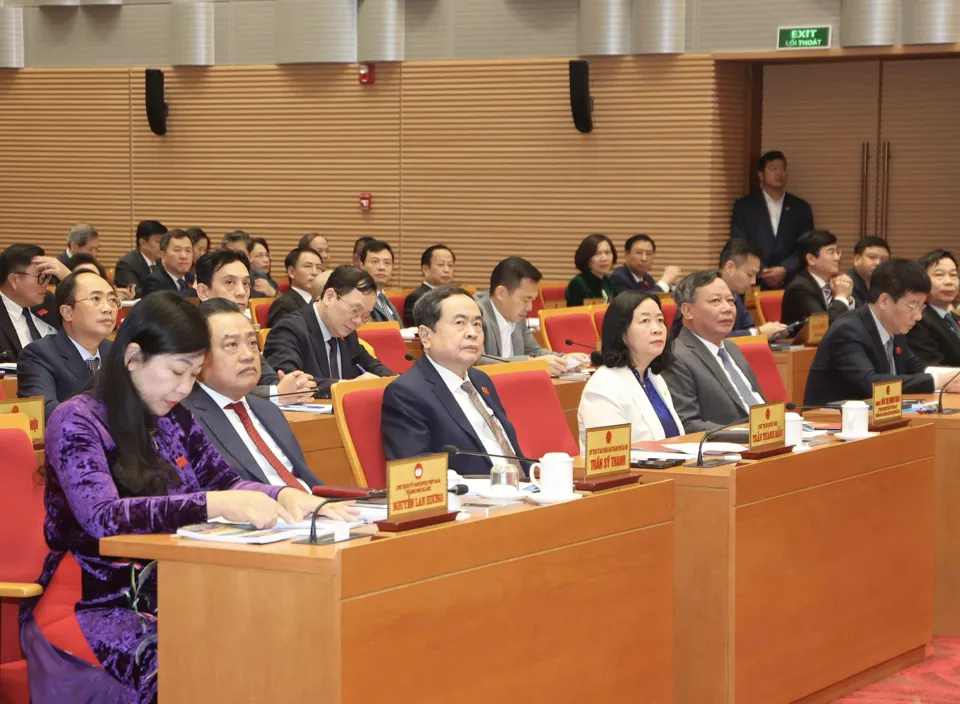
| Hanoi's leaders at the session. |
The city has advanced environmental management with stable operations of drainage systems and sewage treatment plants. Efforts to restore the environment and rivers, including To Lich, Kim Nguu, Lu, and Set, are progressing, marked by the trial operation of the Yen Xa wastewater treatment plant in December 2024. Pilot waste segregation at source in five districts will be expanded citywide by Q1/2025.
In addition, social and resettlement housing projects have progressed, with 30 projects completed, providing 1.7 million square meters of floor area, and 69 projects underway, expected to deliver 4 million square meters of social housing. Resettlement projects include nearly 12,000 apartments, with occupancy rates ranging between 62% and 96%.
Hanoi leads digital transformation initiatives, highlighted by the nationwide implementation of electronic health records and digital judicial records using the VNeID platform. Smart solutions like cashless parking payment apps and the “iHanoi” platform strengthen communication between the government and citizens. On December 6, 2024, the city inaugurated its State Data Center, modernizing over 300 existing applications to improve efficiency and flexibility.
Vice Chairman Hai emphasized Hanoi’s commitment to innovation and creativity to position the capital as a leading, modern city.
Inspired by the strategic vision articulated by General Secretary To Lam, Hanoi recognizes its unique potential and critical role in national development in a new era.
Ambitious goals for 2025
For 2025, Hanoi aims to accelerate economic, cultural, and social development; and invest in infrastructure, especially transport connectivity, public transit, and high-tech, and biotech industrial zones. These initiatives are in keeping with Politburo Resolution 15, focusing on environmental protection, social welfare, and public safety.
Hanoi seeks to institutionalize the revised Capital Law and two urban development plans under the principles of “liberal institutions, smart governance, and unified culture.” The vision is to build a smart, modern capital city that emphasizes green and digital transformation, a digital economy, a digital society, and a thriving cultural identity. Reforms in administrative procedures and decentralization will be prioritized to align with strategic directives and new legislative provisions.