Hanoi identifies e-government as means to achieve higher public services quality
The objective for the city from now until the end of 2022 is to further simplify at least 60% of the local administrative procedures.
Hanoi’s authorities are pushing for the development of an e-Government to improve public services quality, eventually realizing the goal of becoming one of the top localities in Vietnam in terms of digitalization by 2025.
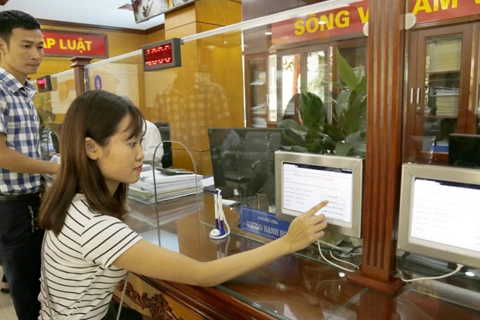
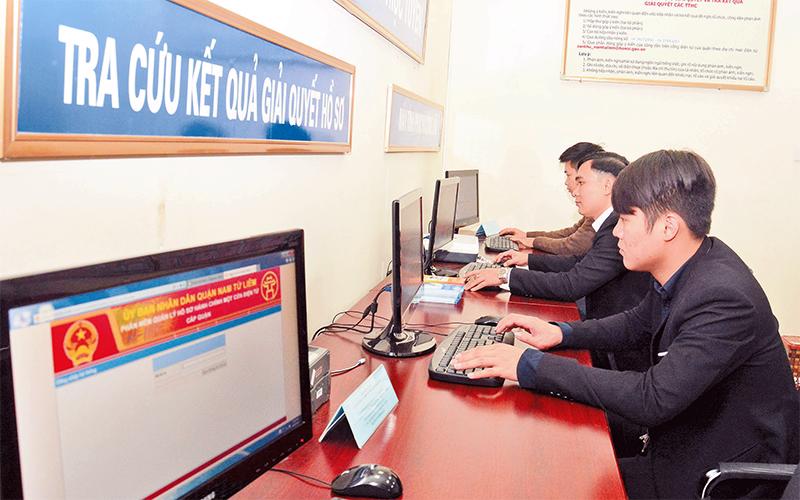
| Locals searching for information at Nam Tu Liem District's one-stop shop. Photo: The Hanoi Times |
Under the municipal Party Committee’s program No.01 on promoting administrative reforms in the 2021-2025 period, the city has identified e-Government as one of the key solutions.
As part of the process, Hanoi has set up a Steering Committee on promoting e-Government and later the backbone for Hanoi’s e-Government, a legal basis for the implementation of such a model.
In addition, local authorities have been working on measures to push for administrative reform and raise public awareness of the benefits of online public services via the city’s and national online public services portals.
During the first quarter of 2022, one of the goals for the city is to digitalize administrative procedures at the “one-stop-shop” services in all levels of public units.
The move, once realized, would help public officials process administrative requests from the people anytime and anywhere.
And in fact, such efforts have demonstrated their effectiveness given the growing number of people turning to public online services.
In Phu Xuyen District, the number of cases that people and businesses using public online services was around 428 during the first months of 2022, significantly higher than the figure of 305 for the whole of 2021.
Similarly, in Ba Dinh District, since January 2022, the one-stop-shop service at the local District People’s Committee has provided an online booking option for locals.
With this new service, people only need to access the district’s online portal to fill out a form to get an appointment date.
Statistics from Hanoi People’s Committee showed the total administrative procedures in Hanoi are 1,843, of which 1,685 are qualified to be processed in the advanced public online services of stages 3 and 4.
As of March 1, Hanoi has integrated 254 administrative procedures into the national public services portal, and the figure is set to rise to 794 by late 2022.
The objective for the city from now on until the end of 2022 is to further simplify at least 60% of the number of local administrative procedures, especially in such essential fields as planning, land management, investment, healthcare, education, social insurance, or taxation.
In addition, the city targets to process at least 30% of the total public services at the advanced online stages 3 and 4, while all the results should be delivered through the national public services portal.
It is expected that at least 30% of the people and businesses would not be required to provide additional information after having successfully conducted an administrative process, thanks to the shared information system among different agencies.
The city’s leaders have also been pushing for greater decentralization in processing administrative procedures in the field of land management, in which grass-roots units are now permitted to issuing land use rights for the people in certain cases.
The use of online services is expected to help cut the waiting time for businesses and people to carry out administrative procedures by up to 30 minutes.