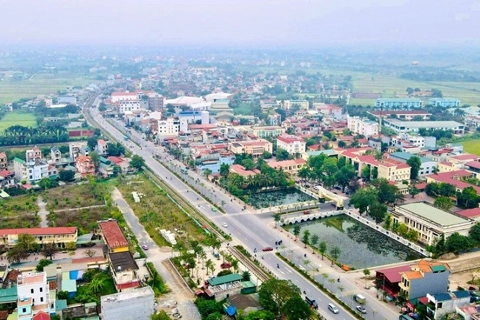
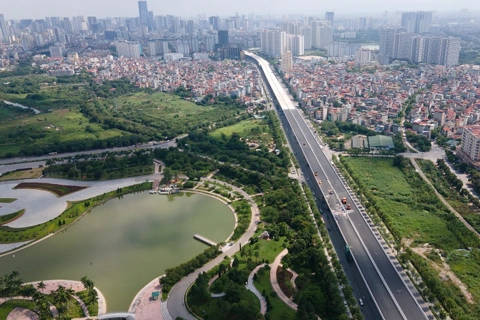
Hanoi legislators pass General Planning for 2021-2030 period
The capital aims to become a leading modern, progressive and civilized metropolis in Southeast Asia by 2050.
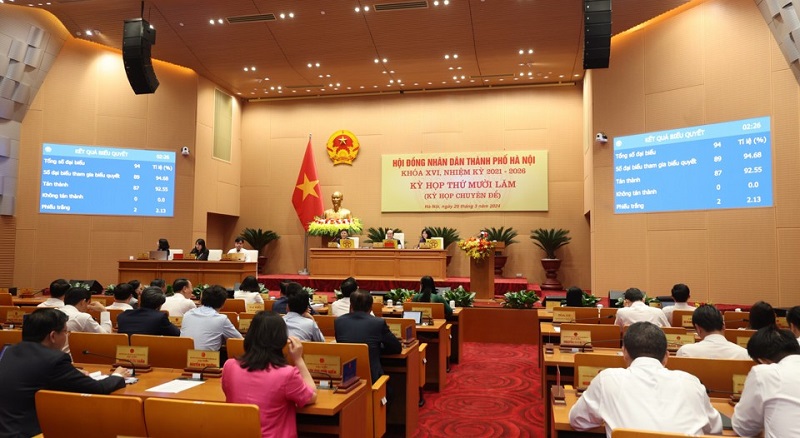
On 29 March, legislators in Hanoi approved the capital’s General Planning for 2021-2030, which aims to help the city become a national and global centre of excellence. This is expected to help the city establish itself as a hub of excellence both nationally and worldwide.
| The meeting of the Hanoi People's Council on March 29, in which delegates approve the capital's General Planning for 2021-2030 with a vision to 2050. Photo: Thanh Hai/The Hanoi Times |
The decision was a major step forward for the authorities in Hanoi, as it created a legal framework for the city to become a more liveable urban area in the future.
Under the general planning, Hanoi expects to become a cultured, modern, and civilized metropolis by 2030 based on scientific and technological advances, and to become the growth engine for the Red River Delta region, the North and the whole country.
The General Planning also envisions Hanoi becoming an international financial and educational hub, growing on the basis of a green and circular economy, a digital economy and a shared economy.
It also sets a goal for Hanoi to transform itself into a city with high-quality living conditions and comprehensive socio-economic growth by 2050. The plan aims to make Hanoi a global, green, smart, peaceful and prosperous metropolis that keeps pace with the growth of other cities in the region and the world.
By 2050, the city's population is expected to reach 13.5 million. By then, Hanoi residents are expected to have an income of US$45,000-46,000 and the city would be 80-85% urbanized.
During 2021-2050, Hanoi will develop on the basis of five spaces, five economic corridors, five growth axes, five socio-economic regions and five satellite cities.
The five socio-economic corridors are the city's central districts, the north side of the Red River, and the south, south-west and north-west of the city.
The five urban areas will include the central districts, a city covering the region of Son Tay Town and Ba Vi District, and three suburban cities to be built in the west, north and south of the city.
Hanoi will also revive polluted rivers like the To Lich, Nhue and Day to improve water supply for agriculture and urban greening. Local authorities will speed up the rehabilitation of old residential buildings and prevent potential fires.
In the field of cultural and historical preservation, the city authorities will improve the infrastructures of the Old Town and the French Quarter, thus exploring the values of the thousand-year-old city.
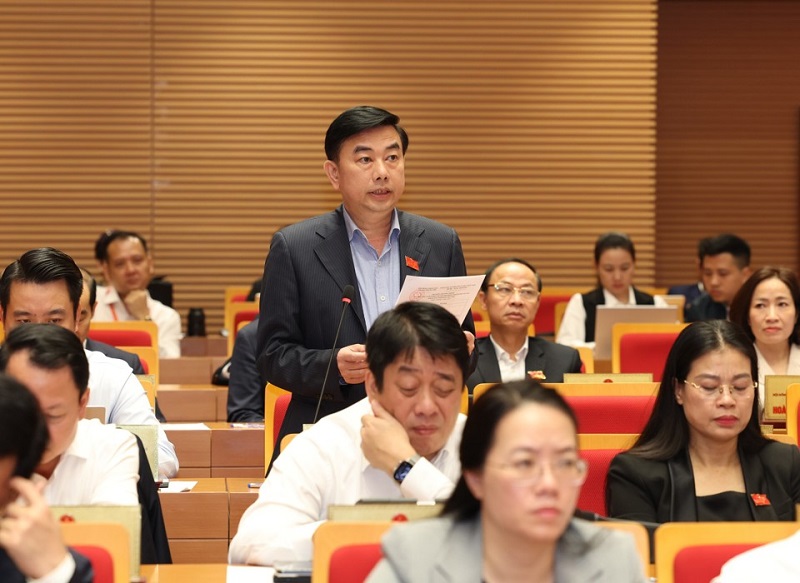
| Delegate Nguyen Minh Duc from Hoang Mai District speaks at the meeting. Photo: Thanh Hai/The Hanoi Times |
Hanoi will also speed up the development of 14 new metro lines, in particular to connect the central districts with the Noi Bai International Airport and the Hoa Lac Hi-Tech Park.
The capital plans to expand and upgrade Noi Bai airport to handle 100 million passengers and five million tons of cargo annually by 2050. Hanoi will build a second airport for domestic use in Phu Xuyen or Ung Hoa district, with a planned annual capacity of 30-50 million passengers and one million tons of cargo.
Doan Viet Cuong, deputy head of the Urban Development Committee under the Hanoi People’s Council said the city's People's Committee should work on further clarifying the General Planning before submitting it to the Prime Minister.
“As the capital, the general planning must highlight the central role of Hanoi in the Capital Region as well as its leadership role in the growth of the capital region, the Red River Delta and the nation," he said.
Sub-municipal authorities need to take a close look at existing problems and their causes, and come up with appropriate solutions to improve the capital's infrastructure in the areas of transport, waste management and sanitation, Cuong said.
Delegate Nguyen Minh Duc from Hoang Mai District said that urban railroads are the backbone and the key to solving the problem of traffic congestion in the city.
"The city needs a special regime that allows local authorities to raise technical and financial support to build new metro lines without any delays," he said. "Just as many cities around the world have banned fossil-fuelled cars, we should facilitate the growth of green vehicles."