Log in
Business

Hanoi mulls strategy to reform tax system until 2030

The application of modern and highly automated information technology is expected to create the best conditions for taxpayers to fulfill their tax obligations.

Chairman of the Hanoi People's Committee Tran Sy Thanh on February 28 signed directive No.04/CT-UBND to carry out the strategy to reform the local tax system until 2030.


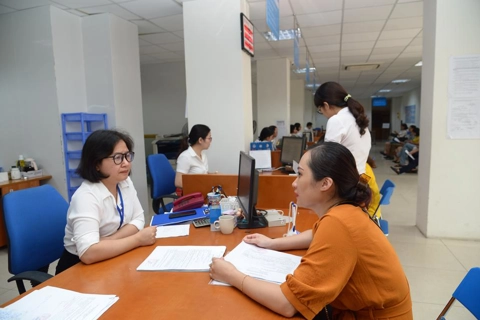
 Locals pay taxes in Ba Dinh District, Hanoi. Photo: Pham Hung/The Hanoi Times

Under the directive, the mayor stressed the Hanoi Taxation Department's need to establish a Steering Committee responsible for implementing the Tax System Reform Strategy to 2030.

The Steering Committee must efficiently reorganize its activities to ensure the timely and effective execution of the tax sector's reform and modernization programs, plans, and contents.

Furthermore, an implementation plan must be drawn up to ensure compliance with the requirements and roadmap of the Ministry of Finance and the General Department of Taxation, in line with the administrative reform program and the city's actual needs.

The Hanoi Tax Department is requested to participate in improving Vietnam's tax policies toward meeting international standards, focusing on anti-transfer pricing, new production and business models emerging in the economy, the digital and sharing economy, smart production, and cross-border transactions.

In addition, tax administrative procedures must be reformed to make them simple, easy to understand and apply while creating conditions that promote production and business development and ensure sufficient revenue for the implementation of socioeconomic development objectives and national security and defense.

Creating best conditions for taxpayers to fulfill their obligations

According to the directive, it is crucial to implement modernization effectively in tax administration. This requires raising awareness of the administrative procedures and professional management processes of tax authorities, renewing and improving the efficiency of the one-stop mechanism for electronic administrative procedures, shortening the processing time for taxpayers, and expanding electronic transactions among businesses and organizations.
The application of information technology in tax administration aligns with ongoing efforts to develop e-Government. This should also include strengthening risk management in tax inspection and examination to prevent and promptly deal with tax fraud, as well as the creation of a competent tax workforce.

The Department of Finance, State Treasury, and Hanoi Customs Department should closely coordinate with tax authorities to implement the Tax Administration Reform Strategy in their jurisdiction, such as modernizing tax collection, authorizing collection orders, and stepping up electronic tax payment.

The application of modern and highly automated information technology is expected to create the best conditions for taxpayers to fulfill their tax obligations.

The Hanoi Tax Department, the Department of Planning and Investment, and the Hanoi Police Department are required to work closely together to simplify administrative procedures, including granting business licenses, tax identification numbers, and business seal registration. The aim is to ensure that organizations and individuals can easily carry out administrative procedures.

The Department of Industry and Trade is also required to collaborate closely with the City Tax Department in supervising representative offices, branches of companies, and foreign traders in the city. The Department will provide the tax authorities with copies of licenses for operation, advertising, trade promotion, and other relevant documents, which will serve as the basis for tax management and collection following regulations.

The Department of Natural Resources and Environment is responsible for enhancing cooperation with tax authorities in providing information and resolving problems related to land policy mechanisms to ensure that land-related budget revenues are fully and promptly collected.

To facilitate national digital transformation, the Hanoi Police Department is requested to work with tax authorities in utilizing the national population database under the Prime Minister in Decision No.06/QD-TTg of January 6, 2022. The agency is in charge of detecting and investigating cases of fraudulent activities, such as the creation of companies to buy and sell VAT invoices or the use of illegal invoices to evade taxes and to control taxpayers who have frozen debts or debts forgiven and recoup tax loss. In addition, the Municipal Police must speed up the processing of tax evasion and fraud cases to discourage people from committing similar acts.

Reactions:
Share:
Trending
Most Viewed
Related news
Hanoi's tax authorities to launch lucky bill program

Hanoi's tax authorities to launch lucky bill program

29 Sep, 21:47

The first selection process for the second quarter would take place on October 15 at the latest, with the invoice’s owner having the opportunity to win prizes of up to VND50 million (US$2,100).

Vietnam OCOP Festival 2025 honors products as program marks nationwide development milestones

Vietnam OCOP Festival 2025 honors products as program marks nationwide development milestones

The festival aims to promote and honor outstanding OCOP products and producers and to reaffirm Hanoi’s leading role as the country’s “pacesetter” in the One Commune One Product (OCOP) program.

Vietnam posts five-year high FDI disbursement as investor confidence strengthens nationwide 2025

Vietnam posts five-year high FDI disbursement as investor confidence strengthens nationwide 2025

Despite global economic and geopolitical headwinds, foreign capital flows into Vietnam accelerated in 2025, with investment increasingly concentrated in high value-added sectors, highlighting the country’s growing appeal as a stable, long-term destination for investors.

VN-Index set for 2,200-mark next year: JP Morgan

VN-Index set for 2,200-mark next year: JP Morgan

Vietnam’s appeal goes beyond the upgrade, driven by major economic reforms that are lifting business and consumer confidence, as well as improving profit prospects over the next three to five years.

Vietnam to launch smart agriculture innovation center in Lang Son

Vietnam to launch smart agriculture innovation center in Lang Son

The center is expected to bridge gaps in technology testing, connect farmers with researchers and markets and accelerate sustainable, high-tech agricultural development nationwide.

Hanoi urged to train 100,000 digital engineers through online academy

Hanoi urged to train 100,000 digital engineers through online academy

The Capital Strategic Technology Development Forum gathered a wide range of proposals from businesses, experts and investors on how Hanoi should shape its deep-tech development agenda in the coming decades with a long-term vision to 2045.

Inclusive innovation must give everyone equal voice, experts say at TECHFEST Vietnam 2025

Inclusive innovation must give everyone equal voice, experts say at TECHFEST Vietnam 2025

Open innovation is becoming a cornerstone of Vietnam’s development strategy, as policymakers, experts and international partners emphasize people-centered collaboration to tackle inequality, climate change and urbanization through inclusive, technology-driven solutions showcased at TECHFEST Vietnam 2025.

Vietnam attracts $400 million in venture capital as tech startups surge

Vietnam attracts $400 million in venture capital as tech startups surge

Vietnam’s startup ecosystem continues to expand rapidly, with strong venture capital inflows and fast growth in digital, AI and green technologies, reinforcing the country’s appeal to global investors.

Vietnamese policymakers push for early launch of gold exchange

Vietnamese policymakers push for early launch of gold exchange

A transparent gold exchange would not only offer a safe investment channel for the public but also provide a foundation for Vietnam to become a regional hub for jewelry manufacturing and exports.