Hanoi named in Vietnam’s top 10 business-friendly localities
Given its status as Vietnam’s major economic hub, improvements in administrative reform in Hanoi would have significant impact on the overall economy, said an expert.
Hanoi remained in Vietnam’s top 10 business-friendly localities for a third year running, standing at 9th out of 63 provinces/cities with score of 66.93 in the country’s Provincial Competitiveness Index (PCI) 2020 report.
| Director of VCCI's Legal Department Dau Anh Tuan at the launch. Photo: Nguyen Tung |

“An unchanged rank means Hanoi continue to be one of the country’s top destination for businesses, but more efforts are needed if the city wants to climb higher in the ranking,” Dau Anh Tuan, director of the Legal Department under the Vietnam Chamber of Commerce and Industry (VCCI) told Hanoitimes on the sidelines of the PCI 2020 report launching today [April 15].
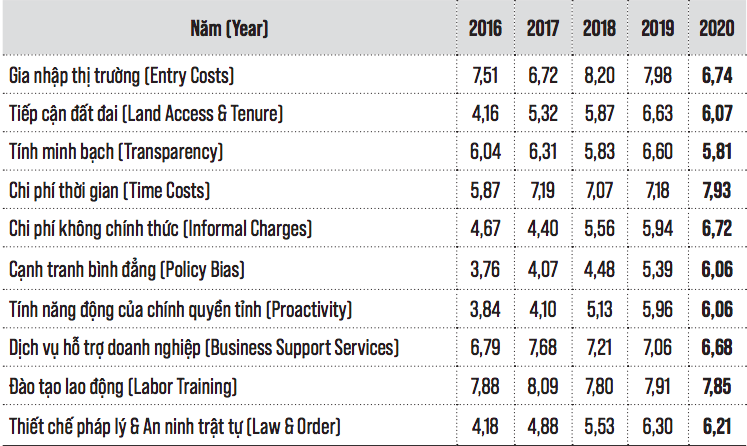
“In the past, the city had made significant breakthrough in terms of the Entry Cost [a PCI sub-index] by adopting technologies for greater convenience for businesses to join the market. As a result, the city has been at the top nationwide in this regard, which is reflected by the 100% rate of enterprises registering business online,” Tuan said.
| Detailed of Hanoi's 10 PCI subindices in the 2016-2020 period. Source: PCI report |
“I expect Hanoi to continue pushing for stronger improvements in administrative reform and facilitating favorable conditions for enterprises to grow,” he said, adding this would have significant impact given Hanoi’s status as an economic hub of the country.
Introduced since 2005, the PCI is designed to assess the ease of doing business, the efficacy of economic governance and administrative reform efforts by provincial governments in Vietnam for private sector development.
| Top 30 provinces/cities in PCI 2020. Source: PCI report |

This year, Quang Ninh, Long An, and Binh Duong provinces secured the top 3 places in the 2020 PCI rankings.
Dr. Vu Tien Loc, Chairman of VCCI, said PCI is an index of action. It incentivizes provincial authorities to take substantive actions towards better governance and create an enabling business environment for developing and implementing evidence-based policies provided by PCI findings, while exploring and developing reform initiatives and good practices at local level.
"In fact, the PCI has encouraged and inspired many good practices in Vietnam over the years,” Loc said.
According to Loc, the 2020 PCI findings showed that provincial economic governance has maintained its improvement trend over time.
The most notable improvements included declined informal charges, well maintained security and order, improved proactivity of provincial leaderships, positive results in administrative reforms, and a less skewed business landscape, Loc added.
Sharing the view, USAID Acting Mission Director Brad Bessire commented, “PCI has played a critical role in driving transparency and accountability in provincial economic governance.”
| VCCI Chairman Vu Tien Loc. Photo: Nguyen Tung |

Vietnam remains attractive destination for foreign investors
Going further into details of the report, Head of VCCI’s Legal Department Tuan, however, suggested the business community expects to see stronger reform efforts from provincial governments to improve the transparency of the business landscape, the quality of implementation at grassroots level, and further promote administrative procedure reforms, especially in inspection and informal charges.

Meanwhile, Tuan stated in the 2020 PCI, foreign invested companies still consider Vietnam as an attractive investment destination, listing stable political institutions, improving regulatory framework and inspection burdens, and anticorruption achievements as Vietnam’s competitive edge.
“Foreign investors in Vietnam expected to see sustained reduction of corruption, improved public service delivery, fewer regulatory constraints, and enhanced infrastructure,” Tuan added.
The year 2020 was tumultuous for the business community in Vietnam. As business performance across sectors and regions was severely hit by Covid-19, significant declines in sales revenue and profitability were reported. There were lay-offs across a plurality of business operation. The government relief policies had uneven effects, among which the utility of tax relief supports such as extension of tax payment and land rent were highly rated. The survey also found that firms in Vietnam had become more resilient during the crisis.
The 2020 PCI report was developed from responses by approximately 12,300 firms, including 10,700 domestic private businesses operating in 63 provinces and municipalities, and nearly 1,600 foreign invested enterprises (FIEs) operating in 22 provinces in Vietnam. |