Hanoi pioneers AI-powered public services in push for administrative reform
The digital model transforms how citizens access public services and interact with the local government.
THE HANOI TIMES — Cua Nam Ward becomes the capital’s first locality to deploy an AI-powered service robot, following the rollout of the two-tier local government model.
The initiative marks a breakthrough in Vietnam’s administrative reform, as digital transformation and AI reshape public service delivery with greater speed, transparency, and citizen engagement.
The robot offers water and guides citizens through procedures, helping to streamline services.

Pham Thi Pho is delighted by the AI service robot in Hanoi’s Cua Nam Ward. Photos: An ninh Thu do Newspaper
Pham Thi Pho, a resident of Tho Nhuom Street, said: “I was pleasantly surprised. With this smart robot, elderly people like me can now navigate administrative procedures more easily.”
Equipped with Vietnamese language capability, the robot assists citizens by handing out queue numbers, scanning QR codes to look up service information, and directing them to the correct counter.
"It feels like a real staff member—quick and efficient," said Nguyen Manh Hung, a citizen from Ly Nam De Street.
Trinh Ngoc Tram, Vice Chairwoman of the Cua Nam Ward People’s Committee, said the robot brings the committee's vision of a digitally progressive ward to life.
“We measure success by how satisfied our citizens are with our services,” she said. "The robot will continue to be upgraded to provide more integrated, time-saving services."
The AI robot acts as both a service assistant and a built-in information library. It helps reduce waiting times and empowers citizens to handle administrative procedures more independently while reinforcing the image of a friendly, service-oriented government.
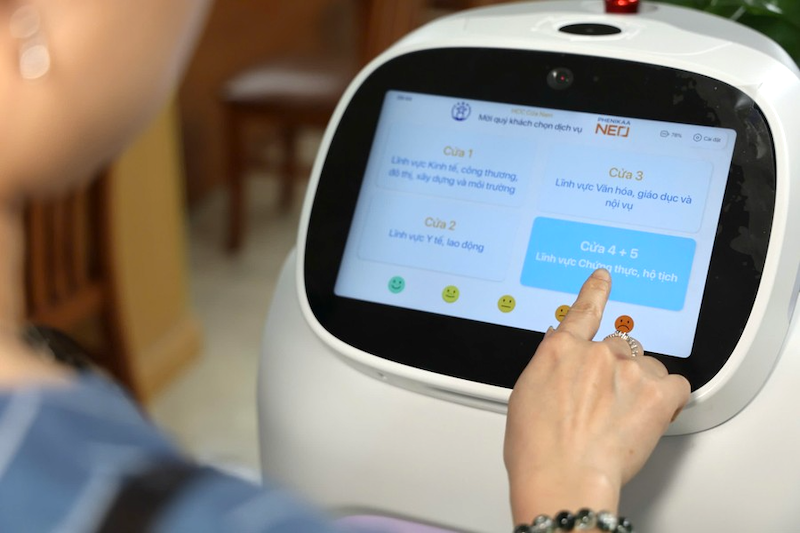
Interface of the Al-powered robot at Cua Nam Ward’s Public Administration Center.
Cua Nam Ward is not the only in the use of AI in public administration. The central government is moving to institutionalize AI integration, and Hanoi is expanding its AI-powered virtual assistant systems to support citizens and government officials.
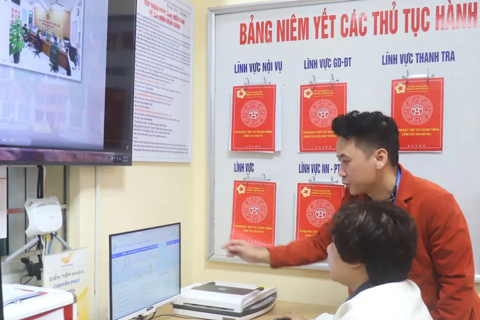
Nguyen Hoang Long, Deputy Director of the Hanoi Public Administration Service Center’s customer support division, said the center receives hundreds of questions and pieces of feedback daily. This information serves as a valuable source of insight for service improvements.
"We are rolling out AI call centers for multi-channel support and instant, accurate responses," he said.
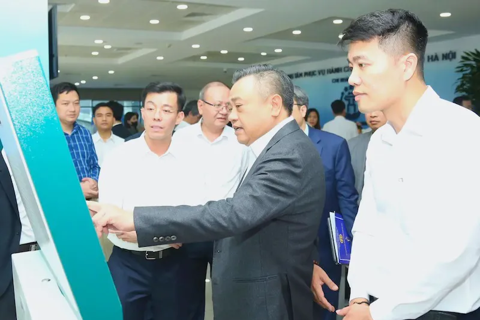
At a mid-June conference announcing 28 new decrees on decentralization and defining authority under the new two-tier local government model, Standing Deputy Prime Minister Nguyen Hoa Binh emphasized the crucial role of AI assistants.
“These tools allow officials to instantly access regulations, procedures, and workflows, while enabling citizens to search for information on more than 1,800 public services, anytime, anywhere,” he said.
During a recent field visit to the Thanh Hoa Commune Administrative Center in the central city of Cantho, National Assembly Chairman Tran Thanh Man stressed the importance of leveraging AI to enhance productivity.
“Every local officer should be equipped with AI tools to boost efficiency and performance,” he said.
As Vietnam accelerates digital government reforms, integrating AI technologies such as robots and virtual assistants is reshaping how public services are delivered, making them faster, more responsive, and more accessible to all.