Hanoi prepares human resources to operate Nhon-Hanoi metro line
The second metro line is expected to help reduce Hanoi's vehicle emissions by 20,000 tons of carbon dioxide per year.
Hanoi is preparing proper human resources to put Nhon-Hanoi Station metro line into commercial operation in July.
Nguyen Cao Minh, Director of the Hanoi Metropolitan Railway Management Board, made the statement at this week's inspection of the Nhon-Hanoi Station metro line by the State Inspection Council and Hanoi's leader.
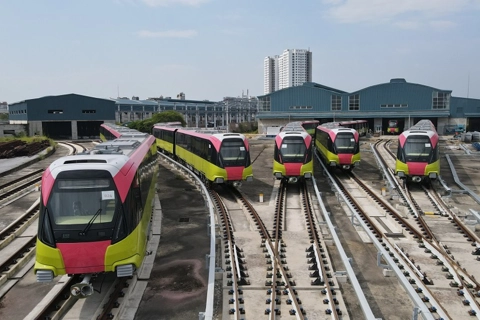
"The line is 74.7% complete, with the elevated section 99.93% built. Only 0.5% of the project is still under construction. The Nhon-Hanoi station metro line has been on trial for 1.5 months since March 11, with 57 trial scenarios," Minh said.
He added that by mid-May, the project had completed the final scenario for handling emergencies and evacuating passengers at the station, with the coordination of firefighters, traffic police, ambulance, and others.
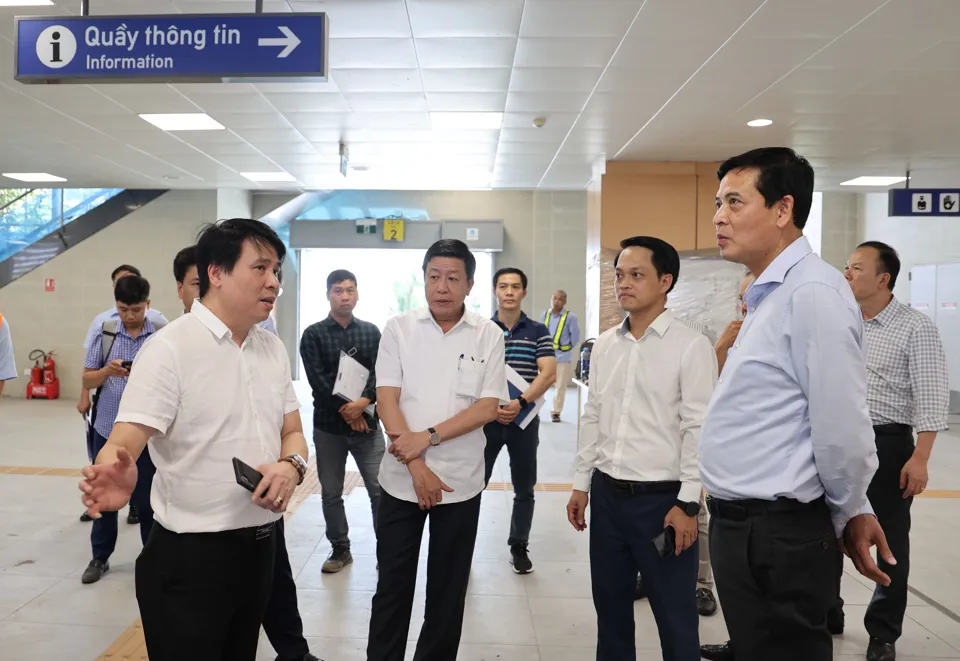
Director of the Hanoi Metropolitan Railway Management Board Nguyen Cao Minh (first, left) speaks to the inspection council at the S8 station of the Nhon-Hanoi metro line. Photo: Pham Cong/The Hanoi Times |
Regarding system safety assessment and certification, Minh said that the joint venture Apave - Bureau Veritas - Certifer Consulting (ABC Consulting) has performed the system safety assessment for the elevated section in accordance with the guideline and completed 10/12 assessment reports.
During the trial operation, 26 ABC Consulting’s experts came on site to evaluate and certify system safety, Minh stressed, adding that the Ministry of Transport and relevant agencies have also established a team to appraise the system safety dossier for the project.
"The Ministry of Transport is expected to complete the appraisal and accept the system safety documents no later than 15 days after ABC Consulting issues the system safety certificate. Work on the inventory of assets for the handover has been underway since January 2024 and has been completed," Minh said.
Speaking at the inspection meeting, Deputy Minister of Construction Bui Xuan Dung, Vice Chairman of the State Inspection Council for Construction Work Acceptance, appreciated the efforts of the investor, the contractor and the supervision unit to complete the project which is a key project for the whole country and the capital city.
Deputy Minister of Construction Bui Xuan Dung speaks at the inspection meeting. Pham Cong/The Hanoi Times |

Dung requested the investor to complete the acceptance work according to regulations, coordinate with the evaluation unit to quickly complete the system safety certification before June 10, and finish the project before June 20.
Vu Hong Truong, General Director of Hanoi Railway Company Limited (Hanoi Metro), the line's operator, told The Hanoi Times that Hanoi's first metro line Cat Linh-Ha Dong, has helped gradually cultivate the habit of using public transport.
"Hanoi's public transport capacity has increased to over 30% in the first three months of 2024, while Hanoi has set a target to increase this figure to 35% by 2025. Based on the successful experience of the Cat Linh-Ha Dong metro line, we are confident that the Nhon-Hanoi Station line, the second line, will also be a success once it is effectively put into operation," Truong said.
He added that according to the newly approved master plan for the city's development in 2021-2030 with a vision to 2050, Hanoi authorities will issue special mechanisms to speed up the construction of 14 urban railway lines in the city, four more than the number approved in the previous plan.
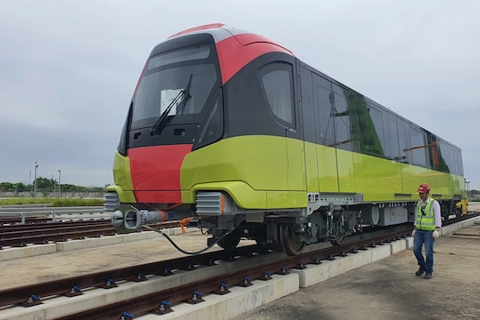
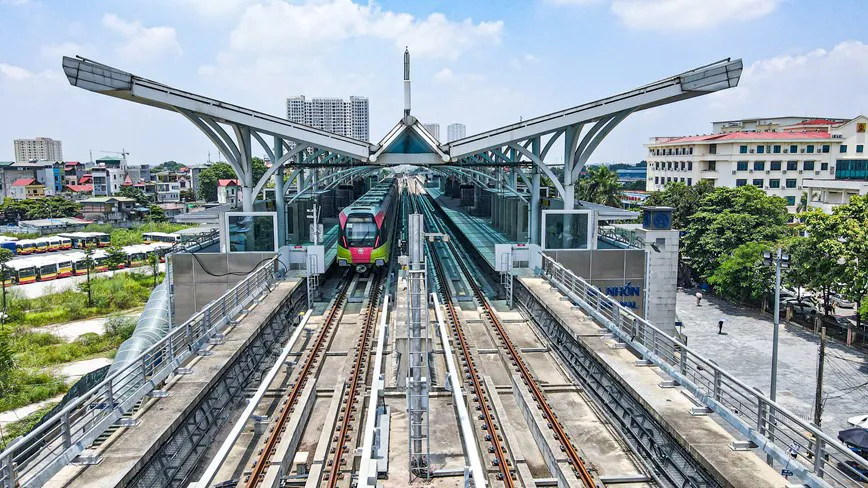
A train is being tested on the Nhon-Hanoi station metro line. Photo: Ngoc Trang/The Hanoi Times |
Meanwhile, Le Trung Hieu, a transportation expert, said that since its official opening, the Cat Linh-Ha Dong metro line has achieved four key objectives: safety, attracting passengers, reducing the use of private cars, and gaining experience in managing and operating urban railways.
"It's necessary to increase the completion of the public transport network to increase ridership. There are seven sets of tasks to be carried out to effectively operate a light rail system, including corporate structure, recruitment and human resources, system maintenance and operation procedures, fare policy, pilot program and early operation support, and subsidy planning," Hieu told The Hanoi Times.
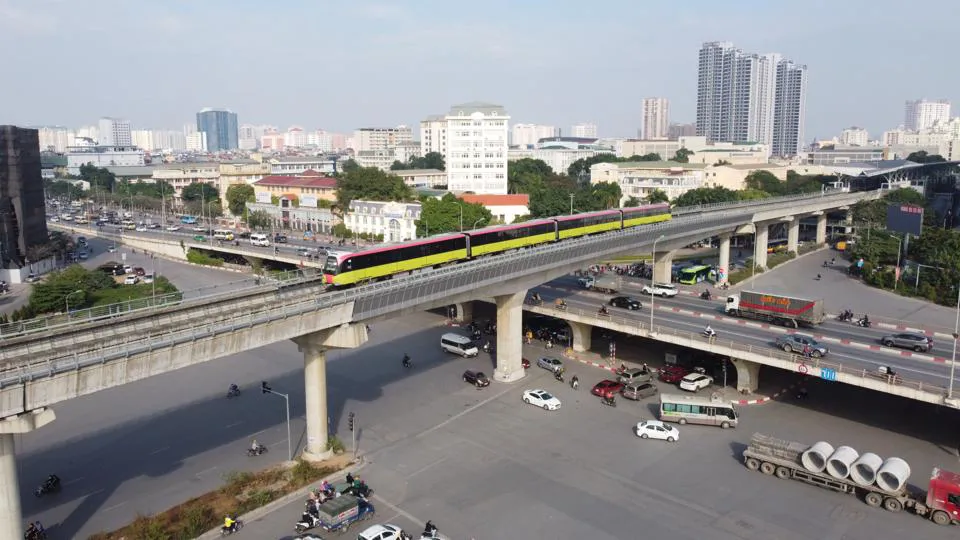
The 12.5-kilometer Nhon-Hanoi Station metro line has eight elevated and four underground stations. It passes through six districts: Bac Tu Liem, Nam Tu Liem, Cau Giay, Dong Da, Hoan Kiem and Ba Dinh.
The project started construction in 2009 and was scheduled to be completed in 2015, but there have been several delays. This metro line has since experienced a budget overrun, from an estimated VND18 trillion (US$728 million) to VND34.5 trillion (US$1.4 billion).
The Nhon - Hanoi Station metro line. Photo: Pham Cong/The Hanoi Times |