Hanoi pushes ahead with EV battery-swapping infrastructure
Hanoi is stepping up efforts to address challenges in helping residents shift from gasoline vehicles to electric ones.
THE HANOI TIMES — Hanoi government has called for the development of battery-swapping stations in densely-populated areas where demand is high but space for chargers is limited.

Vice Chairman of the Hanoi People's Committee Nguyen Manh Quyen at the meeting. Photo: Minh Tuong/The Hanoi Times
Those stations will diversify electric vehicle (EV) infrastructure, Vice Chairman of the Hanoi People's Committee Nguyen Manh Quyen told a meeting to review the progress of green transport transition in the city on September 5.
He tasked local government agencies to study potential sites for installing battery-swapping stations, while stressing that all projects must strictly adhere to fire safety regulations.
The vice chairman also called on the power, construction and finance sectors to collaborate in resolving relevant issues such as electricity supplies and access to loans.
Regarding green transition in public transport, Quyen said that the roadmap and policies for taxis should mirror those for buses. Hanoi targets to run all bus fleets on clean energy by 2030.
He added that ride-hailing companies must align with the city’s master plan and collaborate with agencies to design policies for green mobility.
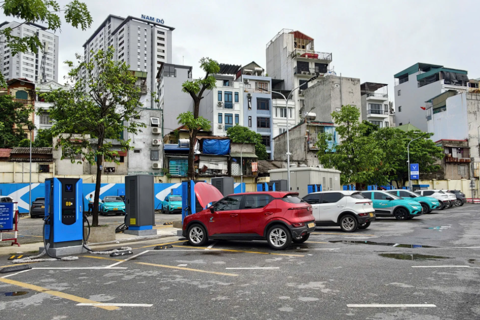
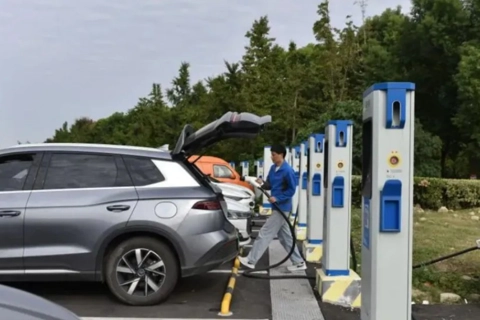
Deputy Director of the Hanoi Department of Construction Dao Viet Long said that a total of 1,400 charging stations have been suggested across the capital, including 115 locations within nine wards inside Ring Road No. 1.
“The city government must give priority to finalizing legal standards for charging systems as it is a crucial factor in making transportation go green,” he said.
According to Long, the Ministry of Science and Technology has issued 23 national standards related to EV charging stations. A draft regulation on charging station technical requirements is now under public review with finalization expected by November 2025.
The official said that a lack of unified standards prevents manufacturers and service providers from sharing charging stations, which is a major obstacle.
Other difficulties include the absence of an overall plan for the power grid and charging infrastructure, and unclear land classification rules for charging stations, Long added.

A battery-swapping station for electric motorbikes in Hanoi. Photo: Selex Motor
Hanoi should put several charging stations on test run to verify whether they are able to meet technical standards and serve vehicles with different charging ports, according to the city Department of Construction.
The department noted that gas stations, shopping centers and commercial facilities need specific technical criteria to install substations, charging points and battery-swapping stations.
It also recommended adjusting and updating power infrastructure planning to ensure flexibility in land use and alignment with clean-energy goals and compiling a list of land types eligible for charging infrastructure development.
Following a directive issued by Prime Minister Pham Minh Chinh early July, Hanoi will take measures to ensure no fossil-fuel motorcycles remain within Ring Road No. 1 starting on July 1, 2026.
The city targets at least 10% of existing parking spaces to be equipped with chargers by the end of that year. For new projects, the requirement is 30%. Hanoi will also prioritize curbside chargers and encourage investment in hydrogen and other clean-fuel stations.
Starting January 1, 2028, the restriction will apply to private cars running on fossil fuel within ring roads No. 1 and No. 2, and by 2030 to all private fossil-fuel vehicles inside Ring Road No. 3.
Ring Road 1 is a 25-km route encircling a 31-km² area, including 5.2 km² of West Lake, covering parts of nine wards. The population within the zone is about 600,000, with nearly 450,000 motorbikes currently in use.
As of June 30, 2025, Hanoi had more than seven million motorbikes and cars legally registered, not to mention a large number of vehicles traveling to the city from other localities.