14TH NATIONAL CONGRESS OF THE COMMUNIST PARTY OF VIETNAM
Log in
Business

Hanoi rates OCOP products together with IP protection

Many rural products of Hanoi needs protection for their trademarks.

Nguyen Minh Tien, Chief of Secretariat of the National Coordination Office of the National Target Program on New Rural Development, found that businesses manufacturing and commercializing One Commune One Product-labeled (OCOP) products have not paid attention to protecting trademarks, or registering with intellectual property (IP) authorities.

“This can cause disputes, lawsuits and loss of the IP rights if they ignore the issue,” Tien told a relevant meeting in late April in Hanoi.

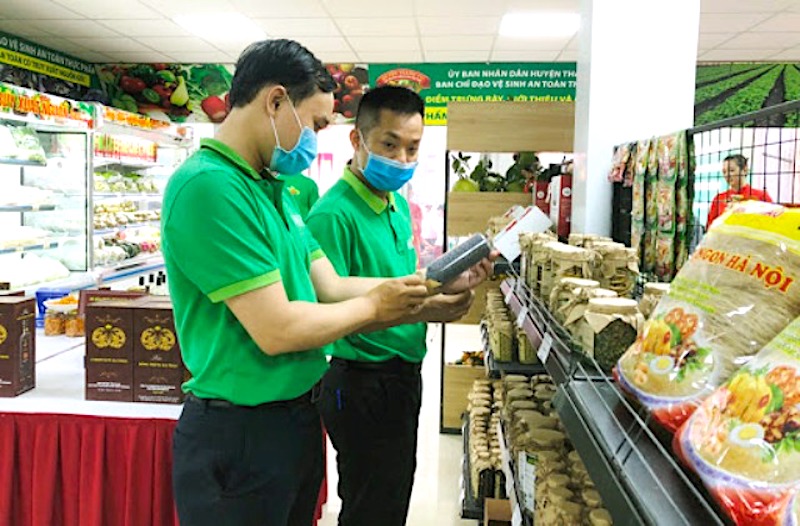
 An OCOP point in Thanh Tri district. Photo: kinhtedothi.vn

Sharing his view about the role of IP protection for OCOP-labeled products, Nguyen Anh Tuan, Deputy Director of the municipal Department of Science and Technology, said: “The registration for protection and effective management of IP rights for specialty products will contribute to maintaining and developing brands for businesses and cooperatives in rural areas.”

The effective protection of trademark ownership and IP rights will contribute to promoting the creation and innovation, Tuan added. “Therefore, products recognized by OCOP and protected by IP law will be enhanced in quality, value and competitiveness on domestic and potential foreign markets. For OCOP products with export potential, brand protection becomes even more essential,” he told Hanoitimes.

IP protection is one of the three main criteria for the evaluation and grading of OCOP-labeled products set by the national strategy. According to the National Intellectual Property Development Program, by 2030, at least an estimated 60% of OCOP products are to be protected by IP law.

In order to raise awareness on IP protection among handicraft villages in the city, the Hanoi Department of Science and Technology has advised the municipal People's Committee to promulgate plans encouraging the IP registration for agricultural products and craft villages of the city in the coming years. 

The department also counseled and guided 31 organizations and individuals to complete procedures for industrial property protection (25 trademark applications, six patent applications, one utility solution application and eight industrial design ones).

Last year, the municipal department's IP Management Division organized 18 training courses on brand development for handicraft villages with 1,260 participants.

In 2020, among 27 approved IP projects according to Decision No. 4506, twenty-two were related to OCOP products. 

The chosen projects were Yen Nghia safe vegetable (Ha Dong district), Dan Phuong flowers (Dan Phuong district); Do Dong rice (Thanh Oai district); Huong Ngai potatoes (Thach That district), and Dong Cao red pomelo (Me Linh district).


Reactions:
Share:
Trending
Most Viewed
Related news
Hanoi poised to lead low-altitude space economy

Hanoi poised to lead low-altitude space economy

The low-altitude economy is not a distant vision but a reality already taking shape, bringing a rare opportunity for Hanoi to lead the next phase of urban technological transformation.

Vietnam, US to continue reciprocal tariff talks next week

Vietnam, US to continue reciprocal tariff talks next week

Vietnam has reaffirmed its willingness to facilitate greater access for US goods and companies as Hanoi and Washington prepare to hold the sixth round of negotiations on reciprocal tariffs.

Viettel Money added to national public service portal, expanding cashless government payments

Viettel Money added to national public service portal, expanding cashless government payments

Vietnam is expanding cashless public services as Viettel Money joins the National Public Service Portal, helping streamline administrative processing for both citizens and government agencies nationwide.

Vietnam’s online food delivery market jumps 19% in 2025 as duopoly tightens grip

Vietnam’s online food delivery market jumps 19% in 2025 as duopoly tightens grip

Rapid urbanization and app-based lifestyles are reshaping how Vietnamese consumers order meals, with food delivery platforms expanding quickly in 2025 amid rising competition, service innovation and growing reliance on digital channels for everyday dining across major cities.

Four competitive pillars shape HCMC-based international financial center vision

Four competitive pillars shape HCMC-based international financial center vision

Currently ranked 95th out of 120 cities in the Global Financial Centres Index, Ho Chi Minh City aims to reach the top 75 by 2035 and the top 50 by 2045.

FPT opens advanced chip testing plant, deepening Vietnam’s role in global semiconductor chains

FPT opens advanced chip testing plant, deepening Vietnam’s role in global semiconductor chains

FPT has announced the establishment of an advanced semiconductor testing and packaging plant in the northern province of Bac Ninh, expected to begin operations this year, marking a significant step toward completing Vietnam’s semiconductor value chain.

Japanese food companies step up focus on Vietnam market

Japanese food companies step up focus on Vietnam market

As Vietnam’s income levels rise, consumer demand has gradually shifted toward higher-quality and more diverse food products.

Vietnam targets national gold exchange launch in February to improve market transparency

Vietnam targets national gold exchange launch in February to improve market transparency

Vietnam is accelerating financial market reforms as the government pushes forward plans for a national gold exchange platform and experiments with digital asset trading, aiming to improve transparency, stabilize markets and strengthen macroeconomic management.