Hanoi’s one-stop public service center marks breakthrough in governance reform
Hanoi sees administrative reform as a way to improve service quality, boost transparency, and build public and business trust, not just simplify procedures or speed up processing.
THE HANOI TIMES — The one-stop public service center model represents a breakthrough in reforming management thinking, operational mechanisms, and the delivery of administrative services.

Overview of the meeting. Photo: Hanoi Portal
Vice Chairman of the Hanoi People’s Committee Truong Viet Dung shared this view during a working exchange on August 6 with a delegation from Danang, led by its Vice Chairman Ho Quang Buu, who visited the capital to learn from Hanoi’s experience in implementing the one-level public service center model.
According to Vice Chairman Dung, the implementation of this model in Hanoi is the result of a coordinated effort combining institutional reform, modern technology adoption, and the professionalization of the administrative apparatus.
“Hanoi views administrative reform not merely as simplifying procedures or shortening processing times, but as a means to improve service quality, enhance transparency, and strengthen public and business trust in the government,” Dung said.
The Hanoi People’s Council on October 4, 2024, passed Resolution No. 35/NQ-HDND, approving the pilot proposal and establishment of the Hanoi Public Administrative Service Center.
The center currently comprises four specialized departments, two affiliated public service units, and oversees 12 regional branches, managing a total of 30 service reception points citywide.
Since the launch, a relatively independent operational mechanism has been established, fully separating the “one-stop” units from the authorities in charge of resolving administrative procedures.
Deputy Director of the Hanoi Public Administrative Service Center Hoang Van Bang noted this structure enables the center to cross-monitor the performance of specialized agencies in handling administrative tasks, while allowing those agencies to also oversee how the center guides citizens, receives applications, and returns results.
“This system of checks and balances plays a vital role in reducing misconduct and improving transparency,” Bang said.
In particular, the center’s branches have effectively helped urge competent agencies to process pending, near-due, or overdue cases on the city's administrative procedure resolution platform, contributing to a 15% decrease in delayed applications compared to previous figures, he noted.
The center has also formed inspection teams to directly monitor administrative procedure handling at departments and agencies, with a particular focus on sensitive areas such as land and construction. Findings are reported to the relevant authorities for review and accountability.
The model also enables a more professional approach to state administration and public service delivery. While the responsible agencies focus on resolving applications, the center assumes full responsibility for service quality.
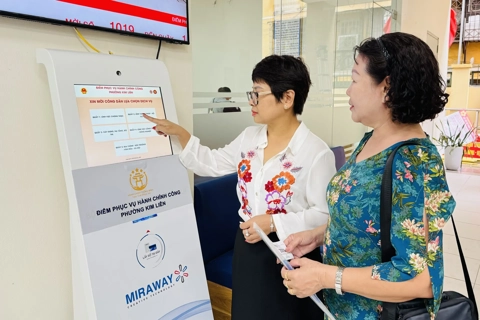
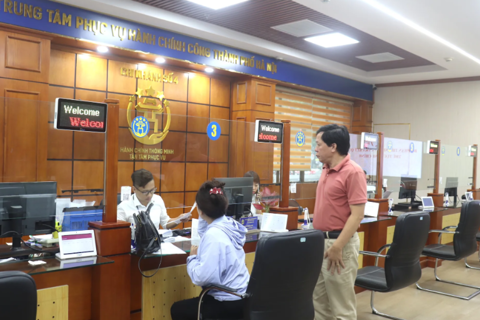
This marks a significant departure from traditional “one-stop” units, now reorganized into modern, multi-functional zones: reception areas, self-service spaces with advanced equipment, digitalization areas, customer support zones with specialized services, application intake counters, fee collection and result-return counters, dedicated service zones for enterprises handling high-volume or high-priority cases (such as real estate), and feedback stations for citizen satisfaction ratings.
These features are more than visual improvements; they symbolize a shift in institutional mindset and the commitment of every official to better serve citizens and businesses, Bang said.

The network of public administrative service branches and service points under the People’s Committees of 126 communes and wards across Hanoi began operations on July 1, 2025. Photo: The Hanoi Times
"Digital pressure" to form "digital habits and skills"
On lessons learned from the implementation, Bang stressed the critical role of information technology. The center identified the City’s Administrative Procedure Resolution System as the backbone of digital public services and committed significant resources to upgrade and rebuild it.
In fact, Bang said that the center opted to start from scratch with a new system to resolve fundamental limitations of the old one, redesigning the entire platform for greater efficiency, flexibility, and user-friendliness. Despite some technical issues during the transition, the process was completed within a month, at an unprecedented speed, earning recognition for both its pace and effectiveness, he said.
Alongside this, the iHanoi platform serves as a digital bridge between the government and citizens, gathering feedback and public concerns. To date, it has received 78,000 submissions, with nearly 90% processed or in progress.
The platform also hosts 2,700 initiatives for Hanoi’s development. Integrated features include a mini public service app, digital document wallets, feedback channels on waste and business-related concerns, an open science and technology forum, and 55 other utilities.

Vice Chairman of the Hanoi People’s Committee Truong Viet Dung presents souvenirs to the delegation from Danang.
After nearly a year of deployment, iHanoi has become the largest digital citizen platform in Vietnam, with 5.8 million user accounts and about 72 million visits. Recently, the platform added a Vietnamese social network feature that supports official interaction groups at the neighborhood, village, and residential community levels, an effective tool for grassroots governance in the two-tier local government structure.
The center has also implemented 24/7 Chatbot and Callbot systems and deployed an AI-driven civil servant assistant capable of supporting over 2,000 administrative procedures. In just three months, the Chatbot served 73,568 users with 564,549 queries, while the 19001009 hotline handled 9,021 calls, totaling 204 hours of voice support.
Cameras and microphones have been installed at guidance, intake, and result counters across branches, with integrated AI to analyze satisfaction data and automatically monitor staff performance, helping to prevent misconduct and ensure accountability.
To support seamless operations and better serve citizens and businesses, the center has advised the city’s leaders to issue relevant resolutions, plans, and directives as a legal foundation for implementation. In parallel, the center has used "digital pressure" to help form "digital habits and skills" among users.
Bang added that the center is committed to delivering genuine digital public services, not merely symbolic ones, and aims to drive digital transformation across the community through its practices. Each week, Hanoi publishes a list of procedures eligible for full online service, which will be accepted exclusively via digital channels.
Even citizens arriving in person are guided to complete the process online. This “digital pressure” is paired with extensive “digital support” mechanisms, including on-site assistance desks at the center’s service points, 476 free online public service agents offering help with form completion and document scanning, traditional hotlines, smart switchboards, 24/7 Chatbots and Callbots, and the AI assistant mentioned earlier.
During the meeting, leaders from Hanoi and Danang agreed to strengthen cooperation, share best practices, and foster a results-oriented partnership. Together, both sides aim to build a modern administration that centers on the needs of citizens, leverages technology as a driving force, and upholds professionalism and dedication as core service values.