Hanoi sets breakthrough GRDP growth target of 11% in 2026
The private sector remains a core economic engine for Hanoi, as the city will encourage the formation of large domestic corporations.
THE HANOI TIMES — Hanoi aims for GRDP growth of 11% in 2026 with services, industry and construction serving as the key pillars driving development.

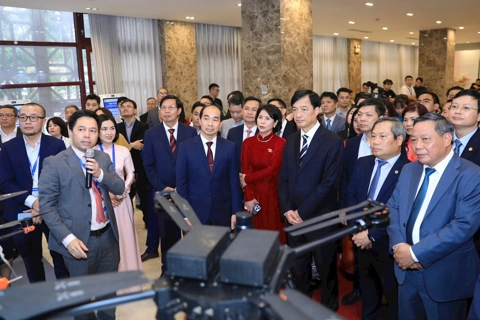
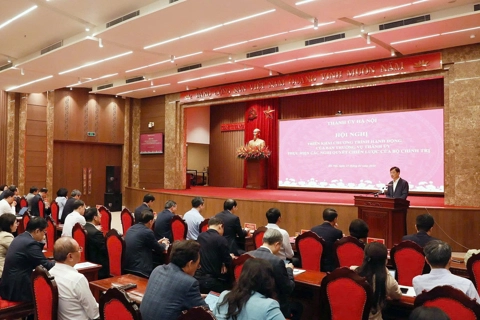
Hanoi leaders at the meeting. Photos: Thanh Hai/The Hanoi Times
Vice Chairman of the Hanoi People’s Committee Nguyen Xuan Luu shared the figures during the meeting of the municipal Party Committee on November 25.
According to Luu, Hanoi’s economy continued to expand solidly in 2025, meeting the overall development goal and achieving 23 out of 24 indicators.
The capital’s GRDP is estimated to rise 8.5% for the full year. Its economic scale reached US$63.5 billion, accounting for roughly 12.5% of the national GDP.
For the first time, the city’s budget revenue exceeded the VND600 trillion mark, reaching VND641.71 trillion (US$25.67 billion), equal to 124.9% of the estimate.
“This level of revenue reflects Hanoi’s central role in the country’s fiscal stability,” stated Luu.
Cultural and social indicators also improved. Celebrations for the 80th anniversary of the August Revolution and National Day generated strong public engagement and strengthened civic pride.
The education sector maintained its high standing with a school graduation rate of 99.75%, placing Hanoi second nationwide and nine spots higher than in 2024.
Social welfare continued to advance with health insurance coverage rising to 95.95% and surpassing the annual target.
Luu noted that Hanoi accelerated infrastructure development in 2025 and completed or began work on 18 major projects tied to national anniversaries.
Eight more projects are scheduled to begin on December 19.
Additionally, administrative reform and digital transformation recorded further gains. Processing times for public investment procedures were shortened and Hanoi maintained its national lead in innovation with 18 out of 52 indicators ranked first.
“Innovation must remain the backbone of Hanoi’s development model,” Luu said.
Meanwhile, security and social order were maintained and international cooperation expanded. Foreign direct investment (FDI) reached more than US$4.1 billion, marking a 1.5-fold increase from 2024. Export turnover rose to US$21.4 billion, increasing 11.6% year on year.
For GRDP growth to reach the 11% target in 2026, Luu expects services to grow 11.1% industry 9.5%, construction 12.8% and agriculture 4.3%.
The city targets VND730 trillion (US$29.2 billion) in total social investment capital, including VND216 trillion (US$8.64 billion) in state capital, VND60 trillion (US$2.4 billion) in FDI and VND454 trillion (US$18.16 billion) in private capital.
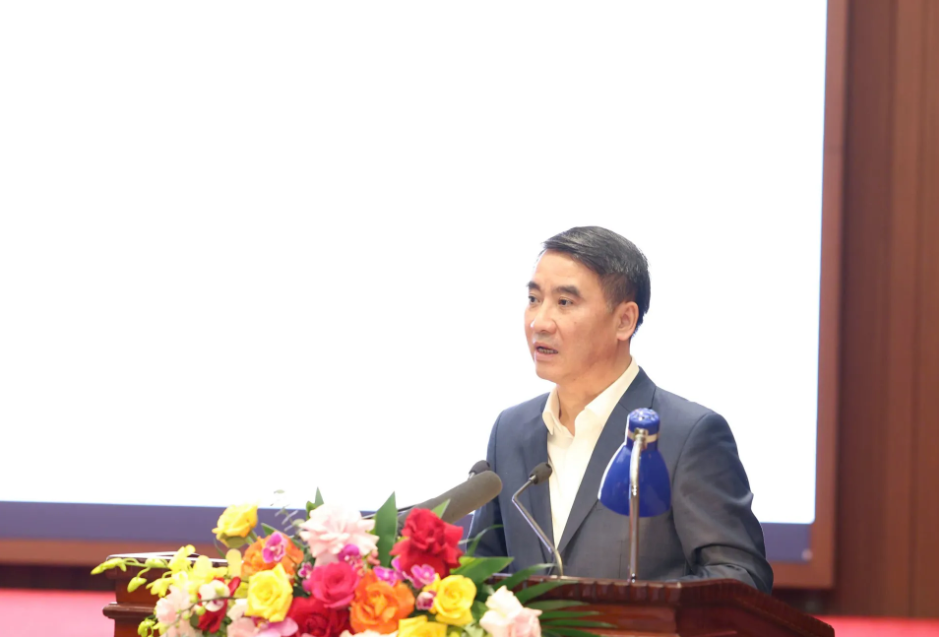
Vice Chairman of the Hanoi People's Committee Nguyen Xuan Luu.
Private sector as core economic engine
The services sector, which accounts for 66% of GRDP, will remain a priority with an emphasis on trade, tourism, finance, banking and the development of a national e-commerce platform, Luu said.
Hanoi also plans to apply blockchain and QR-based systems in logistics and product tracing.
New growth momentum will come from improved governance, institutional reform and adjustments to the Capital Law and planning frameworks.
Spatial development will follow five major axes, including the Red River, West Lake–Co Loa, Nhat Tan–Noi Bai, West Lake–Ba Vi and the southern corridor.
The private sector remains a core economic engine and Hanoi will encourage the formation of large domestic corporations while supporting micro and small enterprises through business model transformation.
Luu noted that the city will expand science and technology infrastructure and advance digital transformation.
Hanoi plans to accelerate the development of the Hoa Lac science and technology urban area, along with intellectual property-based industries and the digital gaming economy.
“The city would build a governance model capable of driving modern development and managing a smart and digitally connected capital,” he said.
Workforce development and social welfare programs will accompany these efforts.
Urban infrastructure will receive renewed investment. Hanoi will adjust its urban railway planning and speed up construction of Lines 2.1 and 5, Ring Road 4 and new Red River bridges such as Tu Lien, Thuong Cat and Tran Hung Dao.
Land management will be strengthened through completion of the cadastral database and improved land use efficiency, especially around Ring Road 4 and transit-oriented development zones.
Hanoi also plans to address five major urban challenges: traffic congestion, flooding, pollution, food safety and urban order while restoring water quality in four inner city rivers.
Public investment remains a key driver. The prime minister allocated VND83.7 trillion (US$3.348 billion) to Hanoi for 2025. Accounting for the two-tier local government model, the city assigned VND103.7 trillion (US$4.148 billion), which is 1.28 times higher than in 2024.
Cumulative disbursement reached VND52 trillion (US$2.08 billion) as of November 22, 2025, equal to 62.1% of the central target compared with the national average of 55.4%.
To address disbursement bottlenecks, Hanoi is revising land clearance policies, prioritizing resettlement land in areas where land use auctions are planned and offering temporary cash support to allow affected households to relocate quickly.
The city is also adjusting prices for fixed bid packages affected by land clearance delays and streamlining administrative procedures for public investment across all levels.
“These coordinated measures are essential to support growth and ensure Hanoi enters 2026 with a decisive and breakthrough mindset,” Luu concluded.