Hanoi targets GRDP growth of at least 8% in 2025
Citizen and business satisfaction remains the key benchmark for measuring the effectiveness of Hanoi’s local governance system.
THE HANOI TIMES — Despite mounting global challenges, Hanoi is firmly committed to achieving a gross regional domestic product (GRDP) growth rate of at least 8% this year.

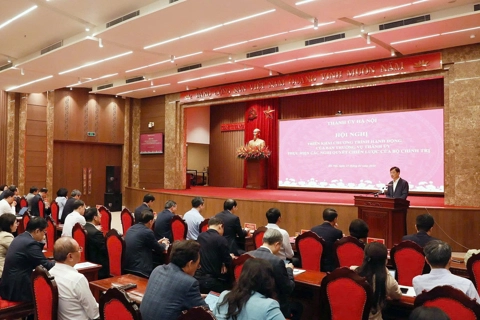
Vice Chairman of the Hanoi People's Committee Truong Viet Dung at the session on July 8. Photos: Thanh Hai/The Hanoi Times
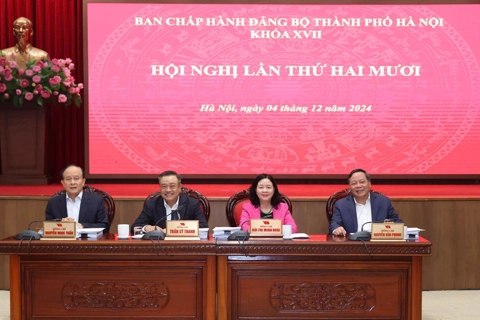
Truong Viet Dung, Vice Chairman of the Hanoi People's Committee, reaffirmed this target during the 25th session of the municipal People’s Council this week. He noted that Hanoi’s economic performance in the first half of the year had already surpassed expectations.
Dung reported that growth had accelerated quarter by quarter, reaching 7.63%, higher than the national average and notably above that of the same period in 2024.
"With forecasts pointing to 8.18% growth in the third quarter and 8.53% in the fourth, Hanoi appears to be on track to meet its full-year target," said Dung.
He added that this performance reflects the city’s determination and adaptability, especially since global growth forecasts have been revised downward by institutions like the IMF (from 3.3% to 2.8%).
A key driver of this momentum is the implementation of the amended Capital Law, which introduced more effective governance mechanisms. The city has also launched major policy programs and accelerated administrative reforms through proactive and creative strategies.
Dung also highlighted progress in digital transformation and the development of a smart city model. Infrastructure projects are being fast-tracked under the “green lane” mechanism to reduce approval timelines.

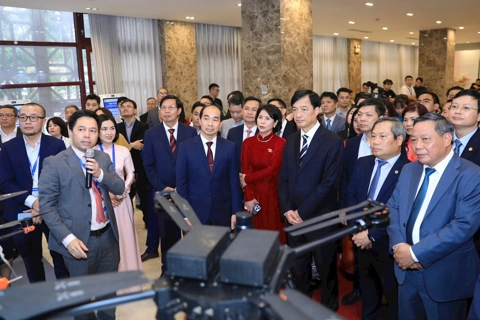
Overview of the 25th session.
The city’s two-tier governance model was fully implemented within just eight days. All 126 newly reorganized communes and wards became operational without disruption, supported by more than 84,000 temporary digital workflows to assist residents and businesses during the transition.
Budget revenue surged past 77% of the annual target, driven by a strong services sector, rising industrial output, and steady contributions from agriculture. Retail and consumer services continued to expand on the back of resilient domestic demand.
Inflation remained under control at 3.2%, lower than the national average. Meanwhile, the tourism sector rebounded with 3.6 million visitors, including 2.63 million international arrivals.
Foreign direct investment (FDI) reached US$3.67 billion, three times higher than the same period last year, while 15,681 new businesses were established and thousands resumed operations.
Urban development advanced rapidly. All city zoning and architectural regulations were approved, paving the way for new housing and infrastructure projects.
Social housing received a notable boost as Hanoi’s urbanization rate surpassed 52%. Key transport initiatives progressed, including the groundbreaking of Tu Lien Bridge and plans to launch additional bridge projects within the year.
The capital’s innovation ecosystem also gained momentum, with dozens of new science and technology enterprises approved and expanded vocational and leadership training programs. Public health and social welfare systems remained stable.
Looking ahead to the second half of the year, Hanoi aims to sustain growth by stimulating consumption, accelerating industrial production, and enhancing support for the private sector. The city is also intensifying efforts to disburse public investment capital in full and on schedule

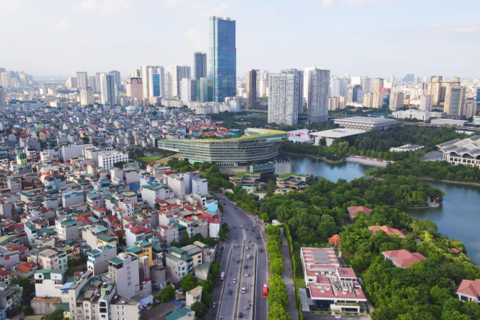
Hanoi from above. Photo: Pham Hung/The Hanoi Times
In parallel, Hanoi is advancing its innovation agenda through Resolution 57, aiming to digitize medical records in all public hospitals by Q3, boost digital literacy in 80% of urban households, and integrate thousands of government accounts to enhance data sharing.
Support for tech startups continues to grow, with fifty innovation projects in Hoa Lac High-Tech Park expected to attract an additional $500 million in foreign investment.
Urban planning remains a high priority. Four major new zoning schemes are scheduled for completion, and key infrastructure projects, including metro lines and Red River bridges, are advancing. Half of the expected investment funds are set to be disbursed this year, Dung said.
On the environmental front, the city is scaling up wastewater treatment and beginning operations at Yen Xa, while also pushing forward with other key projects. Efforts to revitalize rivers are underway to cut pollution levels in half before the end of the year.
Hanoi is preparing for national celebrations marking the 80th anniversary of the August Revolution and National Day on September 2. Plans for upcoming party congresses are progressing, and the new governance model is being fine-tuned to ensure seamless service delivery.
The official reiterated that citizen and business satisfaction will remain the most important metric of government effectiveness.
"With unity, responsibility, and the highest determination, the Hanoi People’s Committee is committed to working closely with the municipal People’s Council, the Vietnam Fatherland Front, and partner organizations to fulfill this year's objectives, especially the 8% growth target," Dung affirmed.