Hanoi, Chinese province cooperate in heritage conservation
The two localities will enhance cultural cooperation, focusing on sharing experiences in heritage preservation and cultural values exploitation.
Cultural development remains a key priority in relations between Hanoi and Chinese province Shaanxi - one of China’s "Eight Great Ancient Capitals" and a place with a long history and cultural tradition in the country.
| Vice Secretary of the Hanoi Party Committee Nguyen Van Phong (l) and Fang Hongwei, Secretary of the Party Committee of Xi’an (r). Photos: The Hanoi Times |

The view was shared during a meeting between the Vice Secretary of the Hanoi Party Committee Nguyen Van Phong, who is currently visiting China, and Fang Hongwei, Secretary of the Party Committee of Xi’an, the capital of Shaanxi Province, China on May 20.
Phong emphasized that building on the good and friendly relations between Vietnam and China, he was pleased to lead the Hanoi delegation to visit and work in Shaanxi this time to promote cooperation between the two localities, especially in the cultural field.
The Hanoi delegation spent time learning about Shaanxi Province's conservation efforts, value promotion of heritage, and cultural industry development through visits to a number of important heritage sites and museums such as Emperor Qinshihuang’s Mausoleum and the Shaanxi Provincial Museum.
Phong noted that both Hanoi and Shaanxi possess extensive and diverse cultural heritage systems.
“Collaborating and sharing experiences in exploiting this cultural heritage system to unleash its latent values will undoubtedly have profound practical significance for economic development in general and cultural industries in particular,” he noted.
He called on both sides to continue promoting bilateral exchanges and contacts between the two localities, including at the leadership and grassroots levels.
“Hanoi welcomes the leadership and specialized agencies of Shaanxi Province and Xi’an City to visit and work in Hanoi, thereby enhancing friendly relations at the local level and contributing to nurturing the comprehensive strategic partnership between Vietnam and China,” he added.
| Delegates at the meeting. |
.png)
Particularly, Phong hoped that Hanoi and Shaanxi would expand and deepen cooperation in the cultural field, including expert exchanges, scientific seminars, and the sharing of experiences in the preservation and exploitation of cultural heritage values.
“In the immediate future, we hope to cooperate with Shaanxi Province in researching, conserving, and restoring palaces and promoting the multiple values of the World Heritage Site of the Imperial Citadel of Thang Long,” Phong added.
Meanwhile, Phong expected the two cities to strengthen cooperation in tourism, explore new tourism routes between Hanoi and Shaanxi, coordinate in promoting the tourism resources of both localities, contribute to economic development, promote people-to-people exchanges, and enhance mutual understanding between the two sides.
According to Phong, Hanoi would continue to promote economic cooperation and investment in areas of mutual interest and strength.
“Hanoi welcomes and creates favorable conditions for Chinese enterprises and conglomerates with strong capital and technology to invest in Hanoi and expand their business, especially in new areas such as digital transformation, green growth, renewable energy, circular economy, and environmental protection,” he said.
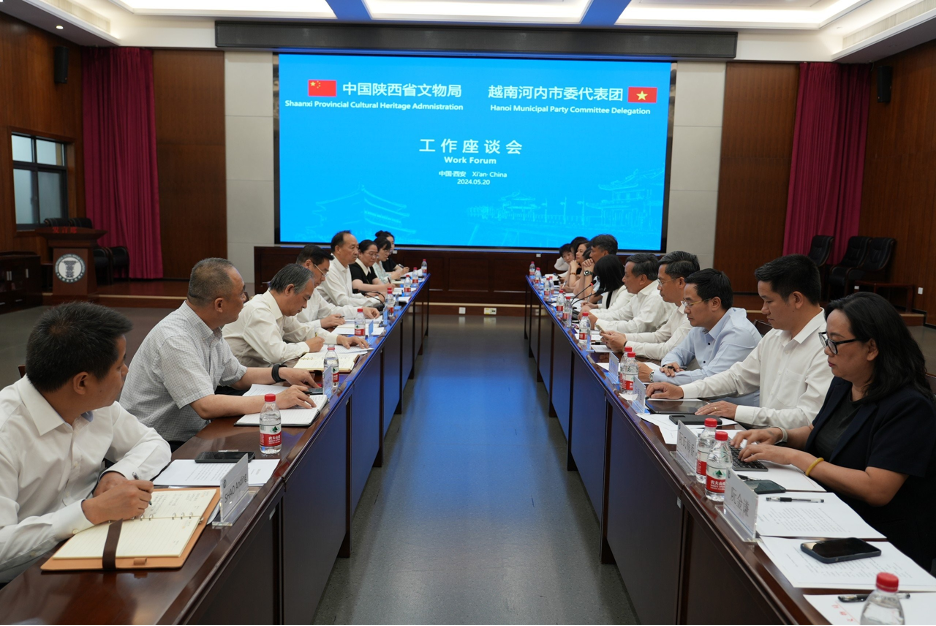
| The delegation during a meeting with Shaanxi Provincial Cultural Heritage Administration. |
For his part, Xi’an Party Chief Fang Hongwei stated that Shaanxi was one of the cradles of Chinese culture, once the capital of 14 dynasties with a rich history and famous landmarks.
Xi’an in particular holds a special position in Chinese history. Among the ancient capitals of China, the capital of Changan (now Xi’an) was the first capital of the unified Chinese state under the Qin Dynasty, when Emperor Qin Shi Huang built the Great Wall.
He added that Shaanxi has established friendly relations with 40 cities in 33 countries. Despite its geographical distance from Vietnam, there are over 700 Vietnamese students studying at 12 educational institutions in the province.
Fang said that both sides share a long-standing cultural and historical foundation. The visit of the high-level delegation from Hanoi serves as a motivation for both cities' development in the future, he said.
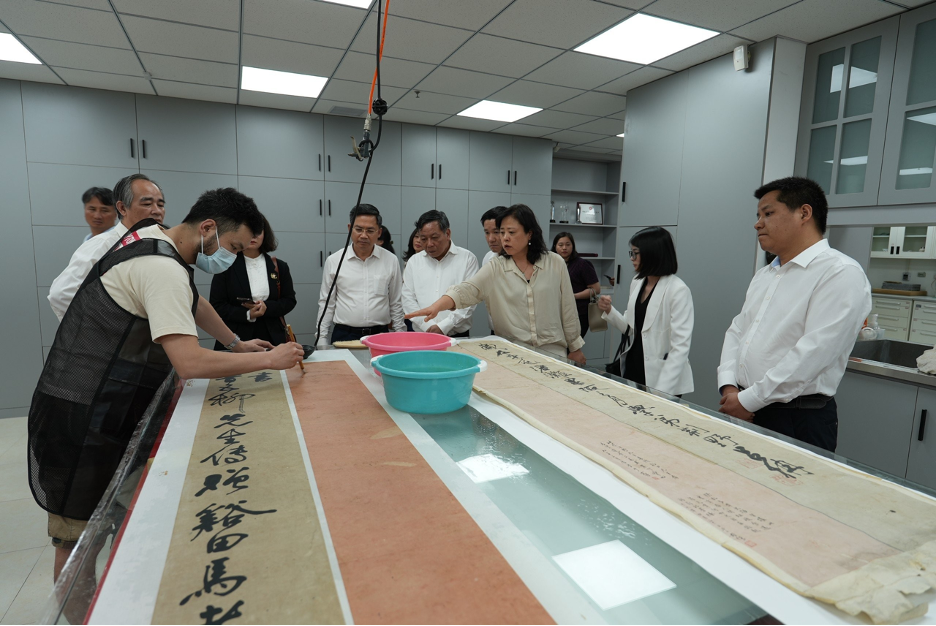
| The delegation was introduced to technologies for the restoration and conservation of relics and artifacts. |
Fang added that the two cities share cultural similarities and ideals, and will have many cooperation opportunities in the future and hoped the visit would be a great success.
Later that day, the high-level delegation from Hanoi visited and worked with the Cultural Heritage Department of Shaanxi Province. Both sides exchanged views on heritage conservation, value promotion, and especially shared experiences in conserving and restoring artifacts and the assessment of indoor and outdoor antiquities in museums.
The delegation also visited and worked with the Research Institute for Cultural Heritage Conservation of Shaanxi. Here, the delegation was introduced to modern technologies used in the excavation, assessment, restoration, and conservation of relics and artifacts.