Hanoi to find solutions for effectively implementing OCOP program
The One Commune One Product (OCOP) program, which has been implemented since 2019, has created a breakthrough in rural economic development in Hanoi.
Permanent Deputy Chief of the Hanoi Office of New Rural Development Program Coordination Nguyen Van Chi talked to Hanoitimes about how to effectively implement the One Commune One Product (OCOP) program.
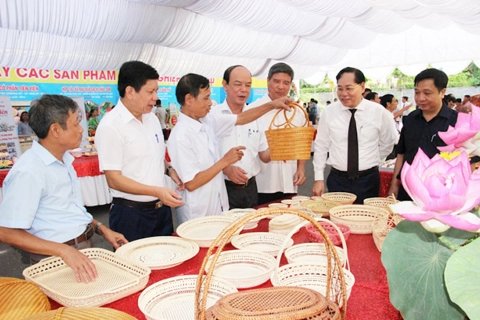
OCOP products on display at a promotion fair. Photo: Hoai Nam |

Could you name some outstanding results from the implementation of the OCOP program in Hanoi?
Implementing the prime minister's decision, the Hanoi People's Committee immediately issued a concrete plan to roll out the OCOP program for the 2019 - 2020 period. In 2019, Hanoi had 301 OCOP products, including six products submitted for being labeled with five stars.
In 2020, despite the impact of the Covid-19 pandemic, localities have made great efforts to promote the program. So far this year, 147 products from five districts and towns have been evaluated and classified as OCOP ones.
For five-star products, Hanoi will support and submit them for evaluation and inclusion in the national OCOP list. In addition, the city maps out a policy of upgrading the rating of all OCOP products, those of three stars to four stars, and those of four stars to five stars.
In the process of implementing the OCOP program, what difficulties are entities in Hanoi facing?
In fact, the production scale of the facilities is still small. As products are mainly semi processed, we are building an investment project for deep processing to improve the quality of products. The local handicraft industry is causing strong environmental pollution, thus, Hanoi has requested departments, branches and localities to focus on environmental impact assessment to draw up solutions. Design and the quality of products also need to be improved in the coming time.
Design and the quality of products also need to be improved in the coming time. |

What solution does Hanoi have to address the consumption of OCOP products?
In addition to consulting and assisting the businesses to improve the quality of products for evaluation at all levels, in the OCOP product development cycle, Hanoi has also focused on promoting sales. In 2020, Hanoi has issued a plan to organize four events to promote, introduce and sell OCOP products with provinces in the Northern mountainous, Red River Delta, Central - Central Highlands and Southern regions.
Due to the impact of Covid-19, the implementation progress has been slower than expected. However, we have managed to organize three events recently. The remaining event will be held in December 2020. Through the evaluation of the Vietnam Retailers Association, after three trade networking events, about 65% of the memoranda of understanding to sell OCOP products in distribution channels have been effectively implemented.
What are your suggestions to effectively implement the program?
We are aware of the importance of the quality management of OCOP products. The city has conducted four inspections and evaluations of those who have been granted OCOP product certificates. Any business that fail to comply with quality standards will see its certificate revoked. In fact, the implementation process in the past period shows that localities are very active in upgrading the quality of OCOP products. Entities are also aware of the importance of OCOP-labeled products. This will be the premise for Hanoi to complete the objective of the OCOP program to ensure the criteria of quantity and quality.
Thank you for the interview with Hanoitimes!