Hanoi to phase out motorbike in core districts after 2025
The local authorities estimated the public transportation system built during the 2026-2030 period would be able to handle 30% of the city's passengers.
Hanoi is scheduled to ban motorbikes in five core districts and parts of others for a total area of 145 square kilometers after 2025, five years earlier compared to the previous plan.
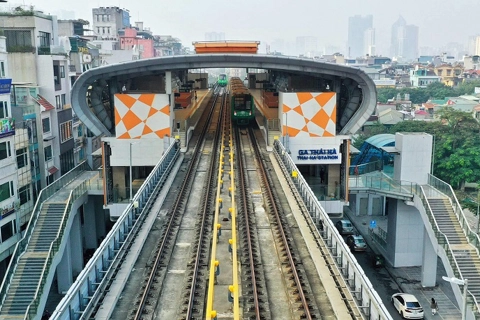
| Hanoi is set to phase out motorbikes after 2025. Photo: Hoa Thang |
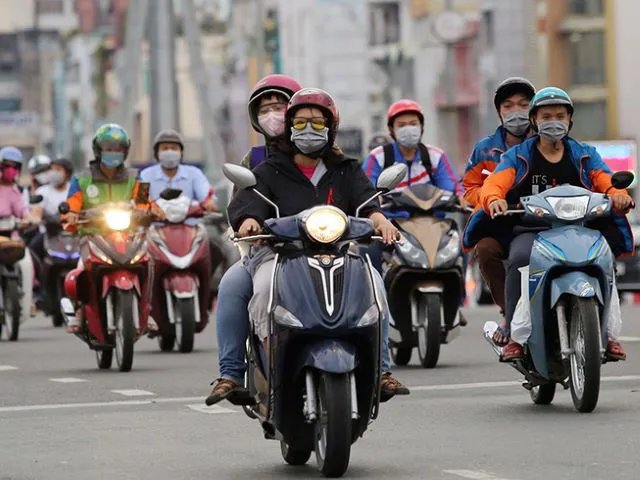
The move was revealed in a proposal from the Hanoi People’s Committee which was submitted to the municipal People’s Council for consideration, to reduce traffic congestion and accidents in the capital city for the 2021-2025 period.
During this period, Hanoi would continue to finalize the proposal to limit motorbikes and then ban this transport vehicle in five core districts from 2026 onwards, specifically in Hoan Kiem, Hai Ba Trung, Ba Dinh, Dong Da, Tay Ho, and parts of Hoang Mai, Thanh Xuan, Nam Tu Liem, Bac Tu Liem, Dong Anh, Long Bien, and Gia Lam, equivalent to 4.4% of the city’s total area.
The proposal suggested to close core districts to motorbikes traffic, the city would invest in transport infrastructure, including the conversion of four existing bus stations into public parking, construction of four new bus stations, and two bus interchanges.
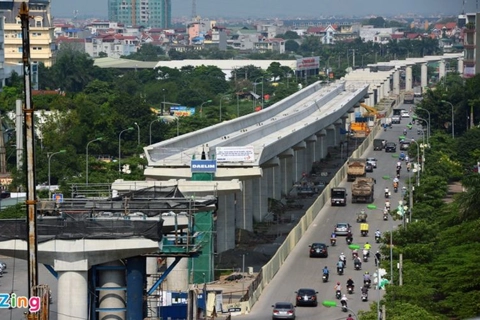
For the 2026-2030 period, Hanoi would operate two urban railway routes of Cat Linh – Ha Dong and Nhon – Hanoi station, along with an addition of 4,000 buses and 7,300 taxis/ride-hailing cars.
The local authorities estimated the public transportation system during this period would be able to handle 30% of the passengers, and total transportation capabilities in no-motorbike zones to meet 75% of the demand.
Beyond 2030, the city would expand the motorbike-free zones to 12 existing districts and other rural ones that are set to be upgraded to urban districts for a total of 650 square kilometers, or 20% of the city’s area.
According to the proposal, Hanoi would continue to invest in expanding mass transit network to meet the public demand, including the launch of two new urban railway routes of the Hanoi station – Yen So – Hoang Mai; Van Cao – Ngoc Khanh – Lang – Hoa Lac; and raising the number of buses to 6,700, along with 78,000-108,000 taxis or contract cars.
The city expects to provide other commuting options for locals such as 10,000 public bicycles, and 15-20 short bus routes.
After 2030, it is estimated public transport system would handle 45-50% of the passengers, and up to 80% in the no-motorbike zones; and 80% of the people in downtown live within 500 meters from the bus stop.
Once people move to these zones, they are expected to park their vehicles at the station and then use the mass transit network.
Meanwhile, those living inside no-motorbike zones are expected to use public transport systems, and private vehicles such as cars, bicycles.
In addition, the city would renovate sidewalks for people to access the public transport system more conveniently, expand the walking spaces in certain areas, and set the bicycle lane in the main streets.
At present, Hanoi is subsidizing new vehicle purchase costs as a way to encourage people to discard their old vehicles that are not qualified for new environmental standards.
The proposal also notes that motorbikes would be allowed to operate in a motorbike-free zone beyond the operational hours of the public transport system.
It is estimated the city would need around VND334.6 trillion ($14.6 billion) in investment capital for the plan to phase out motorbikes, focusing on upgrading transport infrastructure and public transport systems.
Around 3.5-6.5 million people in Hanoi are set to be affected by the plan, the report noted, but at the same time, this could create the foundation to promote public transportation, reduce traffic congestion and environmental pollution.
As of December 2020, Hanoi has a total of 7.1 million transport vehicles, including 6.1 million motorbikes,167,000 electric motorbikes, and 870,000 cars.
The growth of the number of private cars reaches 10% per year on average and 4.5% for motorbikes. The public transport system, however, only handles 14% of the city's passengers in 2020.