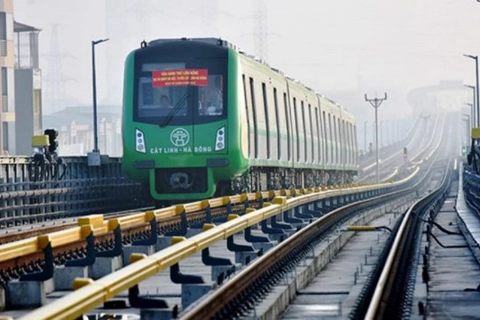
Hanoi’s first metro eligible for commercial operation in late 2020
The general contractor of Hanoi’s first metro has submitted all required dossiers for acceptance of the project at the request of the Hanoi Metropolitan Railway Management Board.
The Chinese general contractor of Hanoi’s first metro, the Cat Linh-Ha Dong urban railway line, has told local media that the project can be put into commercial operation late this year.
Tang Hong, who represents contractor China Railway Sixth Group Co. Ltd., said that the Chinese side and the management board of the project expect to fully complete the project's safety assessment and acceptance within July.
| Hanoi’s first metro eligible for commercial operation in late 2020. Photo: Trung Kien |
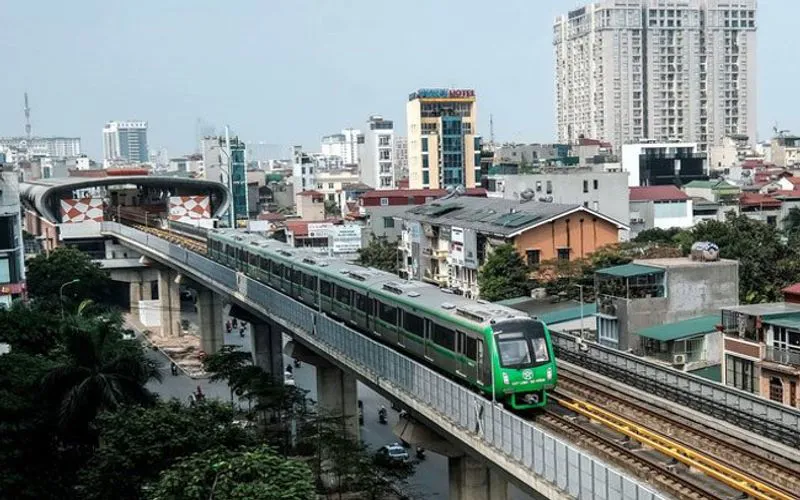
The general contractor of the 13-kilometer metro project has submitted all required dossiers for acceptance of the project at the request of the Hanoi Metropolitan Railway Management Board, Hong added.
The quality inspection and evaluation of each construction item is well under way, and the Hanoi Metropolitan Railway Management Board has commented that the acceptance review is being "coordinated well by both sides", he said.
After completing its review, the project will conduct a test run during 20 days, during which the State Acceptance Council will be invited to evaluate it. Once the evaluation is done, the Ministry of Transport will take over the control of the project, and hand it over to the Hanoi Metropolitan Railway Management Board.
So far, 31 Chinese experts of the Chinese general contractor have completed their compulsory Covid-19 isolation period, and have started their work on the project. Of them, 12 are cooperating with the project’s investor to complete acceptance procedures, while the others are checking the operation of equipment at construction sites.
"If the work goes according to plan, by the end of 2020, the project will be eligible for commercial operation," Tang Hong affirmed.
He added that after the investor completes paying US$50 million to the contractor, the Chinese side will dispatch some experts to Vietnam to operate the project on a trial basis for 20 days before handing it over to Vietnam for commercial operation. Therefore, the trial operation of the railway depends on the progress of the investor’s payment.
In early June, the Chinese general contractor had asked for US$50 million in advance to run the test of the trains, but the petition was refused by the Ministry of Transport on the grounds that all outstanding costs, which was 78% of the contracted amount, had been paid on schedule in accordance with the contract.
In addition to acceptance work, the project also needs to be assessed for technical safety by an independent organization, assigned to French consulting firm Apave-Certifer-Tricc (ATC).
The ACT’s assessment on the safety of the railway will also decide if the project can be put into operation as expected. However, ATC has begun their assessment a little behind schedule, and has requested some documents that the Chinese contractor cannot currently submit.
The Cat Linh-Ha Dong metro line runs from downtown Dong Da district to Yen Nghia in Ha Dong district and is one of eight lines planned in Hanoi.
Work on the Cat Linh-Ha Dong railway line began in October 2011 and was originally planned for completion in 2013.
However, several hurdles, including loan disbursement issues with China that were only resolved in December 2017, stalled it for years.
Project costs have more than doubled from the original VND8.8 trillion (US$553 million) to VND18 trillion (US$868 million), according to state auditors, applying the exchange rate at their respective timings.