Hanoi seeks lessons from Chinese localities to shape long-term growth
Hanoi looks to Beijing and Nanjing for urban planning lessons, focusing on congestion, pollution, heritage preservation and long-term sustainable growth strategies.
THE HANOI TIMES — Hanoi looks forwards to sharing experience and learning effective practices from major global cities to address bottlenecks and advance its long-term master plan, according to Standing Vice Chairman of the Hanoi People’s Committee Duong Duc Tuan.
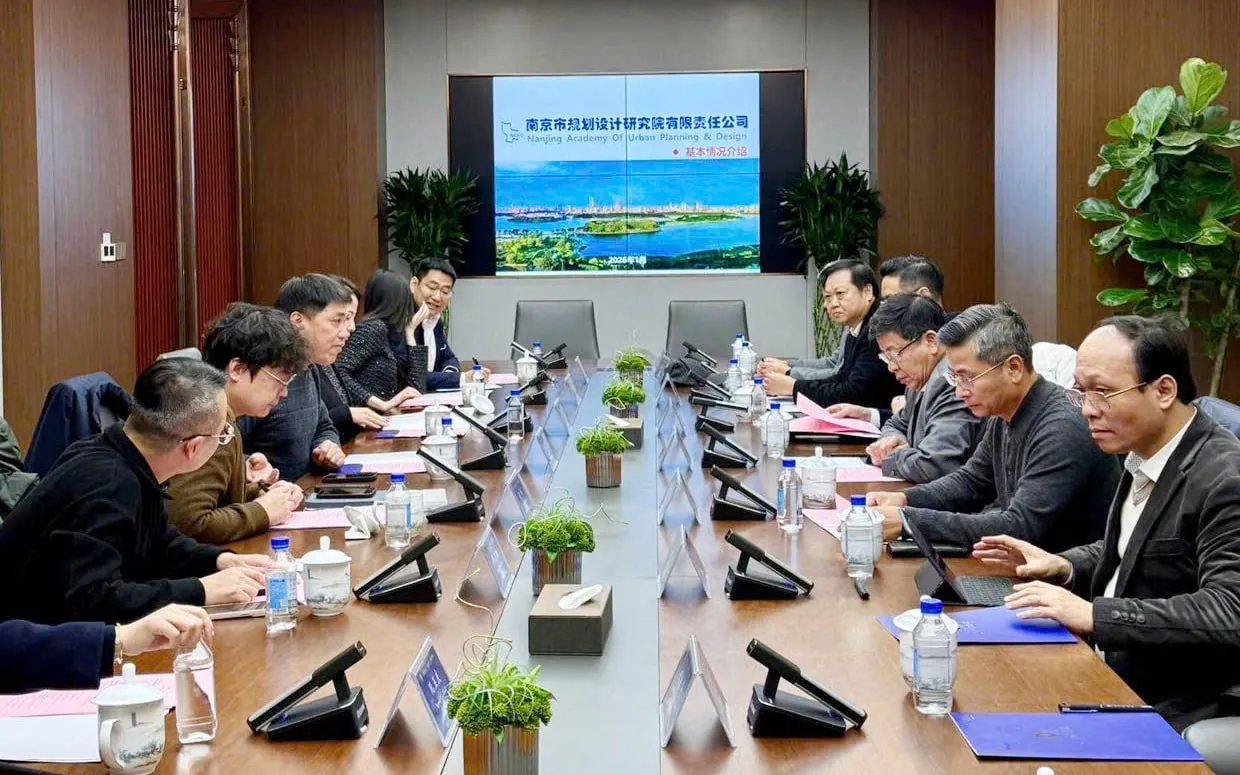
The meeting between the Hanoi delegation and authorities of Nanjing. Photos: The Hanoi Times
Such cooperation will help Hanoi achieve strategic goals of fast and sustainable growth, build a modern and livable city and improve living standards and public welfare, Tuan said during meetings with officials from Beijing and Nanjing, the capital of China’s Jiangsu Province, from January 28 to February 1.
The visit by Tuan and a Hanoi delegation aimed to deepen exchanges on urban development planning, with a focus on easing bottlenecks and turning long-term development visions into reality in large cities.
Meetings in Beijing and Nanjing centered on urban and transport planning, air quality and environmental management, urban renewal linked to heritage preservation, underground space development and transit-oriented development models at major rail hubs.
Tuan said Hanoi serves as Vietnam’s national political and administrative center and a major hub for the economy, culture, science, education and international cooperation.
He said the city has made notable progress in socio-economic development and urban planning, improved living standards and expanded cooperation with capitals and major cities worldwide.
As Vietnam enters a new development phase following the 14th National Party Congress, Tuan said Hanoi is determined to lead and contribute meaningfully to the country’s long-term growth vision.
He said the city will focus on removing five major bottlenecks traffic congestion, urban order, flooding, environmental pollution and food safety and aim for growth of minimum 11% in 2025-2030.
Hanoi will also accelerate decentralization alongside digital transformation, establish a new growth model targeting double-digit expansion and rely on science, technology, innovation and high-quality human resources as core drivers, the standing vice chairman said.
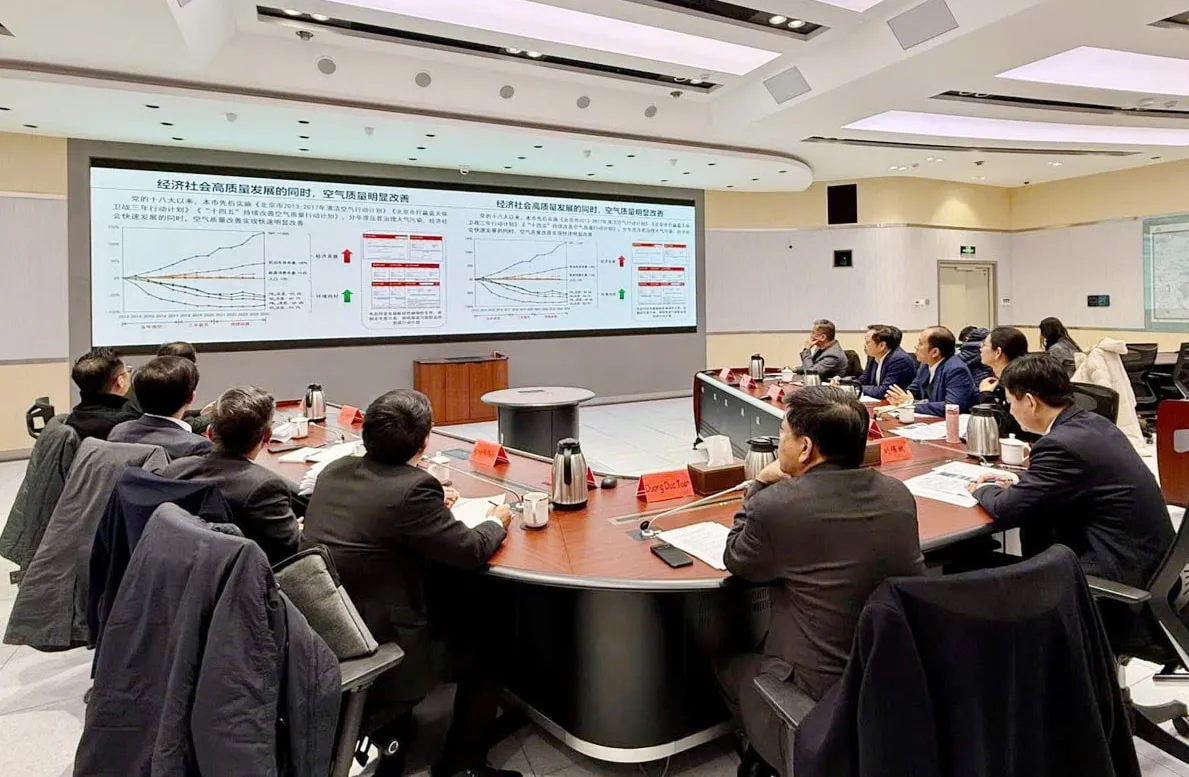
The Hanoi delegation meets authorities of Beijing.
At the meetings, Tuan stressed the importance of cooperation between Hanoi and Beijing and Nanjing and with major Chinese cities more broadly, within the overall Vietnam-China relationship.
Officials from Beijing and Nanjing said the visit would help deepen local-level cooperation and strengthen ties between the two countries.
They expressed readiness to share effective solutions with Hanoi to address common “big city challenges” such as congestion, flooding and pollution and to support sustainable development and improved quality of life.
According to Beijing’s municipal ecology and environment authorities, air pollution once posed a serious challenge for the city, prompting the launch of a “blue sky protection campaign” built on five pillars to cut PM2.5 levels and improve air quality.
A decade ago, Beijing established a dense air-quality monitoring network, applied big data and artificial intelligence and carried out four comprehensive air-quality surveys to identify pollution sources.
The city reduced coal use in favor of cleaner energy, curbed vehicle emissions by limiting private cars and promoting new-energy vehicles, expanded public transport, shut down or relocated high-emission facilities and strengthened regional coordination.
So far, average annual PM2.5 levels fell from 89.5 micrograms per cubic meter in 2013 to 27 micrograms in 2025, while the share of days with clean air rose above 85%.
Beijing also sees its 2016-2035 master plan as key to tackling urban sprawl, rising housing prices, air pollution and congestion.
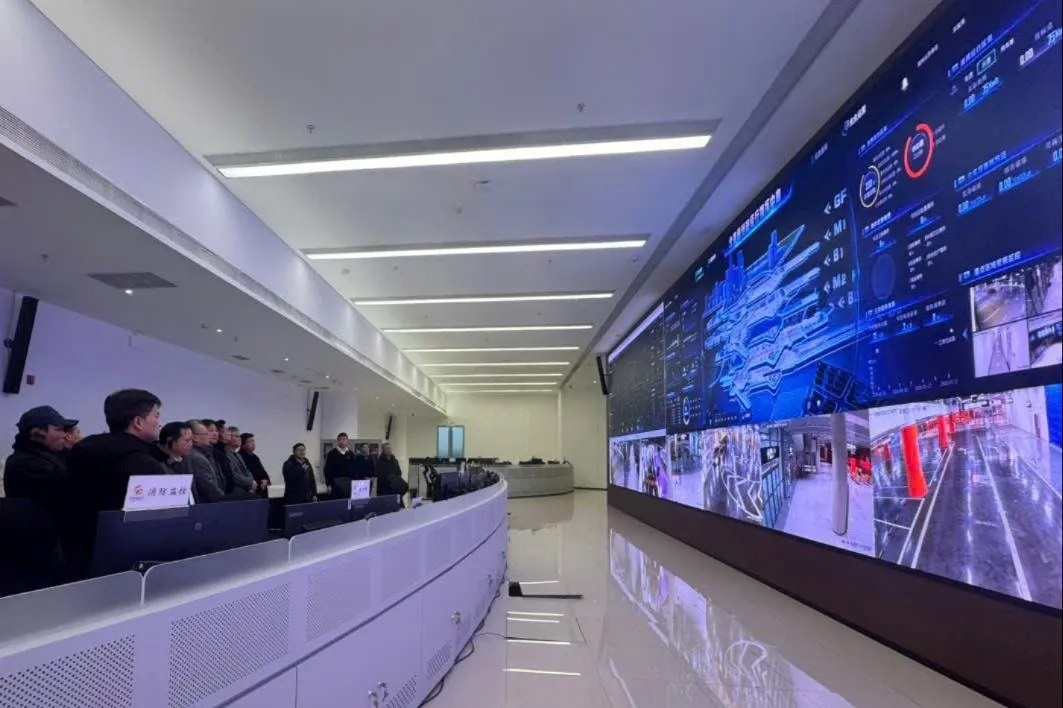
Inside the traffic control center in Beijing.
According to the Beijing Institute of Urban Planning and Design, the city follows a spatial structure described as “one core, one main area, one sub-center, two axes, multiple nodes and one zone” to shift non-capital functions outward and optimize population and resource distribution.
The core serves as the national political and administrative center and preserves historical values, while the main urban area covers six central districts as the city’s primary economic, cultural and residential hub.
The sub-center in Tongzhou District absorbs non-capital functions, reduces pressure on the core and supports a multi-center urban structure.
Tongzhou has taken on city government offices, hospitals, schools and major corporate headquarters, supported by integrated infrastructure, a multi-layer traffic control center and modern cultural facilities.
Key features include sponge-city design to collect and reuse rainwater and large-scale underground development, including Asia’s largest underground transport complex where three metro lines and two regional railways intersect beneath parks and commercial areas.
Beijing also emphasizes regional coordination with Tianjin and Hebei to ease pressure on the capital.
In contrast, Nanjing has adopted a more flexible approach known as adaptive conservation, integrating heritage into modern urban life.
Urban planners in Nanjing said the city reduced population density and government functions inside the old city wall, reserving the area mainly for tourism and culture.
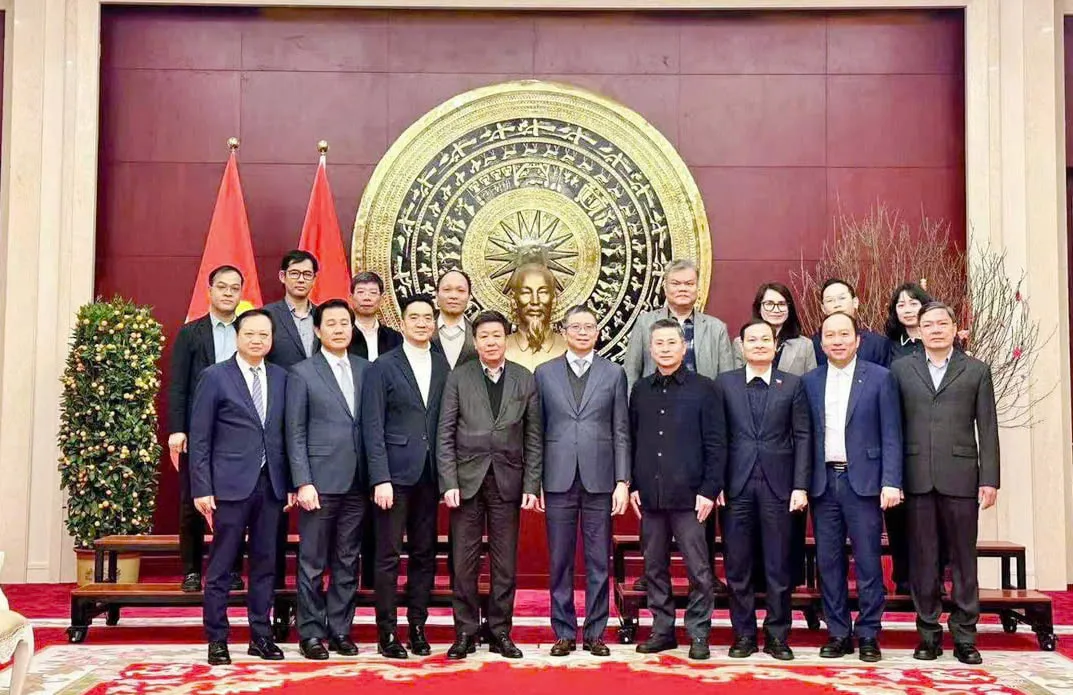
Standing Vice Chairman of the Hanoi People's Committee Duong Duc Tuan (front row, fourth from left) and the Hanoi delegation visit the Vietnamese Embassy in China.
New urban areas with modern infrastructure were developed to attract residents, shifting the city from a single-center to a multi-center structure and easing pressure on heritage sites.
Home to the world’s longest surviving Ming Dynasty city wall, Nanjing has transformed the structure into a continuous park belt, adding walkways and green spaces to form a cultural green ring.
The city also revived the Qinhuai River, once heavily polluted, turning it into a tourism landmark lined with cultural and commercial spaces that generate revenue for conservation.
Historic riverside buildings were restored into restaurants, tea houses and performance venues, creating one of the city’s most vibrant night-time economic zones.
Other historic districts have adopted adaptive reuse, becoming cultural pedestrian streets, creative spaces, small hotels and museums, allowing heritage to sustain itself.
During the visit, the Hanoi delegation also met with the Vietnamese Embassy in China to discuss bilateral relations and ways to deepen cooperation between Hanoi and Chinese localities.