How is Vietnam’s role in world affairs 2020?
Vietnam has proactively demonstrated exceptional leadership in the year as ASEAN Chair.
Vietnam has been upgraded to a new position and gained in confidence in the regional and global affairs in 2020 despite challenges for the world because of coronavirus pandemic, a famous Southeast Asia regional specialist has said.
| Vietnam proactively demonstrates exceptional leadership in the year as ASEAN Chair. Photo: Reuters |
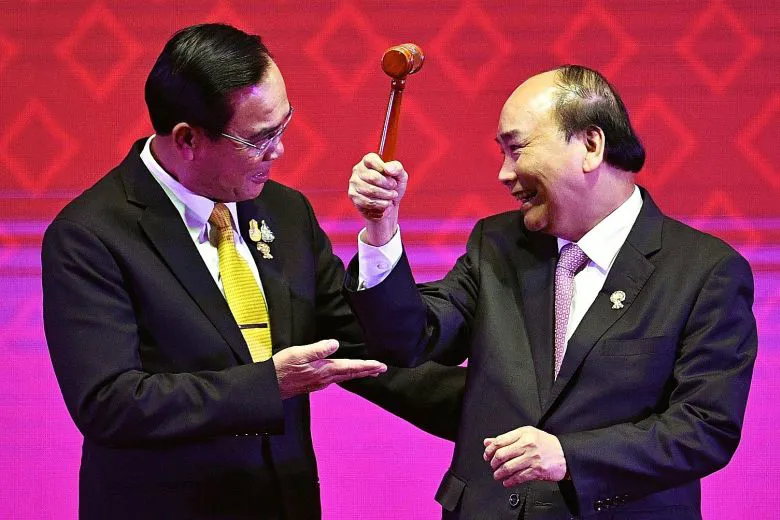
In 2020, Vietnam assumed the role of ASEAN Chair. Vietnam’s leadership role in developing a regional response to the coronavirus pandemic increased its prestige regionally and internationally, especially among its dialogue partners, according to Carl Thayer, Emeritus Professor at the University of New South Wales, Canberra.
Also in 2020, Vietnam became a non-permanent member of the United Nations Security Council for the second time. This reflects the unanimous support by the Asian bloc at the UN and a commanding majority of support by members of the UN General Assembly, Prof. Thayer said when being asked about Vietnam’s position in Southeast Asia and the world change in 2020.
Specifically, as ASEAN Chair, Vietnam proactively demonstrated exceptional leadership in four areas. First, Vietnam unified ASEAN member states around a regional response to the Covid-19 pandemic and recovery. Second, Vietnam forged consensus on neutrality and centrality of ASEAN members amidst great power rivalry. On the 53rd anniversary of ASEAN its foreign ministers issued a Statement on the Importance of Maintaining Peace and Stability in Southeast Asia. Third, Vietnam successfully managed the completion of negotiations on the Regional Comprehensive Economic Partnership. Fourth, Vietnam strengthened ASEAN’s declaratory policy on the East Sea [known internationally as the South China Sea] by re-emphasizing the importance of international law including the UN Convention on the Law of the Sea (UNCLOS).
As a non-permanent member of the UN Security Council, Vietnam strongly supported three building-blocks of global security: a commitment to multilateralism centered on the United Nations; an enhanced role for regional organizations, such as ASEAN, and expanded collaboration by ASEAN with the UN and the Security Council; and adherence by all states to the fundamental principles of international law and the UN Charter.
As ASEAN Chair, Vietnam hosted the 11th ASEAN-UN Summit
| Vietnam holds leadership role in developing a regional response to the coronavirus pandemic. Photo: Vietnam MOFA |
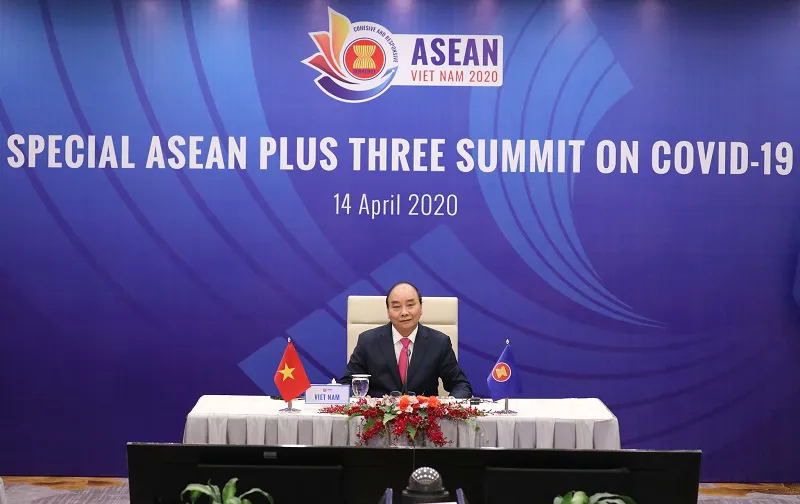
With regard to Vietnam’s policy on Covid-19 issues, Prof. Thayer said when the Covid-19 pandemic broke out and spread to Southeast Asia, Vietnam had to rapidly shift from ASEAN’s business-as-usual agenda, to a priority focus on organizing a regional response to the coronavirus.
Vietnam pioneered the use of video conferencé to bring ASEAN health officials and other key government leaders together virtually. Hanoi postponed the 36th ASEAN Summit and organized a Special Summit on Covid-19.
Vietnam showed initiative in turning to its dialogue partners for assistance by holding high-level meetings of the ASEAN Plus 3 (China, Japan and South Korea) and well as bilateral meetings with other dialogue partners such as the US.
Notably, Vietnam’s success in leading ASEAN’s response to Covid-19 was due in no small part to its successful efforts domestically to counter the coronavirus, Prof. Thayer emphasized.
Regarding the East Sea issues, a month before Vietnam became ASEAN Chair, Malaysia tabled a Note Verbale to the UN Commission on the Limits to the Continental Shelf rejecting the legal basis for China’s claims over the East Sea. This led to a cascade of Note Verbales from the Philippines, Indonesia, Vietnam, the US, and Australia and jointly by France Germany-United Kingdom (EU Three) during 2020.
The famous expert said Vietnam was able to strengthen ASEAN’s declaratory policy on the East Sea by incorporating this convergence of views on the fundamental importance of UNCLOS.
Prof. Thayer also shared some reflections on Vietnam’s diplomatic challenges in 2021. He said the country will face at least five major diplomatic challenges in 2021. The first challenge is the management of post-Covid-19 recovery, particularly the Gavi Alliance Initiative to see that there is equitable access to coronavirus vaccines for Vietnam and other Southeast Asian states.
The next challenge is to implement obligations in three major free trade agreements (FTA) namely the Comprehensive and Progressive Trans-Pacific Partnership (CPTPP), the EU-Vietnam Free Trade Agreement (EVFTA), and the Regional Comprehensive Economic Partnership (RCEP) at a time of protectionism and when global supply chains have been disrupted.
The third diplomatic challenge is to promote sustainable development in the Lower Mekong by developing greater synergy among the many multilateral mechanisms now underway to avoid overlap and competition among donor states.
The next diplomatic challenge is its efforts in working relationships with China and the US to ensure that the South China Sea remains a region of peace, cooperation and development, Prof. Thayer noted.