How East Sea issues weigh on at ASEAN meetings?
ASEAN is urged to keep its position to maintain balance and regard UNCLOS 1982 as the legal basis of all activities at sea.
The South China Sea (called East Sea by Vietnam) issues have almost dominated the majority of agendas of ASEAN’s meetings under Vietnam’s 2020 chairmanship.
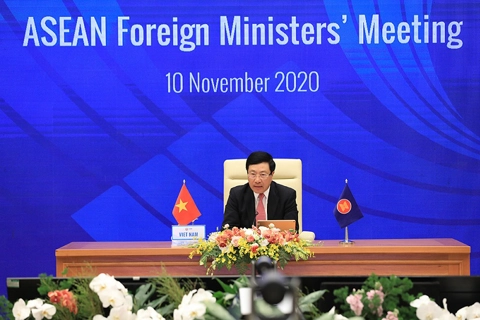
| A meeting by ASEAN foreign ministers during the Vietnam Chair 2020. Photo: Nikkei |
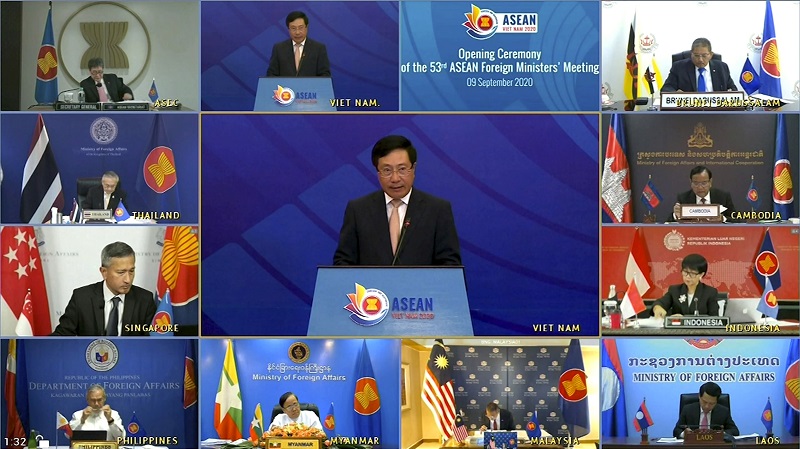
ASEAN member states and its key partners want to participate in discussions on developments in the resources-rich sea because this is a geo-strategic and geo-economic region where freedom of navigation is crucial for their interest.
They have consistently maintained that disputes should be resolved by peaceful means, in accordance with international law, especially the UNCLOS 1982.
South China Sea: common interest of all parties
VnExpress quoted former Vietnamese Deputy Foreign Minister Pham Quang Vinh as saying “Security and safety in the East Sea (referring to the South China Sea) is a common interest.”
Meanwhile, Collin Koh Swee Lea, a research fellow at Singapore's S. Rajaratnam School of International Studies, said it has always been the position of ASEAN member states to maintain balance and regard UNCLOS 1982 as the legal basis of all activities at sea.
“So we won’t expect Vietnam to push for these alone. It’ll surely be joined by many other member states,” he said.
“The only major constraint is how Vietnam balances these regional interests at the bloc level with its own national interests if tensions again emerge in the South China Sea, repeating for instance what happened in Vanguard Bank last year,” he said, referring to reports of China's oil survey vessel Haiyang Dizhi 8 and escorts operating illegally in Vietnam’s exclusive economic zone (EEZ) and continental shelf in the southern part of the waterway.
As a frontline littoral state, Vietnam, in international experts’ perspective, has ensured that the South China Sea issues were given due weight, unifying the bloc in expressing concern about developments that may undermine regional stability and run counter to a rules-based maritime order.
Hoang Viet, a lecturer at the Ho Chi Minh City University of Law, who is also a researcher closely following ASEAN meetings, said Mekong was another issue that Vietnam needs to push for discussions at future ASEAN meetings, because Brunei, the ASEAN chair next year, is unlikely to prioritize it.
He said Mekong is an important issue, but it has not been treated at ASEAN meetings as a regional issue. The serious drought in the lower Mekong area has heavily affected people's livelihoods which could lead to other issues threatening the region’s security.
Vinh said a highlight of Vietnam's chair is the bloc’s strong focus on its principled stand on the sea in a year with complicated developments.
"Maintaining peace, stability and maritime security are key principles of ASEAN, which are of interest to member countries as well as non-regional nations," he said.
Mr. Vinh picked up the release of ASEAN Foreign Ministers’ Statement on the Importance of Maintaining Peace and Stability in Southeast Asia in the 53rd anniversary of the establishment of ASEAN August 8 as an example of the consensus.
This is a renewed commitment to maintaining Southeast Asia as a region of peace, security, neutrality, stability, and strengthening peace-oriented values in the region in line with international law.
The statement expresses ASEAN's position on competition between major powers. The bloc does not want to take sides, but asks its powerful partners to cooperate based on international law, supporting peace, stability, and development in the region
With this statement, ASEAN has once again demonstrated its unity on the issue.
“The document summarizes ASEAN's principles, and has a longer vision,” noted Mr. Vinh, who was Vietnam's Ambassador to the United States and ASEAN SOM Leader.
At the online ASEAN Foreign Ministers’ Meeting (AMM) held on November 10, all top diplomats of ASEAN countries expressed concerns over unilateral activities, including militarization, unsubstantiated sovereignty claims, and continuous coercion harming the stability in the sea.
Meanwhile, Nikkei reported that security challenges in the South China Sea are “always present” as expressed by Vietnam’s foreign minister.
ASEAN called for the full and serious implementation of the Declaration on the Conduct of Parties in the South China Sea (DOC), and looked forward to the building of an effective and substantive Code of Conduct in the South China Sea (COC) in line with international law and the 1982 UNCLOS.
For that reason, they treasured solidarity in ensuring peace, stability, independence and self-reliance amidst global uncertainties.
Vietnam is committed to closely coordinating with other ASEAN countries and China to fully and effectively implement the DOC and soon reach a result-oriented COC in line with international law, especially the 1982 UNCLOS.
Addressing the opening ceremony of the 37th ASEAN Summit on November 12, Vietnam's Prime Minister Nguyen Xuan Phuc reaffirmed the bloc's determination to maintain “peace, stability, and security” in the South China Sea.